
Village Name Generator

This village name generator does something most name tools skip entirely: it tells you what the name means. Real English place names are not random noise — they are compositional, built from a small set of elements that each carry a genuine meaning, and once you know the code you can read a country's settlement history off its map. Every result here comes with that code cracked: a literal reading ("the ford by the ash trees") and a gloss on both elements, drawn from real Old English, Old Norse, Celtic, Japanese and half a dozen other naming traditions. Pick a culture, a settlement size, a landscape feature and a form, and the generator hands you a name that would make sense to a historian, not just to your ear.
👇 Click any name to copy it
How to Use the Generator
Four filters control the output, and none of them is decorative — each one changes the actual construction of the name, not just its flavour.
- Culture picks the register: English (Anglo-Saxon), Norse/Danelaw, Celtic, Japanese, Slavic, Germanic, French, Fantasy, Dark, Coastal or Elven. This is the biggest lever in the tool, because each culture has its own vocabulary and its own grammar for putting a name together. Celtic names, for instance, run backwards compared to English ones — more on that below. For a dedicated Japanese-only naming tool, see the Japanese name generator.
- Size sets the settlement's scale: hamlet, village, town or city. This gates which suffixes are even allowed to appear. A hamlet cannot end in -chester any more than a real one could — the suffix pool for a four-house hamlet and a walled city barely overlaps.
- Feature tells the generator what the place is named for: a river or ford, a hill, a wood, a marsh, the coast, a valley, a crossroads, a mine, a holy site or a fort. Set this and both halves of the name are pulled from elements tagged to that landscape, so a "coast" result will not hand you a mountain name.
- Form chooses the shape: a single word (Ashford), two words (Nether Ashford), the X-upon-Y river pattern (Ashford-upon-Wenn), or a manorial name that appends the medieval owner or a Latin clerk's tag (Abbot's Ashford, Ashford Mandeville).
Every card decodes its own name. The reading line gives you the plain-English translation — what a speaker of Old English or Old Norse would have understood on hearing it. Underneath, the description breaks the name into its two elements and glosses each one separately: what language it comes from, what it originally meant, and — where scholars genuinely disagree about the element — a note saying so, rather than a confident guess dressed up as fact. That is the whole point of the tool. A name generator that just concatenates a root and a suffix is guessing at what sounds plausible. This one shows its working.
The Vocabulary of English Place Names
Open an Ordnance Survey map of England and most of what you are looking at breaks cleanly into two pieces: a qualifier that says what or whose (a tree, a colour, a long-dead farmer's name) and a generic that says what kind of place it is. The qualifier is the part that varies infinitely. The generic is the part with a fixed, learnable vocabulary — a few dozen suffixes that between them account for most of the country. Learn them and you can read a map the way you read a sentence.
Two language layers supply nearly all of it. Old English, the language of the Anglo-Saxon settlers, gives the oldest and commonest endings: -ton, -ham, -ford, -ley. Old Norse, left behind by Viking-age settlers in the north and east, gives a second layer laid on top of the first: -by, -thorpe, -thwaite. A scattering of Latin survives too, mostly filtered through Old English rather than borrowed directly — -chester is Latin castra wearing an English spelling.
| Element | Origin | Meaning |
|---|---|---|
| -ton | OE tūn | An enclosed farmstead — the single commonest ending in England, later drifting to mean village and then town. |
| -ham | OE hām | A homestead, estate or village — usually an older name than a neighbouring -ton. |
| -ham (contested) | OE hamm | A completely different word: land in a river bend or an enclosed water meadow. By the modern spelling the two are often impossible to tell apart. |
| -by | ON bȳr | A farmstead or village — the clearest single marker of Scandinavian settlement, and the Danelaw's own signature. |
| -thorpe | ON þorp | An outlying farm — the daughter settlement of a bigger -by, carved out of the waste later. |
| -thwaite | ON þveit | A clearing, a piece cut out of woodland and taken into use. |
| -caster / -chester / -cester | OE ceaster ← Latin castra | A Roman fort. Wherever this ending sits, Roman masonry was still standing when the English named the place. |
| -wich / -wick | OE wīc | A specialised settlement, not an ordinary village — salt-boiling, dairying, or a trading post, depending on the region. |
| -worth | OE worð | An enclosed farmstead — the enclosure itself, not the buildings inside it. |
| -den | OE denu | A valley — except in Kent and Sussex, where it is instead denn, a woodland pig pasture. |
| -hurst | OE hyrst | A wooded hill or knoll, thick on the ground in the old Weald. |
| -ley / -leigh | OE lēah | A clearing in woodland — as the woods disappeared, the word drifted to mean an ordinary meadow. |
| -mere | OE mere | A lake or pool; many are long drained and only the name survives. |
| -combe | OE cumb, likely from British Celtic | A short, steep-sided valley — one of the clearest Celtic loanwords in the English map. |
| -stow | OE stōw | A place — but in practice almost always a holy place or an assembly site, very often a saint's own ground. |
| -burgh / -bury | OE burh | A fortified place: an Iron Age hillfort, a planned Saxon stronghold, or a walled manor. |
| -ford | OE ford | A shallow river crossing — the reason the road went where it went, and the road made the village. |
| -bridge | OE brycg | A bridged crossing, which outranked a ford and was worth tolling. |
| -field | OE feld | Open land cleared of trees — the near-opposite of what "field" means today, when an enclosed field is normal and open land is not. |
| -ing (contested) | OE -ingas or topographical -ing | The traditional reading is "the followers of" a named man; many scholars now argue plenty of -ing names are simply topographical instead. The disagreement runs case by case, not by rule. |
| -ey (contested) | ON ey or OE ēg | An island, or dry ground rising out of marsh — both words mean roughly the same thing, and the modern spelling erases which one a given name actually is. |
A few of the fine points are worth carrying with you. -gate is genuinely two different words depending on where you stand: Old English geat, a gate or gap, in the south, and Old Norse gata, a street, in the Danelaw — which is why York's medieval streets are called gates and its actual gates are called bars. -wick on the coast is usually Norse vík, a bay (the word behind "Viking" itself), while inland it is more often English wīc, a specialised farm — two words that collided into one spelling. The generator's gloss on each card tells you which reading applies, or says plainly when the question is still open.
What the Map Tells You: Reading a Country From Its Place Names
This is the part that turns a suffix table into something genuinely useful. Because these elements are dated and regional, a map of place-name endings is a map of settlement history — no archive required, just the names themselves.
Plot every -by and -thorpe in England and you get a tight, unmistakable cluster across Yorkshire, Lincolnshire and East Anglia, thinning out fast and then stopping almost dead at the old frontier between the Danelaw and Wessex. That line was drawn by treaty in the ninth century, and eleven hundred years later the place names still trace it more precisely than most history books manage. Cross it heading south and the Norse endings vanish; the English -ton and -ham country takes back over completely.
Every -chester, -caster and -cester marks a Roman fort — not approximately, but reliably enough that historians use the suffix as a search term. A road atlas of Roman Britain and a list of English place names ending this way overlap almost exactly. -wich often marks a salt town specifically — Nantwich, Northwich, Middlewich and Droitwich were all in the salt trade, close enough together that the pattern is not a coincidence. A cluster of -minster names shows where the early minster churches drew people to them before the fields did. None of this requires reading a chronicle. It is sitting in the names, in plain sight, for anyone who knows the vocabulary — which is exactly what a worldbuilder can steal for an invented map.
Naming by Culture
Eleven registers are available, and each one is built with its own vocabulary and its own rules for assembly — not the same skeleton with a different word list glued on.
- English (Anglo-Saxon) is the deepest pool in the generator and the backbone of the whole page: qualifier plus generic, in that order, built from real Old English roots and suffixes. It is the default register for grounded medieval fantasy, and pairs well with the medieval name generator for naming the people who live there.
- Norse / Danelaw shares the same qualifier-generic grammar but draws on Old Norse vocabulary throughout — -by, -thorpe, -dale, -fell — with harder-sounding roots and Viking-age personal names as qualifiers.
- Celtic is the one genuinely different grammar in the set, and it is worth slowing down for. Welsh, Irish and Scottish Gaelic place names are head-initial: the generic element comes first, then the qualifier, the reverse of the English order. Aber- (river mouth), Llan- (church enclosure), Kil- (church cell), Bally- (townland) and Dun- (fort) all open the name rather than close it, so a Llan- name reads "the church of [saint]" rather than "[saint]'s church." Any adjective that follows also lands at the end rather than the front — Welsh gwyn, white, becomes -wen tacked onto the back of a name, mutated by the word before it, because Welsh and Irish put the describing word after the noun it describes. Get this order wrong and a Celtic-style name simply does not scan as Celtic, no matter how good the vocabulary sounds. It is also worth knowing that Wales and Scotland split the river-mouth word between them: Welsh says aber-, Gaelic says inver-, for the same idea.
- Japanese place names are landscape compounds, exactly as transparent as the English ones, built from kanji that mean mountain, river, rice-field, valley and so on, closed off with -mura (village), -machi (town) or -sato (hamlet). The generator shows the kanji alongside the reading, and it applies rendaku, the voicing shift that happens at many compound boundaries — kawa (river) becomes -gawa, shima (island) becomes -jima, after most first elements. A name like Yamakawa keeping an unvoiced -kawa where a native compound would voice it is one of the fastest tells that a "Japanese-sounding" name was built without knowing the rule. Compass elements do a lot of the same work Old English -ton compounds do in England: kita- (north), nishi- (west), higashi- (east) and minami- (south), or the paired kami- and shimo- (upper and lower, meaning upstream and downstream), fix one settlement against a neighbour of the same base name — the exact same job Norton and Sutton do for an English estate split in two.
- Slavic settlements lean hard on possessive and patronymic suffixes — -ovo, -ov, -ice — which mark a place as belonging to a named person or to that person's descendants as a group, plus a smaller set of straightforward generics like -grad (fortified town) and -selo (village with a church).
- Germanic runs almost element-for-element parallel to English, because the two languages split from the same root not that long before either was written down: -dorf answers to English -thorpe in sense if not in cognate, -heim is the direct cousin of -ham, -furt is simply ford, and -burg is -bury with a German accent.
- French sits on a Gallo-Roman foundation. Many villages carry a Roman landowner's name worn down over sixteen centuries, closed with -ville (from Latin villa, an estate) or the reduced -y / -ac endings that are what is left of Gallo-Roman -acum. A separate and very productive pattern names a village directly for its patron saint — the hagionym, Saint- plus the saint's name, which accounts for a striking share of the map of rural France.
- Fantasy, Dark and Elven are constructed registers, and the generator says so honestly rather than dressing invention up as history. Fantasy borrows the real English qualifier-generic frame and swaps in softer invented vocabulary; Dark leans on genuinely historical but grim elements — gallows, gibbet, barrow, mire — sites that really were named for executions, graves and bad ground; Elven is built from vowel-heavy invented syllables in the post-Tolkien tradition, hung on the same real frame everything else here uses.
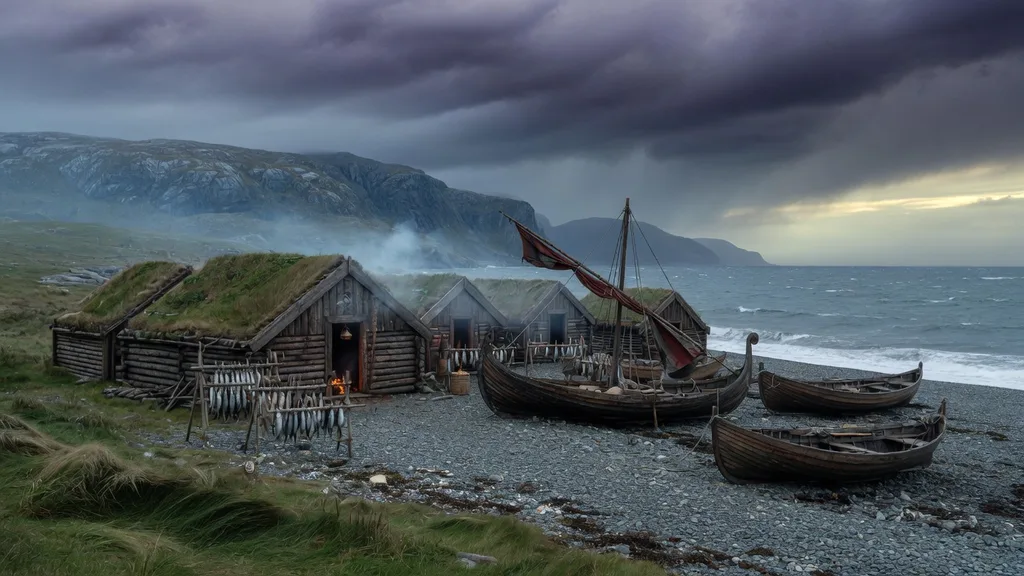
- Coastal / Fishing stays inside real English vocabulary but restricts it to the sea: salt, net, herring, wreck, tide, closed with harbour and shore words like -port, -haven, -wick (here almost always Norse vík, a bay) and -hythe, a landing place.
Size, and Why It Changes the Name
A hamlet and a city were never named by the same logic, and the generator enforces that rather than treating scale as a label stuck on afterwards. Each suffix in the data carries the sizes it is actually plausible for, and the pools barely overlap at the extremes.
A hamlet — a handful of houses, no church, no market — draws on the smallest habitative endings: -cot (a cottage), -thorpe (an outlying farm, by definition secondary to somewhere bigger), -booth (a herdsman's summer shelter that sometimes became permanent), -sato in Japanese (a hamlet, carrying a warmth that -mura does not). These are modest words for modest places, and none of them implies defences, a market, or a church.
A city, by contrast, pulls from the fortification and infrastructure vocabulary: -chester (a Roman fort — cities disproportionately sit on Roman sites, because Roman forts were the largest existing fortifications for later builders to inherit), -burgh (a planned stronghold, Alfred's system of fortified towns that grew into real cities), -grad in Slavic, -minster (a mother church serving a wide district, which needed a town's worth of population to support it), -port (a harbour with trading rights, which required a charter) and -machi in Japanese (a proper town organised around trade, distinct from a mura). A village and a town sit between these two poles, taking the mid-weight endings — -ton, -ham, -by, -dale — that can plausibly describe either a few hundred people or a few thousand.
The Manorial Form
Set the form filter to manorial and the generator reproduces a genuinely real and underused pattern in English place names: a settlement carrying the name of the medieval family or institution that once held it, appended to the ordinary place name. Stoke Mandeville is Stoke held by the de Mandeville family. Norton Fitzwarren is Norton held by the Fitzwarren line. Ashton under Lyne, Melton Mowbray, Sutton Courtenay — the pattern runs through the country, usually a Norman surname stuck onto an older English or Norse base to tell two identically named villages apart once a tax roll needed to distinguish them.
A second, distinct branch of the manorial pattern comes from Latin, not French: the medieval clerks who kept the records wrote in Latin, and their tags stuck. Magna and Parva (great and small) mark the larger and smaller of a divided settlement — Wigston Magna and Wigston Parva. Regis (of the king) marks a manor held directly by the crown, as in Bognor Regis. Episcopi (of the bishop) marks an episcopal holding. None of these are decoration. Each one is a fossilised administrative record — who owned the place, in whose language the paperwork was kept.
For fiction, this pattern earns its keep because nothing else reads as quite so convincingly aged. A single invented name can be dismissed as arbitrary. A name with a family tag or a Latin clerk's affix implies an entire apparatus behind it — a survey, a tax roll, a dispute between two villages sharing a name, a scribe writing in a dead language — three centuries of bureaucracy compressed into two words, at no cost to you.
It is worth noticing that English surnames and English place names are built from the same vocabulary, because most surnames started life as exactly this kind of tag: a family took its name from the manor it held, or the manor took its name from the family. A run through the last name generator turns up the same qualifier-and-owner logic from the other direction.
Naming Settlements for a Fantasy Map
A good set of invented place names should feel like the work of one country, not a pile of unrelated words that happen to be villages. A few habits from real toponymy do most of the work.
- Keep one register per region. A map where every village borrows a different culture's vocabulary reads as noise rather than history. Real regions layer cultures in bands — Norse names cluster in one corner of the map and stop at a border, exactly as they do in the real Danelaw — rather than scattering evenly.
- Vary the elements, not the pattern. Real regions repeat qualifiers across many settlements — Ashford, Ashley and Ashbourne all share the same root, because whoever cleared the district planted the same landmark tree in three different farmers' minds. A cluster of names sharing a root reads as more authentic than the same number of names each built from scratch.
- Let geography choose the suffix, not the mood. A river crossing gets -ford or -bridge. A harbour gets -port or -haven. A hillfort gets -bury or -burgh. Set the feature filter to match the terrain you already drew, and the name will fit the map instead of merely sitting on it.
- Avoid the every-village-has-a-legend trap. Most real place names are administrative or agricultural — somebody's farm, a patch of good soil, a ford. A name that screams "something terrible happened here" on every single settlement stops meaning anything by the third one. Save the dramatic names — a barrow, a gallows, a ruined fort — for the one or two places where the map actually wants a reader to stop and ask a question.
Villages are the smallest unit of a settled map, not the whole of it. Once a region's villages feel consistent, the same naming logic scales up: a kingdom name generator and a fantasy country name generator apply comparable qualifier-and-suffix thinking at the national level, and a fantasy continent name generator does the same at the largest scale of all. The guides on naming a fictional kingdom and keeping names consistent for a culture go deeper into holding a whole map's naming logic together.
Example Names
Decoded readings shown for the English and Norse sets, since that reading is the whole point of the tool.
English & Norse — with readings
- Ashford — "the ford by the ash trees"
- Oakham — "the homestead by the oaks"
- Bramworth — "the enclosed farmstead among the broom"
- Thornley — "the woodland clearing among the thorn bushes"
- Kingsminster — "the king's monastery church"
- Wolfscombe — "the valley of the wolves"
- Grimsby — "Grim's farmstead"
- Ulfdale — "Ulf's valley"
- Thorbeck — "Thork's stream"
- Steinholm — "the island by the stone"
Other Real Cultures
- Llanpadrig (Celtic — "the church of Padrig")
- Aberderry (Celtic — the river mouth by the oak wood)
- Yamakawa (Japanese — mountain river)
- Kitamura (Japanese — the north village)
- Belgrad (Slavic — the white fortified town)
- Dobroselo (Slavic — the good village)
- Steinheim (Germanic — the stone homestead)
- Frankfurt (Germanic — the ford of the Franks)
- Beauville (French — the fine estate)
- Saint-Aubin (French — the hagionym pattern)
Fantasy
- Silverhollow
- Mistvale
- Ravenreach
- Frostgate
- Thornwatch
- Amberfall
- Gallowsmire
- Crowbarrow
- Caelthalas
- Silwynd
Tips and Common Mistakes
- Do not mix a culture's grammar with a different culture's vocabulary. Celtic names run generic-then-qualifier; bolt an English-order qualifier-first name onto Welsh roots and it reads as a mistake rather than a style.
- Match the suffix to the size. A hamlet called something-chester or something-minster implies fortifications or a mother church that four houses could not support. If the name outgrows the settlement, the reader notices.
- Let a region repeat its roots. Three or four villages sharing a qualifier — Ashford, Ashley, Ashbourne — read as more real than the same three names built from entirely different words.
- Use manorial and Latin affixes sparingly. One Magna/Parva pair or one appended family name per region reads as historical texture. Every single village carrying one reads as a gimmick.
- Say it aloud before committing. A name that gets spoken at a game table or read in a novel a hundred times needs to survive being said quickly. If it trips, players will rename it themselves.
- Do not treat rendaku, mutation or contested elements as errors to smooth over. Japanese -gawa instead of -kawa, Welsh adjectives landing after the noun instead of before it, or an honestly unresolved -ing or -ey — these are the details that separate a name built with real knowledge of the source language from one built by ear.
FAQ for Village Name Generator
What does -ton mean in a village name?
-ton is Old English tūn, an enclosed farmstead or homestead. It is the single commonest place-name ending in England, and it drifted over time from meaning one farm to meaning a whole village and eventually a town — which is why the same three letters sit at the end of both a tiny hamlet and a large city on the modern map.
What does -by mean, and why does it cluster in the north-east?
-by is Old Norse bȳr, a farmstead or village, left behind by Viking-age settlers. It is the clearest single marker of Scandinavian settlement in England: plot every -by name on a map and they cluster tightly across Yorkshire, Lincolnshire and East Anglia, then stop almost dead at the old treaty line between the Danelaw and Wessex. The suffix is tracing a ninth-century political border more precisely than most surviving documents do.
How do I name a fantasy village so it sounds real?
Use the same logic real English names use: a qualifier that says what or whose, plus a generic that says what kind of place it is. Pick one culture and stick to it across a region, let the landscape decide the suffix (a river gets -ford, a harbour gets -haven), and reuse a handful of roots across several settlements the way Ashford, Ashley and Ashbourne share a root. The generator's culture and feature filters do exactly this automatically.
How do I name a Japanese village?
Japanese place names are landscape compounds, built the same way English ones are: a kanji for a feature — yama (mountain), kawa (river), tani (valley) — followed by a settlement word such as -mura (village), -machi (town) or -sato (hamlet). Watch for rendaku, the voicing shift at many compound boundaries: kawa becomes -gawa and shima becomes -jima after most first elements. The Japanese culture setting applies this automatically and shows the kanji alongside the reading.
What is the difference between a hamlet, a village and a town?
A hamlet is a handful of dwellings with no church and no market, and it takes the smallest place-name endings — -cot, -thorpe, -booth. A village is bigger, usually with a church, and carries mid-weight endings like -ton, -ham or -by. A town holds a market charter and often walls, and its names lean on endings like -chester, -burgh or -minster that imply defences or an institution big enough to need a charter. The size filter gates which suffixes are available for exactly this reason.
How do I name a whole map consistently?
Keep one culture per region rather than mixing vocabularies inside a single area — real regions layer cultures in bands, not evenly. Let the terrain choose the suffix: rivers get -ford or -bridge, harbours get -port or -haven, hillforts get -bury or -burgh. Reuse roots across neighbouring settlements so the region reads as one people's work, and vary the settlement-size filter so the map has a mix of hamlets, villages and towns rather than everything at one scale.
Are these real places?
No. Every result is an original combination of authentic language elements, checked against a block list of well-known real settlements and well-known fictional ones so nothing lands on London, Whitby, Hobbiton or Winterfell by accident. A coincidental match with an obscure small real village is possible and normal — the block list only rules out places people would actually recognise.
Can I use these names commercially?
Yes. Every name is generated fresh from real linguistic elements rather than copied from an existing place, so you're free to use results in a published novel, a game, a map for sale, or any other commercial project without permission or attribution.
What is a manorial name?
A manorial name appends the medieval owner to an ordinary place name — Stoke Mandeville is Stoke as held by the de Mandeville family, Norton Fitzwarren is Norton held by the Fitzwarrens. A related pattern uses Latin clerk's tags instead of a family name: Magna and Parva (great and small) split a divided settlement, Regis marks land held by the crown, Episcopi marks a bishop's holding. The form filter's manorial option reproduces both patterns.
How were English villages actually named?
Almost always by a qualifier plus a generic: a description of the land, a use, or an owner's name, followed by a word for the kind of settlement. Ashford is the ford by the ash trees. Kingston is the king's farmstead. Most qualifiers are either a landscape feature, a colour, an animal, or — the single most productive category — the name of whoever's farm it originally was, an Anglo-Saxon person otherwise lost to history and preserved only in the place they owned.
What makes a village name sound believable?
Internal logic. A believable name has a qualifier and a generic that both point at the same kind of place — a river-word suffix paired with a water-adjacent root, a fortification suffix that matches a settlement big enough to need one. The generator's decoded reading on every card exists specifically so you can check that logic before you commit to a name.
Does this work for naming a Minecraft village?
Minecraft generates its own villages procedurally by biome, and most players end up naming them by hand once they've settled in — the game doesn't hand out a name on its own. This generator is a good fit for that step: pick a culture that matches the biome's feel (Coastal for an ocean village, Norse or English for a plains or taiga settlement, Dark for a ruined outpost) and the size and feature filters to match what's actually built there.


