Medieval Name Generator — Real Historical Names & Bynames

This medieval name generator pulls from the actual naming record of the Middle Ages: given names drawn from English, French, and German/Frankish sources between roughly 900 and 1400, paired with occupational, locational, and patronymic bynames sorted by social class. No invented syllables. No generic fantasy noise. Real names that real people carried — peasants, nobles, clergy, and merchants — reconstructed from parish rolls, charters, and court records.
👇 Click any name to copy it
Pick a gender, a social class, a region, and a name form. Hit Generate. Each card shows a full name and a short historical note placing that type of person in their world. Click any card to copy. Run it as many times as you like.
How Medieval Names Actually Worked
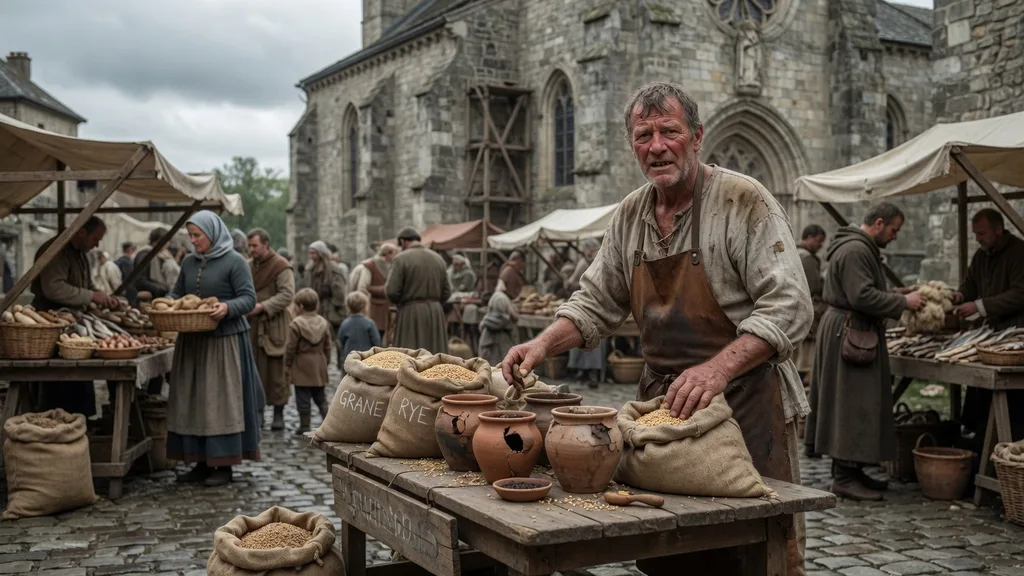
The medieval person had one given name, chosen at baptism. That was it — no middle name, no guaranteed family surname. The problem was obvious: in a village of two hundred people, you might have fifteen Johns and a dozen Marys. So communities added bynames — informal tags that turned a common name into a specific person.
Three types dominated. Occupational bynames named the trade: Thomas the Miller, Agnes the Weaver, William the Cooper. Locational bynames named the origin: Robert of York, Eleanor of Chester, Heinrich von Köln. Patronymic bynames named the father: Edmund Williamson, Marie fils de Renaud, Dietrich Heinrichsohn. Over time — from the 12th century onward, more rapidly among the English nobility after the Norman Conquest — bynames hardened into heritable family names. But for most of the medieval period, the byname described the person, not the bloodline.
Names by Class and Region
Social rank and geography shaped the name pool more than anything else. A Norman baron arrived in England with a French given name and transplanted it into a new landscape. A German peasant's daughter received a Germanic compound name that had been in the family for four generations. The table below maps the feel of names across the generator's classes and regions.
| Class or Region | Feel | Example |
|---|---|---|
| Peasant / Commoner | Plain, functional, tied to a trade or village | Aldric the Thatcher |
| Noble | Formal, often Norman French or Latinised | Beatrice of Gloucester |
| Clergy | Latinised given name, administrative title as byname | Thomas the Archdeacon |
| Merchant / Townsfolk | Guild-adjacent, trade-specific, urban | Guillaume the Mercer |
| English | Old English roots mixed with Norman imports | Oswald, Matilda, Fulke |
| French | Carolingian compound names, softer vowels | Thibault, Alienor, Yves |
| German / Frankish | Heavy Germanic compounds, strong consonants | Wolfram, Adelheid, Hartmann |
Given Names: Where They Came From
Medieval given names were not invented fresh. They inherited from earlier layers of European history — and changed when political power shifted.
England before 1066 ran on Old English names: Aelfred, Edith, Oswald, Wulfric. After the Norman Conquest, French names flooded in from the new ruling class. Within two generations, William, Robert, Richard, and Matilda dominated the baptismal registers. Old English names didn't vanish entirely — they retreated down the social ladder and survived among the peasantry — but the nobility remade itself with Continental names almost overnight.
France carried the Carolingian inheritance: compound Germanic names translated into French phonetics. Karl became Charles. Hludwig became Louis. Thibaud, Raoul, Amaury — all Germanic roots worn smooth by French mouths over centuries. The French Church added Latin names from the sanctoral calendar: Thomas, Nicolas, Jean.
Germany and the Frankish world kept Germanic compounds longer and more visibly. Friedrich (peace-ruler), Adalbert (noble-bright), Hildegard (battle-guard) — the components had meanings, and educated families knew them. Women's names like Mechthild and Cunigunde carried the same compound logic. The Holy Roman Empire's complex politics spread these names across central Europe through dynastic marriage.
Bynames: The System That Named a Society
Occupational bynames tell you what a medieval economy ran on. The most common English bynames — Smith, Miller, Cooper, Thatcher, Weaver — point directly at the trades that kept communities alive. A village needed bread, so it needed a miller; the miller's byname recorded that fact for tax collectors, courts, and posterity alike.
Locational bynames record movement. Someone named "of York" was, at some point, distinguished from their neighbours by having come from York. Whether they were a merchant trading between towns, a younger son who'd left the family land, or a serf who'd moved to a new manor, the byname stuck and marked them as an outsider who'd settled in.
Patronymic bynames preserved family lines without requiring formal documentation. In England, the -son suffix (Williamson, Edmundson) did this work. In France, fils de (son of) appeared in legal records. German and Frankish practice produced -sohn formations. In Wales, ap (son of) and ferch (daughter of) served the same function in a language with its own separate history.
Naming for Fiction, RPG, and Reenactment
The names in this generator work for three different purposes, and the approach differs for each.
Historical fiction benefits most from locational and patronymic forms. A character named "Eleanor of Bristol" lands in a period novel with plausible weight. "Hugh the Marshal" signals rank and function without explanation. Readers who know their history will recognise the authenticity; readers who don't will feel the texture of it.
Tabletop RPG in a pseudo-medieval setting — Pathfinder, WFRP, OSR games — needs names that feel right without demanding historical accuracy. The occupational and locational forms work well here: they're vivid and self-explanatory. "Ranulf the Skinner" implies a character, not just a label.
Historical reenactment has the strictest requirements. Use the region filter to narrow to the culture you're portraying, then cross-reference the form against the period. Patronymics work well for pre-1300 settings; fixed hereditary surnames make more sense post-1300 for noble characters. Clergy names should lean toward Latinised given names (Thomas, Nicholas, Stephen) with administrative titles.
Tips for Choosing a Name with the Medieval Name Generator
- Match the class to the setting. A peasant named "Thibault de Blois" breaks the register immediately — that's a noble name in a noble form. Filter by class first, then pick.
- Pick the byname form that fits the moment. Occupational bynames suit tradespeople and commoners. Locational ones suit anyone who's moved. Patronymics suit any character whose father matters to the story.
- Read the name aloud. Medieval names were spoken, not printed. If it flows at the table or on the page, it works. "Oswald the Hayward" moves; "Engelbert von Würzburg" has weight.
- Don't over-explain the byname. The byname does its own work. You don't need to write "Agnes of Bath, who came from Bath" — the name already says it.
- Consider the gender gap in records. Women's names appear less in surviving sources — which means female names carry extra distinctiveness in a crowd of male-dominated records. That's worth using narratively.
Example Medieval Names
Male Given Names
- Aldric
- Bartholomew
- Conrad
- Dietrich
- Edmund
- Friedrich
- Geoffrey
- Godfrey
- Hartmann
- Hugh
- Joscelin
- Lambert
- Manfred
- Nigel
- Otto
- Raoul
- Reinhardt
- Roland
- Thibault
- Walther
Female Given Names
- Adelaide
- Agnes
- Alienor
- Beatrice
- Cecilia
- Constance
- Edith
- Ermengarde
- Gertrude
- Hedwig
- Hildegard
- Jutta
- Margery
- Matilda
- Mechthild
- Petronilla
- Richeza
- Sibyl
- Ursula
- Yolande
Occupational & Locational Bynames
- the Miller
- the Cooper
- of York
- de Paris
- the Thatcher
- von Köln
- the Goldsmith
- the Shepherd
- of Bristol
- de Rouen
- the Weaver
- the Sacrist
- of Lincoln
- von Mainz
- the Vintner
- the Hayward
FAQ for Medieval Name Generator
How did medieval surnames work?
Most people in the medieval period did not have fixed hereditary surnames. Instead, they used bynames — descriptive additions that identified a person by occupation (John the Miller), location (Agnes of York), or parentage (Robert Williamson). These bynames became hereditary family names gradually, from around the 12th century onward, with the English upper classes leading the shift.
What is the difference between a given name and a byname?
A given name was the personal name a person was baptised with — William, Matilda, Heinrich. A byname was an added identifier used to distinguish people with the same given name in a community. The byname might be a trade (the Cooper), a place (of Bristol), or a father's name (Edmundson). In formal records, both appeared together.
Where can I use the Medieval Name Generator?
It suits historical fiction manuscripts, tabletop campaigns set in a low-fantasy medieval world, LARP and reenactment character sheets, and genealogy or worldbuilding hobbyists who want a period-plausible name fast. Filter by class and region first, then pick the byname form that matches your setting's timeline.
Can I use these names for historical fiction or RPGs?
Yes. The names come from real historical sources — parish records, manorial rolls, chronicles, and charters. For historical fiction, they give your characters period-correct identities. For RPGs set in a pseudo-medieval world, they provide the texture of a real past without tipping into generic fantasy.
Were medieval names different by region?
Significantly so. English names often had Old English or Norman French roots after 1066, producing combinations like Oswald or Baldwin alongside newer arrivals like Richard and Robert. French names reflected Carolingian and Capetian traditions. German and Frankish names leaned on Germanic compound roots — Friedrich, Adelheid, Wolfram — with distinct phonetics that set them apart from their western neighbours.
What makes medieval names historically accurate?
Every given name and byname in this generator is drawn from real medieval sources — parish registers, manorial court rolls, charters — rather than invented syllables, so the names carry the actual sound and structure people used between roughly 900 and 1400. A peasant gets an occupational byname like 'the Thatcher,' a Norman noble gets a French given name, and a German villager gets a genuine Germanic compound — the record, not a fantasy approximation.
Did women in the Middle Ages have bynames too?
Yes, though women's bynames appear less frequently in surviving records since men dominated land transactions and legal documents. When women do appear — in wills, dowry agreements, or court rolls — they carry locational bynames (Alice of Chester), occupational ones tied to their husband or father's trade, or patronymics. The generator reflects this across both genders.
How were clergy named differently from laypeople?
Clergy took the same given names as laypeople — there was no separate pool of clerical names. What differed was the title and administrative role added: a clerk might be recorded as 'Thomas the Deacon' or 'William the Chancellor.' Senior clergy in cathedral chapters had defined roles — Precentor, Sacrist, Treasurer — that functioned as both job titles and bynames in records.