Last Name Generator
This last name generator builds surnames the way real ones actually formed — from a trade, a father's name, a home village, or a nickname that stuck. Pick a culture, a surname type and a style, add your character's first name if you want the two to rhyme properly, and every result comes with the real mechanism behind it: what the name meant, and why a family ended up carrying it.
Real surnames are not decoration. Most of them started as plain, functional descriptions of a specific person, and the description froze into a family label over a few centuries. Fantasy surnames can borrow that same logic instead of reaching for the nearest brooding compound word, and this page explains both halves: how actual surnames work across roughly twenty language traditions, and how to build one from scratch that doesn't sound like every other -thorn or -crow on a shelf of fantasy paperbacks.
👇 Click any name to copy it
How to Use the Last Name Generator
Four controls shape a result, and the fourth one is optional but worth using.
- Culture. English, Irish, Scottish, Welsh, German, French, Italian, Spanish, Portuguese, Dutch, Scandinavian, Slavic, Greek, Japanese, Chinese, Korean, Indian, Arabic, Jewish, or Fantasy. This is the single biggest lever — it decides the sound, the endings, and which of the four surname types below actually gets used for that tradition.
- Surname type. Occupational, patronymic or matronymic, toponymic (place-based), or descriptive. Some cultures lean hard on one type — Scandinavian surnames are almost entirely patronymic in origin — so this filter narrows what the culture filter already offers rather than fighting it.
- Style. Common, rare, noble, or rustic. Common pulls from the names that actually top real population registers; noble reaches for names that historically marked land, title, or a coat of arms; rustic leans toward plain trade and farm words; rare surfaces less-common real forms and less-obvious fantasy combinations.
- First name (optional). Type your character's first name and the generator favours surnames that actually sound right next to it — checking syllable count, matching consonant sounds at the seam, and skipping anything that reads awkwardly out loud. Leave it blank for a surname on its own.
Set the filters, generate, and click a card to copy the name. Each real-surname result shows its literal meaning and its type; each fantasy result is labelled invented, built from morphemes rather than pulled from an actual registry.
Where Surnames Come From: The Four Types
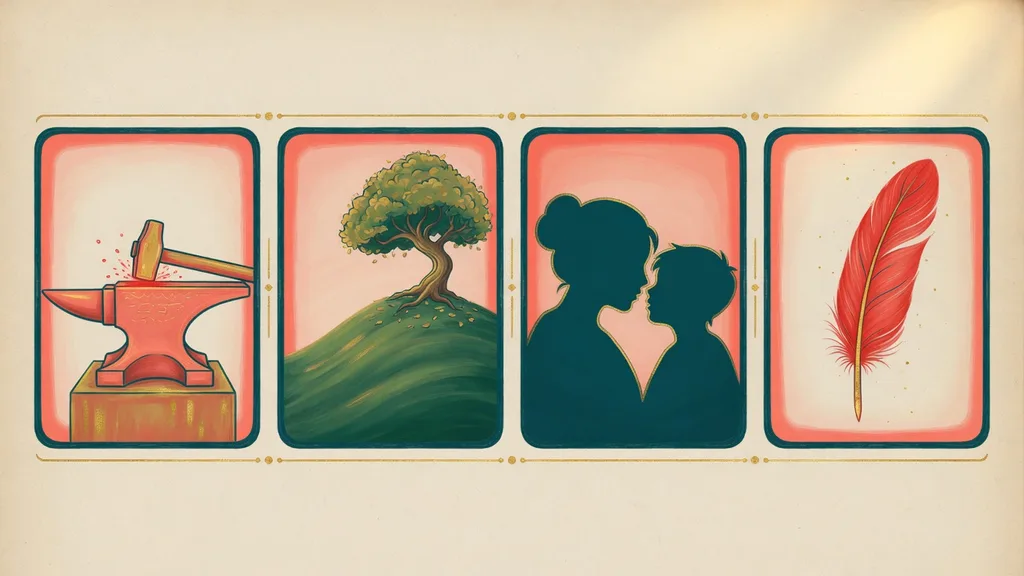
Almost every surname on earth, in every language, was built one of four ways. Once you can spot the pattern, a surname stops being a random string of syllables and starts telling you something about the person who first carried it.
Occupational: what the first bearer did for a living
An occupational surname names a trade. English Smith is the classic case — a blacksmith, so common a job that Smith is still the most frequent surname in several English-speaking countries. The same idea repeats almost everywhere a trade economy existed: German Schmidt, Polish Kowalski (from kowal, smith), Italian Ferrari (from ferro, iron), French Fevre or Lefebvre, Spanish Herrero. Every one of those names means the same job in a different language. Other trades left their own trail: Taylor (tailor), Baker, Carpenter, Miller, Fisher in English; Müller (miller) and Bauer (farmer) in German; Molinari (miller) in Italian.
Patronymic and matronymic: whose child you were
A patronymic surname names a father; a matronymic one, rarer, names a mother. This is probably the largest single category worldwide, and it shows up in nearly identical shape everywhere: English Johnson (son of John), Russian Ivanov (son of Ivan), Scandinavian Nielsen (son of Niels), Irish O'Brien (grandson/descendant of Brian), Spanish Fernández (son of Fernando), Welsh ap Hywel, which flattened into Powell. All of them answer the same question — whose son or descendant is this — in a different grammar. Arabic ibn and Hebrew ben work the same way and mean the same thing. A few traditions kept a working matronymic form too: a child named for a mother rather than a father, usually where the father was absent, unknown, or simply less notable than the mother in that family's story.
Toponymic: where you were from, or where you stood
A toponymic (or locative) surname names a place — a town, a region, a river, or even a specific landmark near the family home. English surnames like Hill, Ford, Brooke and London describe a spot in the landscape or the town a person came from once they moved somewhere else and needed a way to be told apart from the locals. French Dubois (of the wood) and Dupont (of the bridge) work exactly the same way. Dutch van der Berg (of the mountain) and German Bergmann lean on the same landscape logic. Japanese surnames overwhelmingly belong to this category — see below.
Descriptive: a nickname that outlived the joke
A descriptive or nickname surname records a physical trait, a habit, or a personality, and it's usually the type with the most personality left in it centuries later. English Short, Brown, Long and Swift describe a body or a manner. Italian Rossi (red-haired, or ruddy) and Basso (short) follow the same instinct; so does Scottish Cameron, traditionally read as "crooked nose." Some of these were flattering, plenty were not, and a family simply kept whatever description a medieval clerk happened to write down.
| Concept | English | German | Polish/Russian | Italian | Other |
|---|---|---|---|---|---|
| Smith (occupational) | Smith | Schmidt | Kowalski / Kuznetsov | Ferrari | Herrero (Spanish) |
| Son of (patronymic) | Johnson | — | Ivanov | — | Nielsen (Danish), O'Brien (Irish), Fernández (Spanish) |
| Miller (occupational) | Miller | Müller | Młynarz | Molinari | Meunier (French) |
| From the hill/mountain | Hill | Berg / Bergmann | Górski | Montagna | van den Berg (Dutch) |
| Short (descriptive) | Short | Kurz | Krotki | Basso / Corti | Petit (French) |
Surnames by Culture
Every culture built its surname system out of the same four types, but the mix, the timing, and the grammar differ enough that a fluent reader can usually place a surname's origin at a glance.
- Irish. Ó means grandson/descendant of (O'Brien, O'Sullivan); Mac means son of (MacCarthy). Many Irish surnames were anglicised under English rule, sometimes losing the particle (O'Brien became Brien or Bryan in some records) and sometimes keeping it. The particle isn't decoration — it names a specific ancestor the surname is still built around.
- Scottish. Mac again (MacDonald, son of Donald), often tied to a clan rather than a single household, so a surname could signal allegiance and territory as much as direct descent.
- Welsh. ap or ab means son of, and Welsh patronymics only fixed into inherited surnames relatively late, often under English administrative pressure. Repeated contraction produced familiar English surnames: ap Hywel became Powell, ap Rhys became Price, ap Rhisiart became Pritchard.
- Scandinavian. The -sen (Danish/Norwegian) and -son (Swedish) patronymic system meant a son's surname changed every generation — Lars Olsen's son Nils became Nils Larsen, not another Olsen. Most Scandinavian countries only froze patronymics into fixed, inherited family surnames during the 19th century, driven by censuses and, in Norway's case, a specific 1923 naming law — genuinely recent as surname systems go.
- Slavic. Russian and other East Slavic surnames commonly end in -ov, -ev or -in (Ivanov, Petrov); Polish and other West Slavic surnames favour -ski/-cki (Kowalski). Most of these languages also grammatically mark a surname's gender: Ivanov becomes Ivanova for a woman, Kowalski becomes Kowalska. It isn't a spelling variant — it's the surname following the same adjective agreement rule as the rest of the language.
- Spanish. Most Spanish speakers traditionally carry two surnames, paternal first and maternal second (Gabriel García Márquez: García from his father, Márquez from his mother). In everyday use and alphabetising, it's the father's name that usually counts as "the" surname.
- Portuguese. Also two surnames, but the order is commonly reversed from Spanish practice — maternal surname first, paternal surname last, with the final (paternal) name again treated as the primary one. Practice varies by country and by family, so treat this as the common pattern, not a fixed rule.
- Dutch. A prefix called the tussenvoegsel — van, de, van der, van den — sits between first and last name (Vincent van Gogh). It's conventionally ignored when alphabetising, so van Gogh files under G, not V, in Dutch library and phone-book conventions.
- German. Especially dense in occupational surnames — Schmidt, Müller, Schneider (tailor), Fischer, Wagner (wagon-maker) — reflecting how many German surnames crystallised directly out of medieval guild trades.
- Italian. Regional endings are a strong tell: -i is common across much of the country (Rossi, Ferrari, Bianchi), while -o/-a endings run more common in the south (Esposito, Russo), and these are broad regional tendencies, not strict boundaries.
- Japanese. Overwhelmingly toponymic, and unusually transparent about it — surnames are often literally landscape words. Yamamoto (base of the mountain), Tanaka (inside the rice field), Kobayashi (small forest), Watanabe (crossing point by the water). See the Japanese Name Generator for 174 real Japanese surnames with their kanji and meanings.
- Chinese. A relatively small surname inventory covers most of the population — a few hundred surnames in common use account for the large majority of Chinese people, with Wang and Li typically cited among the most common in mainland China, though exact rankings shift with each census and estimates vary by source. Surname always precedes given name in Chinese naming order, the reverse of English convention, and that ordering carries through into Vietnamese and Korean naming too.
- Korean surnames concentrate even more sharply: a small number of surnames, led by Kim, Lee and Park, are shared by a very large share of the population, so a Korean surname alone carries far less individually identifying information than an English one does. Many Korean family lines also trace to a specific regional clan seat (a bon-gwan) recorded alongside the surname in genealogical records, so two people sharing a surname like Kim may still belong to entirely different, unrelated clans.
- Indian. Surname conventions vary enormously by region, religion and community — some surnames mark caste or sub-caste, others mark region, clan, or occupation, and some communities historically used a father's given name in place of a fixed family surname at all. Sikh naming adds its own layer, where Singh and Kaur function as shared identity markers rather than family surnames in the usual sense. Treat "Indian surnames" as a description of many distinct regional systems rather than one tradition.
- Arabic. Classical Arabic naming uses ibn/bin (son of) or bint (daughter of) to build a chain of ancestors, alongside a nisba — an adjective naming a person's tribe, hometown, or field of expertise (al-Baghdadi, of Baghdad). A full classical name could also include a kunya, a name built from a person's eldest child (Abu Bakr, father of Bakr), stacked alongside the given name and the nisba. Modern fixed family surnames are a more recent administrative layer on top of this older naming logic in many Arabic-speaking countries.
- Jewish (Ashkenazi). A large share of Ashkenazi surnames were not chosen freely by families at all — they were imposed by government decree in the late 18th and early 19th centuries, mainly across the Austrian, Prussian and Russian empires, as those states pushed for fixed, registrable family names for taxation and conscription. That history explains why so many Ashkenazi surnames are occupational (Schneider, tailor) or ornamental German/Yiddish compounds (Goldberg, Rosenthal) rather than old inherited clan names.
When Surnames Appeared, and Why That Matters for Fiction
Surnames feel permanent because they're the norm today, but as a global practice they're patchy and, in several places, quite recent. Treating "everyone has always had a surname" as a given is one of the easiest anachronisms to write into historical or medieval-flavoured fiction.
England fixed hereditary surnames gradually across roughly the 12th to 15th centuries, spreading first among nobility and landowners and reaching most of the common population later, driven partly by administrative needs like tax records. Scandinavia, as noted above, mostly held onto patronymics — a surname that changed every generation, not a fixed family name — until the 19th century in many areas. Turkey abolished titles and mandated fixed surnames by law in 1934, which is why "Atatürk" itself is a surname adopted under that same law. Japan required commoners to adopt a surname in 1875, having previously reserved surnames largely for the samurai class. Iceland is the standing exception among modern states: most Icelanders still use a patronymic, or increasingly a matronymic, rather than an inherited family surname today — a name like Guðmundsdóttir means "daughter of Guðmundur," and the next generation's surname is built fresh from a parent's first name rather than passed down unchanged. The mechanics of how those patronymics were actually formed, and the mistakes fiction repeats with them, are set out in our guide to how Old Norse patronymics work.
For a writer, the practical takeaway is simple: a medieval peasant character in your story may plausibly have no surname at all, just a given name plus a description — "Will the miller's son," "Agnes of the ford" — and that's a period-accurate choice, not a gap to fill in. See Epithets, Titles and Bynames for how a byname works as a stand-in before surnames existed, and Character Naming by Social Class for how naming conventions split between nobility and commoners in period settings.
Fantasy Surnames That Don't Sound Generic
Blackthorn, Stormcrow, Nightshade — these names aren't wrong exactly, they're just tired. A compound of one dark noun and one ominous natural image has been the default fantasy surname for so long that it now reads as a costume rather than a name a real family would carry.
The fix is to build a fantasy surname the same way real ones formed, using the four types above instead of grabbing straight for a compound. An occupational fantasy surname names an invented trade specific to your setting — a beastmaster, a rune-cutter, a stormcaller in a world where that's an actual licensed profession, not a metaphor. A toponymic fantasy surname pulls from your own map rather than a stock landscape word: a family named for the specific pass, river, or ruin on your setting's atlas reads as more grounded than one named for a generic "shadow" or "storm." Descriptive and patronymic fantasy surnames work exactly like their real-world counterparts and barely need translating — an invented patronymic particle works the same way ibn or Mac does.
Worked example: instead of reaching for a stock word, start with the job. A family of glassblowers in a coastal city might carry a surname like Glasswick or Panehearth — plausible as an invented trade-name because it follows the same compound logic as Schmidt or Baker, just built from a made-up craft. A family from a specific fictional river might become Vaskarrow or Reedmoor, tied to a place on your own map rather than a generic "shadow" or "storm" that could belong to any setting at all. Both routes produce a name that sounds invented but earned, rather than invented and generic.
Keep it pronounceable. A name a reader has to sound out letter by letter gets silently skipped every time it recurs, and that's a real cost spread across a whole book. And watch for the trap of a surname that describes a plot point rather than a person — a villain literally named Darkbane or a prophecy child named Lightborn tells the reader the ending before the story earns it. The strongest fantasy surnames feel like they belonged to the family before the plot needed them to mean anything. For more on why invented names sometimes ring false even when they're built carefully, see How to Name a Character.
Matching a Surname to a First Name
A first and last name are read as one unit, and the seam between them matters more than either name does alone.
- Avoid a hard consonant collision at the join. "Jack Kraft" and "Mark Kraft" both stack two hard stops back to back and trip on the tongue; a softer surname next to a hard-ending first name usually reads more smoothly.
- Watch identical or near-identical endings. "Anna Vanna" or "Peter Weber" (rhyming syllables) can read as accidentally comic even when neither name is unusual on its own.
- Mind the syllable rhythm. A long, multi-syllable first name (Anastasia, Bartholomew) usually pairs better with a short, punchy surname (Vane, Cole), and a one-syllable first name (Jax, Finn) can carry a longer surname without the whole name feeling top-heavy.
- Alliteration is a tool, not a default. Peter Parker and Lois Lane work because comic-book naming leans into rhythm on purpose. In a grounded novel or a serious RPG campaign, the same trick usually reads as a joke the writer didn't intend.
- Vowel and consonant balance matters too. A surname that's almost entirely consonants next to a first name that's almost entirely vowels can sound harsh at the seam even when neither name is individually hard to say — reading the full name aloud, slowly, catches this faster than staring at it on the page.
This is exactly what the generator's optional first-name field checks for — syllable count, the sound at the seam, and whether the pairing reads as accidentally funny — before it hands you a result. It's worth doing this check even for a name you found elsewhere: type the first name in, browse the matching surnames, and see whether your original choice would have made the cut.
Surnames for Different Purposes
- Novels. Consistency across a cast matters more than any single great name — if one family uses real German surnames and the next uses invented fantasy compounds in the same book, the fantasy compound reads as a mistake.
- D&D and tabletop. A surname is optional for most fantasy ancestries and near-mandatory for others; see the D&D Character Name Generator for surnames matched to a specific race and class rather than picked in isolation.
- Video-game characters. A create-a-character screen usually has room for a full name even when the game barely uses the surname in dialogue — pick one that fits the setting's culture filter here rather than defaulting to English.
- Pen names. A surname chosen for how it reads on a book spine benefits from the same phonetic checks as a character name — short, easy to say aloud, easy to spell from hearing it once.
- Usernames. A real or invented surname makes a more memorable handle base than a random string, and it's worth checking a candidate isn't already someone else's actual, currently-used name before you commit to it publicly.
Example Surnames
Real Surnames Across Cultures, With Meanings
- Smith (English) — blacksmith
- Kowalski (Polish) — smith's son/family
- Yamamoto (Japanese) — base of the mountain
- Fernández (Spanish) — son of Fernando
- O'Sullivan (Irish) — descendant of Súileabhán
- Müller (German) — miller
- Rossi (Italian) — red-haired, ruddy
- Ivanova (Russian, feminine) — daughter of Ivan
- van der Berg (Dutch) — of the mountain
- al-Baghdadi (Arabic, nisba) — of Baghdad
Fantasy Surnames (Invented)
- Emberfell
- Vaskarrow
- Thornhollow
- Duskmere
- Ashgrove
- Corvane
- Ilmwrit
- Graystead
- Nethervane
- Oakenfield
First + Last Pairings
- Mira Ashgrove
- Torren Vale
- Elin Kowalska
- Bastian Corvane
- Saoirse O'Brien
- Hiro Watanabe
- Freya Nielsen
- Dario Ferrari
- Nadia Ivanova
- Cael Thornhollow
Tips and Common Mistakes
- Pick the culture before the vibe. A striking-sounding surname that mixes German endings with Japanese roots undercuts a setting that's meant to feel coherent, unless the mixing itself is a deliberate part of the world.
- Check what the name actually means before you commit. A descriptive surname can carry an unflattering literal meaning that reads differently once a reader knows it — worth a quick check for a major character.
- Don't assume every culture pairs one given name with one fixed surname. Spanish and Portuguese double surnames, Icelandic patronymics, and Vietnamese naming order all break that assumption in different ways.
- Real surnames aren't free of connotation. Some real surnames carry regional, religious or class associations in their culture of origin — worth a moment's thought before assigning one to a comic or villainous character.
- For real names grouped by their meaning rather than their origin, see the meanings section — useful when you know what a name should mean before you know what it should sound like.
- A fantasy surname doesn't need a fantasy first name to match. Plenty of workable fantasy characters pair a plain-sounding first name with an invented surname, or the reverse — it's the phonetic fit that matters, not matching invented-ness on both sides.
- Building a whole cast, not just one character? Generate a batch at once rather than one name at a time, and skim for accidental repeats or near-duplicates before you commit any of them to a manuscript or a campaign sheet — it's a faster fix now than three chapters later.
A surname is a small piece of information doing a lot of quiet work — sound, era, culture, and sometimes an entire family history, all carried in one or two syllables next to a first name. Building it deliberately, using the same logic real surnames were built with, is what makes it hold up under a reader's attention rather than fading into background noise.
FAQ about last names and surnames
What is a good last name for a character?
One that fits the culture and period of your setting and sounds right next to the first name you've already chosen. Start with the four real surname types — occupational, patronymic, toponymic, descriptive — pick one that suits the character's backstory, then check the pairing out loud. A surname that fits the world does more work than a surname that just sounds cool on its own.
Are these real surnames or made up?
Both, depending on the culture you pick. English, Irish, Scottish, Welsh, German, French, Italian, Spanish, Portuguese, Dutch, Scandinavian, Slavic, Greek, Japanese, Chinese, Korean, Indian, Arabic and Jewish results are genuine historical surname forms with real meanings attached. Fantasy results are invented combinations built from the same naming logic and are clearly labelled as invented, not pulled from any real registry.
Can I legally use one of these surnames?
Real historical surnames like Smith, Kowalski or Fernández are common family names, not owned by anyone, so using one for a fictional character, a pen name or a username is fine. The only real caution is a name that's closely tied to a specific living public figure or an active trademark — worth a quick search if you're about to put a name on a book cover or a product.
What are the four types of surname?
Occupational (named for a trade, like Smith or Schmidt), patronymic or matronymic (named for a parent, like Johnson or Ivanov), toponymic (named for a place, like Hill or Yamamoto), and descriptive (named for a trait or nickname, like Short or Rossi). Most surnames in most languages fall into one of these four categories, even though the grammar used to build them differs a lot from language to language.
Why do Slavic surnames change for women?
Because Russian, Polish and several other Slavic languages grammatically inflect a surname for gender the same way they inflect other adjectives. Ivanov becomes Ivanova for a woman, Kowalski becomes Kowalska — it isn't an alternate spelling, it's the surname agreeing with the bearer's gender the way the rest of the language works.
How do Spanish double surnames work?
Most Spanish speakers traditionally carry two surnames: the father's surname first, then the mother's surname second. In everyday use, alphabetising and formal address, it's usually the paternal surname that's treated as the primary family name, though both are legally part of the full name.
Do all cultures have surnames the same way English does?
No. Some cultures use two surnames (Spanish, Portuguese), some historically used a changing patronymic instead of a fixed family name (much of Scandinavia until the 19th century, Iceland still today for many families), and some fixed hereditary surnames only recently by law — Turkey in 1934, Japan for commoners in 1875. Treating a fixed, inherited, single surname as universal is a common but avoidable mistake in historical fiction.
How do I pick a surname that matches my character's first name?
Check the seam between the two names: avoid a hard consonant collision where they meet, avoid identical or rhyming endings, and balance syllable count — a long first name usually pairs better with a short surname and vice versa. Type your first name into the generator's optional field and it checks all three automatically.
What makes a fantasy last name sound believable instead of generic?
Building it from one of the four real surname types — an invented trade, an invented place from your own map, a descriptive trait, a patronymic particle — rather than defaulting to a dark-noun-plus-nature-image compound like Blackthorn or Stormcrow. Keep it pronounceable, and avoid a surname that describes a plot twist before the story earns it.
Can I use a generated surname as a pen name?
Yes. A real surname works as a pen name exactly as well as it works as a legal one, and a well-formed invented surname can work too if it's easy to say and spell after hearing it once. Run it through the same checks you'd use for a character name — read it aloud, check it isn't already a well-known author's actual name.
What is the most common surname in the world?
Wang and Li are usually cited as among the most common surnames globally, largely because a relatively small set of surnames covers a very large population in China. Exact rankings and figures vary by source and by census year, and "most common" also depends on whether you're counting worldwide, per country, or per language — treat any single number here as an estimate, not a fixed fact.
Can the generator give me a first and last name together?
Yes. Type a first name into the optional field before generating, and the surname results are filtered for a good phonetic match to that specific first name rather than generated in isolation.