Troll Name Generator
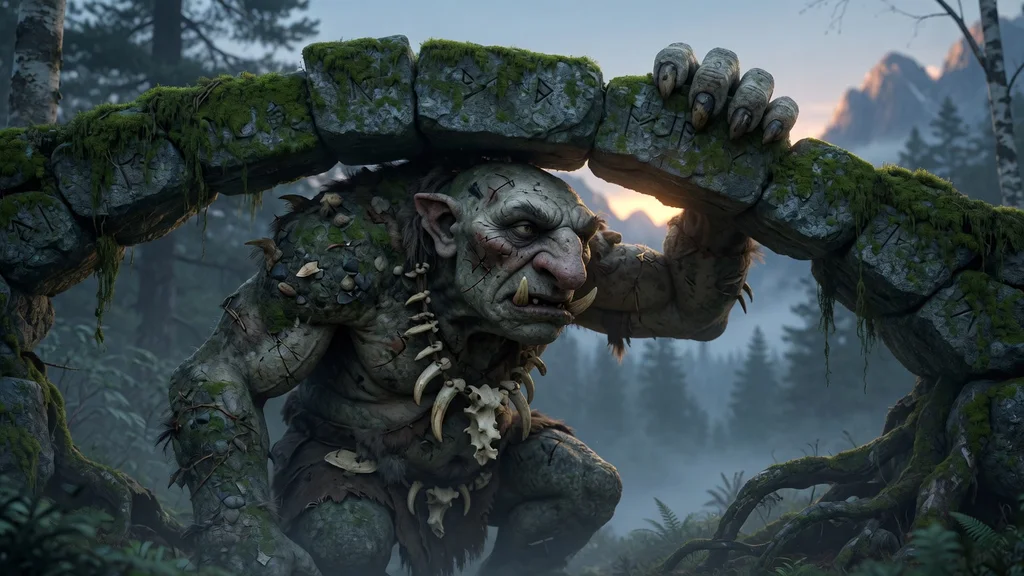
This troll name generator doesn't assume there's one correct kind of troll — because there isn't. Pick from five separate naming traditions (Norse folklore, Tolkien-style, D&D-style, WoW-style, and Discworld-style), set a habitat, and generate names with a badge, a lore line, and an optional place or title tag. Click any card to copy it.
👇 Click any name to copy it
Say "troll" to five different people and you'll get five different mental pictures: a hulking grey-green Norwegian mountain-dweller, a lumbering half-wit Bilbo tricks into arguing past sunrise, a regenerating tabletop monster that shrugs off a sword but fears a torch, an apostrophe-heavy Horde tribesman, or a sentient boulder cracking dry jokes about the weather. All five are correct. None of them share a naming convention, and most generators online quietly pretend they do — one flat list of "troll names," gender toggle, done.
That flattening is the gap this page is built to close. Trolls are scattered across more unrelated traditions than almost any other fantasy monster, which is exactly why gathering them in one place — instead of five separate half-answers — is worth more than another single-pool generator. Below, each tradition gets its own naming logic, its own sound, and its own honest sourcing.
How to Use the Troll Name Generator
- Pick a tradition — Norse folklore, Tolkien-style, D&D-style, WoW-style, or Discworld-style. Leave it on "Any" to mix all five.
- Set a habitat — Cave, Mountain, Forest, Bridge, or River. This changes the lore line and the place tag, not just flavor text.
- Choose a gender, if the tradition you're using distinguishes one (some, like Tolkien's, historically didn't bother).
- Pick a name form — plain name, name plus place ("Grosh of the Old Crossing"), or title plus name ("Chieftain Grosh").
- Set how many names you want and generate. Click a card to copy it straight to your clipboard.
Five Traditions, One Word
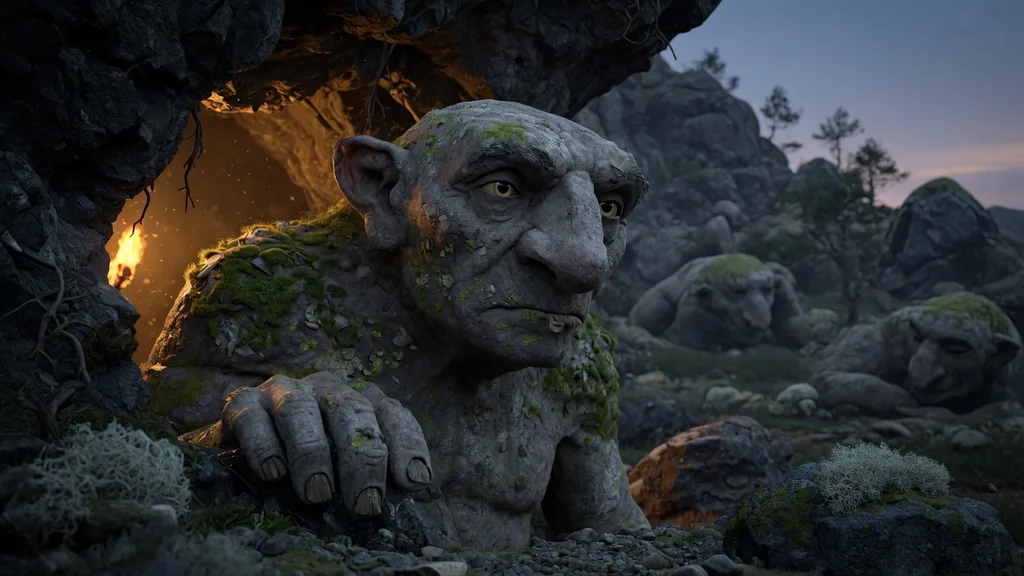
Before diving into each tradition individually, here's the shape of the whole picture — where each version of "troll" comes from, and roughly what it sounds like when you say a name out loud.
| Tradition | Origin | Sound profile | Example |
|---|---|---|---|
| Norse folklore | Scandinavian myth & 19th-century folk tales | Guttural Old Norse-rooted compounds | Skorngrim, Bergveig |
| Tolkien-style | The Hobbit & The Lord of the Rings | Blunt, plain, near-comic | Grubb, Thudd |
| D&D-style | Dungeons & Dragons monster tradition | Harsh consonant clusters | Groshurk, Vrakol |
| WoW-style | World of Warcraft-inspired fan naming | Apostrophe cadence, tribal roots | Vol'gash, Zan'jal |
| Discworld-style | Terry Pratchett's Discworld novels | Mineral and rock words | Gneiss, Feldspar |
Norse Folklore Trolls — Jötunn, Stone, and the Sunlit Curse
The oldest layer here comes from Old Norse sources, where jötnar (giants) and troll overlap heavily as words for dangerous, often magic-using beings outside human and divine society. Medieval Icelandic sagas and the Eddas name specific giants — individuals with their own stories, none of them reused as generator output here — but the broader category of "troll" as a folk creature kept evolving for centuries after those texts were written down.
The sunlight-to-stone rule most people know today is a later addition, best documented in Norwegian folk tales collected in the 19th century by Peter Christen Asbjørnsen and Jørgen Moe. Their collected stories explain Norway's craggy, troll-shaped rock formations as trolls caught outdoors past dawn — a folk etymology for a landscape that genuinely looks like it's full of frozen giants. It's a younger idea than the sagas, but it's the one that stuck, and it's the throughline this generator's Norse mode leans on: short, guttural, stone-and-frost-rooted names built from Old Norse-adjacent syllables.
This isn't the same naming system as the site's Norse or Viking generators, which cover real historical patronymic conventions for people. Troll names in this tradition skip the patronymic entirely — trolls in folklore rarely have named parents — and lean harder into compound, almost geological word-roots instead.
Tolkien's Trolls — Blunt, Simple, Built to Break
Tolkien's trolls are deliberately unglamorous. The three Bilbo's party runs into in The Hobbit — famous for arguing through the night until sunrise turns them to stone, a scene that borrows straight from the Norwegian folk motif above — talk in a broad, rustic register and are outsmarted by a hobbit half their size. The cave trolls and Olog-hai of The Lord of the Rings are grimmer and more dangerous, bred by Sauron to withstand daylight, but they're still defined by brute physical force over cunning.
That's the naming cue this generator's Tolkien-style mode follows: short, blunt, almost comic in how plain the sounds are. No apostrophes, no ornate compounding — just thick consonants and simple syllables that read like something grunted rather than spoken. It's the opposite instinct from an elvish name, on purpose.
D&D Trolls — The Regenerator's Register
Dungeons & Dragons took the folkloric troll and gave it one defining mechanical trait that has nothing to do with sunlight or stone: regeneration. Sever a D&D troll's limb and, unless the wound is sealed with fire or acid, it grows back — a rule that's shaped how generations of tabletop groups approach troll encounters, since the fight isn't really over until someone remembers to bring a torch. That single design choice turned trolls into one of the genre's most recognizable "smart players solve this, dumb players don't" monsters.
Sonically, D&D-style trolls in most published bestiaries and homebrew content lean harsh — dense consonant clusters, guttural endings, names built to sound monstrous rather than cultured. This generator's D&D-style mode follows that same register, distinct in feel from the D&D-adjacent Orc name generator and Goblin name generator on this site, both of which lean their own directions within the same broad "monstrous fantasy" neighborhood.
World of Warcraft-Style Trolls — Tribes and the Apostrophe Convention
World of Warcraft built the single most developed troll culture in modern fantasy gaming — not a monster template, but a full civilization with its own religion, its own regional tribes, and its own naming convention. The apostrophe in names like Zul'jin or Vol'jin (canonical characters, named here only as explanatory examples, never as generator output) marks a genuine glottal stop rather than decoration, and it recurs across the game's major troll tribes: the island-dwelling Darkspear, the northern-forest Amani, the ancient jungle-empire Gurubashi, and the imperial, priesthood-heavy Zandalari.
This generator's WoW-style mode mimics that same apostrophe cadence and tribal flavor with entirely original root combinations — it's a fan-style homage to the naming pattern, not a lookup of canon names. If you specifically want World of Warcraft character names — including that game's own dedicated Troll and Zandalari Troll pools, alongside all 22+ other playable races — the World of Warcraft name generator covers the full game with faction and race filters this page doesn't attempt to duplicate.
Discworld Trolls — Rocks With Opinions
Terry Pratchett's Discworld trolls run on a joke with real internal logic: their bodies are silicon-based, so cold sharpens their thinking and heat dulls it — a troll can be a genius at 3 a.m. in midwinter and barely capable of a sentence by early afternoon. Pratchett named his troll characters after rocks and minerals to match, a naming convention distinctive enough that this generator's Discworld-style mode borrows the logic (mineral and rock words) while keeping every individual name original, not a match for any specific character from the novels.
It's the lightest, most deliberately funny of the five traditions here, and it works well anywhere you want a troll played for comic relief rather than menace — a tavern bouncer, a slow-moving city guard, a boulder that's technically a person.
Habitat: Where Your Troll Lives
Habitat isn't just flavor text in this generator — it changes the lore line and, in "name + place" mode, the actual place tag attached to the name. Folklore trolls are strongly associated with specific terrain, and the five options here map onto the strongest of those associations.
| Habitat | Where it comes from | Typical behavior |
|---|---|---|
| Cave | General folkloric & D&D dungeon convention | Avoids daylight entirely, territorial underground |
| Mountain | Norwegian & broader Scandinavian folklore | Claims a single crag or peak for life |
| Forest | Broader European wood-troll folklore | Sticks to root-shadow, avoids open ground |
| Bridge | "Three Billy Goats Gruff" (Asbjørnsen & Moe) | Extracts a toll or a riddle from anyone crossing |
| River | Regional water-troll folk variants | Waits at a shallow ford where crossing is unavoidable |
The bridge-troll archetype is worth calling out specifically, since it's the version most people picture first even though it isn't Norse mythology proper — it comes from the Norwegian fairy tale "Three Billy Goats Gruff," first collected by Asbjørnsen and Moe, the same 19th-century pair behind the sunlight-to-stone motif above. A troll guarding a crossing and demanding payment or an answer is folk-tale structure, not saga-era myth, but it's become the default image regardless.
Trolls vs. Other Monster Races on This Site
A few neighboring generators cover adjacent ground, and it's worth being clear about where each one starts and stops. The Goblin name generator and Hobgoblin name generator both cover smaller, craftier fantasy races — quick, sneaky, or martial rather than hulking. The Orc name generator covers a warband-and-clan culture built around organized aggression, a different social structure than the mostly solitary troll. And the Fae name generator overlaps with Norse-adjacent British and Scots folklore the way this page's Norse mode does, but fae naming there revolves around a completely different mechanic — the split between a safe "use-name" and a dangerous "true name" — that trolls in any tradition here don't share.
If you're building out a fuller cast — trolls alongside goblins, orcs, or fae in the same world — keeping each race's naming logic distinct is worth the extra minute it takes to switch generators. Our guide on building consistent names for a culture walks through exactly why mixing sound systems by accident is the fastest way to make an otherwise solid cast read as generic.
Example Troll Names by Tradition
Norse Folklore
- Skorngrim
- Bergveig
- Hrafnulf
- Kaldratora
- Uldvald
- Fjallahild
- Steinmund
- Rimmadis
- Vrangbrand
- Draugkar
Tolkien-Style
- Grubb
- Thudd
- Grock
- Muckle
- Snarg
- Wroth
- Bramm
- Knurl
- Wummel
- Grunch
D&D-Style
- Groshurk
- Vrakol
- Thokath
- Morduesh
- Skrellung
- Grathurn
- Uldakaz
- Rezzurk
- Vornol
- Skavaax
WoW-Style
- Vol'gash
- Sen'tok
- Zan'jal
- Rezan'kai
- Hakk'esh
- Gaz'zin
- Amul'kar
- Thren'obo
- Bwon'zin
- Tal'ando
Discworld-Style
- Gneiss
- Feldspar
- Basalt
- Schist
- Malachite
- Dolomite
- Rhyolite
- Onyx
- Jasper
- Andesite
Common Troll Naming Mistakes to Avoid
- Blending traditions without noticing. A guttural D&D-style root with a WoW-style apostrophe tacked on the end reads as a typo, not a hybrid culture. If you want to mix two traditions on purpose — say, a D&D homebrew troll clan with its own apostrophe convention — that's a worldbuilding choice; doing it by accident just looks like noise.
- Forgetting the mechanical hook. A D&D troll's whole identity in most campaigns is "will regenerate unless you burn or dissolve it." A name that's all menace with no nod to that (a fire-themed epithet, an acid-scarred title) skips the detail players actually remember.
- Playing every troll the same way. Folklore, Tolkien, D&D, WoW, and Discworld trolls aren't just differently named — they're differently motivated. A Discworld-style name on a genuinely threatening monster undercuts the menace; a Norse-style name on a comic-relief sidekick undersells the joke.
- Ignoring habitat entirely. A river troll and a mountain troll sharing the exact same lore line feels like a placeholder was never filled in. The habitat filter above exists specifically so that doesn't happen by default.
- Treating canonical names as fair game. Zul'jin, Vol'jin, and Pratchett's individually named Watch trolls are useful references for tone, not names to borrow outright — both for legal reasons and because a lifted name is instantly recognizable to anyone who knows the source.
Naming a Troll for Fiction vs. the Tabletop
The two use cases pull in slightly different directions. A troll in a novel or short story usually needs exactly one good name, chosen carefully enough to carry characterization across an entire book — readers will hear it dozens of times, so it's worth generating a batch, reading each option aloud, and picking the one that fits the character's role rather than settling on the first plausible result.
A tabletop troll, especially a disposable dungeon encounter, doesn't need that level of commitment — a GM often just needs something serviceable to say out loud when a player asks "what's it called?" mid-fight. That's where the "titled" name form earns its keep: "Chieftain Groshurk" or "Sergeant Gneiss" reads as a complete, memorable answer without requiring five minutes of prep beforehand. Save the fully custom, hand-picked name for the troll that's actually going to recur across multiple sessions.
Tips for Naming a Troll
- Match the tradition to your table's tone — a comic Discworld name in a grim D&D dungeon crawl breaks immersion faster than any actual mechanical mismatch.
- Don't mix apostrophes into non-WoW traditions — the apostrophe is a specific phonetic marker in that one tradition, not a generic "fantasy" flourish. Dropping it into a Norse or Tolkien-style name reads as an accident.
- Use habitat to add texture, not just flavor — a bridge troll and a mountain troll from the same tradition should still feel like they live different lives, not just carry different labels.
- Say it out loud before committing — trolls are meant to sound heavy and physical. If a generated name trips lightly off the tongue, it might read better as an elf.
- Keep true canon names as reference, not output — Zul'jin, Vol'jin, the Hobbit trio, and Pratchett's mineral-named Watch trolls are useful for calibrating tone, but using them directly risks both a copyright headache and an obviously "borrowed" character.
- Generate a batch, not one name — trolls in a shared campaign or fiction project benefit from a small consistent naming pool, the same way any other culture in your world would.
This generator is an independent fan tool and is not affiliated with, endorsed by, or sponsored by the Tolkien Estate, Wizards of the Coast, Blizzard Entertainment, or the estate of Terry Pratchett. Canonical characters and creatures — the Hobbit's troll trio, the Olog-hai, D&D's published troll statblocks, Zul'jin, Vol'jin, and Pratchett's individually named Discworld trolls — are mentioned here only as explanatory examples, never as generator output.
FAQ for Troll Name Generator
Where does the idea of trolls turning to stone in sunlight come from?
Not from the oldest Old Norse sources — it's a later folk motif, best known from tales collected in 19th-century Norway by Peter Christen Asbjørnsen and Jørgen Moe. Those collected stories explain Norway's odd rock formations as trolls caught out after dawn. Medieval Old Norse texts describe jötnar (giants) and trolls as dangerous, magic-adjacent beings, but the specific sunlight-to-stone rule is a folk elaboration that came later and stuck because it's such a satisfying explanation for a mountain range full of troll-shaped crags.
Are Tolkien's trolls and D&D trolls the same creature?
No, and the two barely overlap. Tolkien's trolls — the trio in The Hobbit, the cave and Olog-hai trolls of The Lord of the Rings — are dumb, physically overwhelming, and vulnerable to sunlight, closer to the Norse folk tradition. D&D trolls (a Dungeons & Dragons monster manual staple since the 1970s) are built around regeneration: cut off a limb and it grows back unless you finish the job with fire or acid. That single mechanical rule shaped decades of tabletop encounter design and has nothing to do with sunlight at all.
Why do World of Warcraft trolls use apostrophes in their names?
It's a deliberate phonetic convention Blizzard built for the game's most developed troll culture — the apostrophe marks a glottal stop, a hard break between syllables, not decoration. Names like Zul'jin or Vol'jin (canonical characters, mentioned here only as examples) follow tribal patterns across the Darkspear, Amani, Gurubashi, and Zandalari tribes. This generator's WoW-style mode mimics that same apostrophe cadence with original root combinations. For the full 22-race World of Warcraft naming system, including the game's own Troll and Zandalari Troll pools, see the dedicated World of Warcraft name generator.
Why do Discworld trolls have mineral names?
Terry Pratchett built Discworld trolls around a joke with real internal logic: their bodies are silicon-based, so they think faster when cold and slower (sometimes catastrophically slower) when warm — a running gag about a troll who's a genius at 3 a.m. in winter and barely verbal by noon. Naming them after rocks and minerals (this generator's Discworld-style pool avoids the specific characters Pratchett used, keeping the naming logic without borrowing the actual names) fits that bit — they are, structurally, animated geology with opinions.
What's a good troll name for D&D or tabletop?
Pick the tradition that matches your table's tone first. A grim regeneration-focused encounter reads better with the D&D-style pool's harsh consonant clusters; a folk-horror bridge encounter suits the Norse pool; a comic-relief troll works well with Tolkien-style or Discworld-style names. Set the habitat filter to match where the fight happens — a cave troll and a bridge troll get different lore lines even from the same tradition, which is a small detail players notice.
Is a bridge troll a specific type of troll?
Not officially, but it's a strong enough trope to count as one. The best-known bridge troll isn't Norse at all — it's from the Norwegian tale "Three Billy Goats Gruff," first collected by Asbjørnsen and Moe, where a troll living under a bridge extracts a toll (or a meal) from anyone crossing. This generator's Bridge habitat option leans into that same toll-and-riddle archetype regardless of which naming tradition you pair it with.
Can I use these names in World of Warcraft or Dungeons & Dragons?
Yes for D&D and any tabletop game — the names are original and not tied to any publisher's specific character list. For World of Warcraft, character names need to fit the game's own rules (2–12 characters, letters plus an optional apostrophe, realm-unique), so trim a generated name down if it runs long. None of the names here duplicate a canonical WoW character.
What's the difference between this page and the World of Warcraft name generator's troll section?
The World of Warcraft generator covers all 22+ playable races inside that one specific game's lore, including a compact Troll and Zandalari Troll pool built for WoW character creation. This page goes wider: it treats "troll" as a naming problem that spans five separate traditions — folklore, Tolkien, D&D, WoW-inspired fan style, and Discworld — none of which agree with each other on what a troll even is. If you specifically need a WoW character name, use that page; if you want to compare or mix traditions, this is the one.