Kitsune Name Generator — Nine Tails, Zenko & Yako Fox Spirits
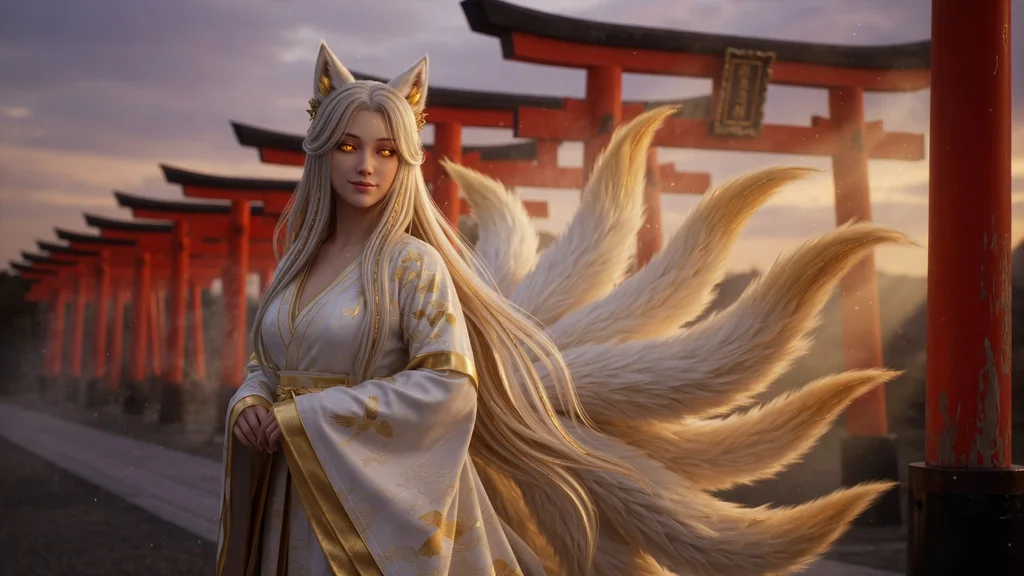
This kitsune name generator runs on a mechanic no other fox or shapeshifter generator uses: tails as an age-and-power scale. A kitsune grows roughly one tail per century, up to nine, and the number you pick actually changes what the generator hands you. Add a type — zenko, yako, or Inari's messenger — and a name form, since a kitsune living among humans usually carries two names: a fox-name, and the human alias it wears to pass as one of us.
👇 Click any name to copy it
Japanese fox-spirit folklore is old, well documented, and full of regional variation — this page tries to be honest about where sources agree and where they don't, rather than flattening centuries of storytelling into one tidy rulebook. Where a detail is genuinely contested or under-specified in the older tales, that's said outright instead of quietly picking a version and presenting it as settled fact.
Set the tails, type, and form filters, roll the count slider, and hit Generate. Click any card to copy the name straight to your clipboard.
How to Use This Kitsune Name Generator
Tails sets the kitsune's rough age and power tier, from a freshly awakened one-tail to a legendary nine-tailed kyūbi — leave it on Any to let the generator roll a random tier each time. Type picks the moral and spiritual alignment: Zenko for a benevolent, Inari-aligned fox, Yako for a wild and unaligned one, or Inari's Messenger for a zenko specifically bound to a shrine. Name form decides what you get back — the fox-name alone, the human alias alone, or both together, matched as a pair. Gender shapes the human-alias pool only; fox-names in this generator are deliberately not gendered, in keeping with a shapeshifter whose true form isn't fixed to begin with.
Nine Tails — Age and Power, Explained
The most widely cited version of kitsune aging works like this: a fox gains a tail roughly every hundred years, and nine tails is the ceiling — the point where, in most retellings, its fur turns white or gold and its power becomes close to limitless. It's a clean, memorable rule, which is probably part of why it's the version that survived into modern reference works, games, and fiction. It's worth saying plainly, though, that older folk tales are rarely this precise — a lot of them just call a fox "ancient" or "very old" and leave the arithmetic out entirely. Treat the century-per-tail rule as the standard, widely used convention rather than a law handed down from a single ur-text.
| Tails | Approx. age | What it means |
|---|---|---|
| 1 | ~100 years | Newly awakened — can hold small illusions but not much more |
| 2 | ~200 years | Can hold a human shape for hours without slipping |
| 3 | ~300 years | Skilled enough to fool most people outright |
| 4 | ~400 years | Confident, and starting to be known by name locally |
| 5 | ~500 years | Halfway to the ninth tail — respected by younger foxes |
| 6 | ~600 years | An elder in every practical sense |
| 7 | ~700 years | Powerful enough to influence weather and dreams |
| 8 | ~800 years | One tail from the legends people actually tell |
| 9 | ~900+ years | Kyūbi — fur turns white or gold, among the most powerful spirits in the mythology |
Zenko, Yako, and Inari's Messenger
Kitsune folklore doesn't describe one kind of fox spirit — it describes a spectrum, and the most common way to sort it is by intent and allegiance rather than by power. The three types below are the ones this generator supports, each with its own naming register.
| Type | Nature | Association |
|---|---|---|
| Zenko (善狐) | Good, heaven-aligned fox spirit | Usually in Inari's service |
| Yako (野狐) | Wild "field fox," also called nogitsune | No divine master — mischievous to genuinely dangerous |
| Inari's Messenger | A zenko bound directly to a specific shrine | Guards a torii gate, carries prayers to Inari |
Zenko — the Good Fox
Zenko literally means "good fox." These are the kitsune most associated with fortune rather than trickery — protective, occasionally strict, and generally working in a household or shrine's favor rather than against it. In folklore they're the fox you'd want to find living under your porch, not the one you'd want to cross.
Yako — the Wild Fox
Yako, or nogitsune ("field fox"), answer to nothing and no one. This is the type behind most of the folklore's darker material — kitsune-tsuki, fox possession, is almost always attributed to a yako rather than a zenko. That said, "yako" doesn't automatically mean "evil" in every source; plenty of tales give a yako motives closer to trickster mischief than genuine malice. The type is a spectrum, not a strict villain flag.
Inari's Messenger — the Shrine Guardian
A specific, especially visible flavor of zenko: a fox permanently bound to one shrine, standing guard at its torii and carrying prayers to Inari Ōkami. This is the role behind the fox statues (kitsune-zō) you'll see at Inari shrines across Japan — most famously the thousands of vermillion torii lining the paths of Fushimi Inari Taisha in Kyoto. This generator's "messenger" names use an honorific "O-" convention as a stylistic nod to that reverence, not a literal transcription of any specific shrine's real fox names.
Two Names — Fox Name and Human Guise
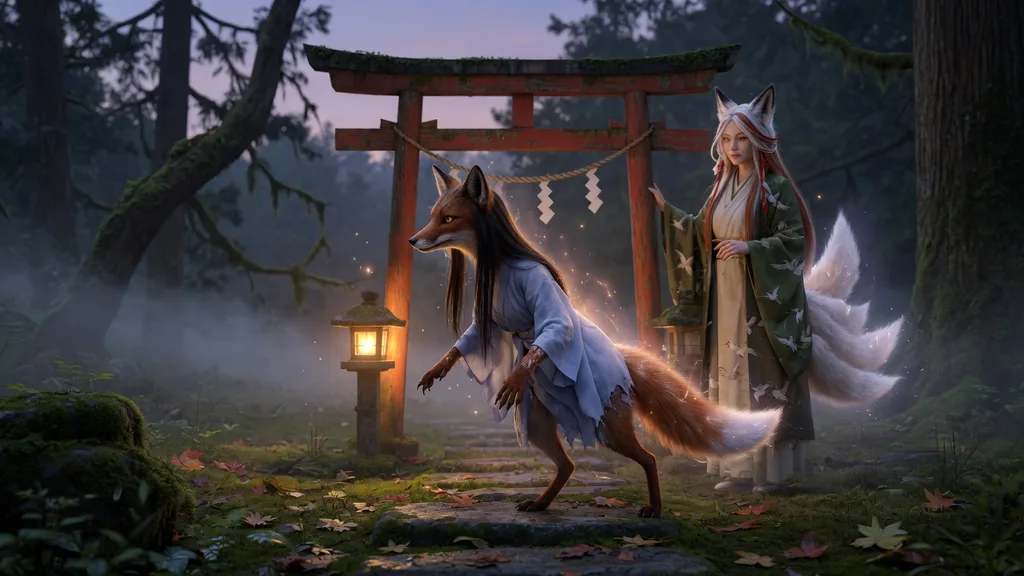
Shapeshifting into human form is one of the most consistent abilities in kitsune folklore, and it comes with a real narrative consequence: a kitsune that lives among people needs a name people won't question. Japanese folklore has entire stories built on exactly this double identity, and the clearest is the Heian-era legend of Kuzunoha — a fox spirit who marries a human man, lives for years as his wife and the mother of his child under a human name, and is only discovered when a moment's forgetfulness reveals her tail. She has to leave once her nature is known, and — in the version most often told — the child she leaves behind grows up to become Abe no Seimei, one of the most famous onmyōji (diviners) in Japanese legend.
That's the mechanic this generator's name form filter is built around. Set it to Fox name for the identity the kitsune actually is. Set it to Human alias for the identity it wears to pass unnoticed. Set it to Both to get a matched pair — the fox-name for your own notes, the human alias for what every other character in the story actually calls this person.
This isn't the only shapeshifter tradition built around a double name — for a British and Irish take on a related idea, where knowing a creature's true name grants power over it rather than just concealing an identity, see our fae name generator. Werewolves run a structurally similar split too, human alias against beast name, but through an entirely different folklore lineage — see the werewolf name generator for that version.
Kitsune and Inari — the Shrine Connection
Inari Ōkami is the Shinto deity of rice, agriculture, fertility, and worldly success — one of the most widely venerated kami in Japan, with tens of thousands of shrines dedicated to it. Foxes are Inari's messengers and guardians, which is why fox statues flank the approach to nearly every Inari shrine, usually carrying a symbolic object in their mouths: a key, a jewel, a sheaf of rice, or a scroll. It's worth being precise here: the foxes are traditionally understood as Inari's servants and messengers, not as Inari itself, though the two get conflated often enough in casual retellings that some shrine foxes are simply called "Inari foxes" as shorthand.
Not every kitsune is tied to Inari — that connection specifically belongs to zenko and, more narrowly, to the messenger type this generator lets you filter for directly. A yako running loose in the fields has no shrine and no master.
The Hoshi no Tama — a Kitsune's Star Ball
One of the more distinctive motifs in kitsune folklore and art is the hoshi no tama — literally "star ball" — a small luminous orb said to hold part of a kitsune's spiritual power. It shows up more in visual folk art and later Noh theater than as a fixed plot device in one canonical myth, but the underlying idea recurs across sources: separated from its tama, a kitsune is weakened, and some tellings say it can't hold human form at all without it. It's a useful detail for fiction and games specifically because it's a concrete, physical object — a maguffin folklore already handed you, rather than one you'd have to invent from scratch.
Famous Kitsune in Folklore and Fiction
Centuries of Japanese storytelling have left plenty of named kitsune worth knowing as reference points. None of the names below appear anywhere in this generator's output pools — they're too specific to particular stories to hand out as random results.
| Name | Source | Note |
|---|---|---|
| Kuzunoha | Heian-era legend, later Bunraku and Kabuki plays | Lives as a human wife under an assumed name; her son becomes the famed onmyōji Abe no Seimei |
| Tamamo-no-Mae | Muromachi-era legend, later Noh theater | A nine-tailed fox disguised as an imperial courtesan; tied to the legend of the Sessho-seki ("killing stone") |
| Genkurō | Kabuki/puppet play Yoshitsune Senbon Zakura | A fox who disguises himself as a drummer to stay near a drum made from his parents' hide — theater tradition, not older folklore |
| Inari's messenger foxes | Shinto shrine tradition, nationwide | The zenko/messenger foxes represented by kitsune-zō statues at Inari shrines |
It's worth noting Tamamo-no-Mae's story doesn't start in Japan — versions of a malevolent nine-tailed fox tied to a corrupted royal court appear earlier in Chinese and Indian legend before the tale took its Japanese shape, which is a good reminder that fox-spirit folklore travelled across East Asia rather than developing in total isolation in any one country.
Kitsune vs. Other Fox and Shapeshifter Traditions
"Fox spirit" and "shapeshifter" both cover a lot of ground across world folklore. Here's where kitsune sits relative to the other traditions covered on this site.
| Tradition | Origin | Core trait | Generator |
|---|---|---|---|
| Kitsune | Japanese folklore | Fox spirit; tails as age/power; fox-name vs. human alias | This page |
| Real Japanese names | Modern and historical Japan | Actual given names and surnames people carry, with kanji meanings | Japanese name generator |
| Fae | British/Irish folklore | Otherworld beings; true-name-grants-power mechanic; courts | Fae name generator |
| Werewolf | European folklore and modern fiction | Human-to-beast curse; beast name vs. human alias | Werewolf name generator |
| Demon | Invented fantasy phonetics, no single mythology | Infernal hierarchy for D&D fiends and dark fantasy villains | Demon name generator |
The clearest lines: a kitsune is specifically a Japanese fox spirit whose power is measured in tails and whose central tension is living undetected among people. A fae creature's danger is about its true name being spoken by someone else — a different kind of vulnerability than a kitsune's disguise slipping. A werewolf carries a curse, not a chosen shapeshifting gift, and the human/beast split is usually involuntary rather than a disguise the character controls. A demon in the sense this site uses the word isn't a folklore tradition at all — it's an invented fantasy-hierarchy naming style built for D&D and dark fantasy, distinct from any single real mythology, including the loose English habit of calling dangerous yako "fox demons." And plain Japanese names are just that — real names real people carry, with no folklore attached, which is exactly why they're handled on a separate page rather than folded into this one.
Tips for Naming a Kitsune Character
- Decide the tail count before the name. A one-tail kitsune and a nine-tail kyūbi should feel like different characters, not the same character with a bigger number attached. Let the age tier inform tone, not just the badge.
- Commit to zenko or yako — don't split the difference. A fox that's vaguely good and vaguely wild reads as indecisive. Pick an allegiance and let it shape the character's choices, not just their name.
- Use both names on purpose. A kitsune with only a fox-name reads as a monster. A kitsune with only a human alias reads as a person with a secret power. A kitsune with both, held in tension, reads as a character with something real to lose.
- Match the name form to the scene. Reveal the fox-name at the moment the disguise fails — that's the Kuzunoha structure, and it still works because the mechanic is doing real narrative labor, not just decoration.
- Don't over-explain the hoshi no tama. Folklore treats it as a given, physical fact, not a magic system with rules to spell out. Use it as a plot object, not a lecture.
- Say the name aloud in both forms. The fox-name should sound a little other — not alien, just not quite the kind of name a human parent would choose. The human alias should sound completely ordinary. If they sound the same, the disguise isn't doing its job.
- Naming more than one kitsune? A single fox-name is easy; a believable population of them is harder. Our guide to consistent names for a culture walks through locking a sound inventory and a structural skeleton so a whole fox-shrine's worth of names reads as one tradition, not fifty random rolls.
Example Kitsune Names
Handpicked combinations pulled from the generator's own pools — fox-names first, then a sample of human aliases.
Zenko Fox Names
- Shiromaru
- Ginzen
- Terukage
- Akihime
- Suzumori
- Tamakitsu
Yako Fox Names
- Kurokage
- Akakiba
- Moriyami
- Tsumekaze
- Nogitsu
- Arashiko
Inari's Messenger Names
- Oinemaru
- Otamako
- Okuramaru
- Oginji
- Osuzuko
- Oyashiro
Human Aliases
- Kenzo
- Ryusuke
- Kohana
- Chiyoko
- Setsuko
- Michiko
Kitsune is also a playable ancestry in Pathfinder 2e, set in the Golarion world rather than Japanese folklore directly — see the Pathfinder Name Generator for that Tian Xia-flavored version and its human-alias mechanic.
FAQ for Kitsune Name Generator
How many tails does a kitsune have, and what do the tails mean?
In the most widely cited version of the folklore, a kitsune grows roughly one tail per century of life, up to a maximum of nine. A one-tailed fox is already about a hundred years old; a nine-tailed kitsune (kyūbi no kitsune) is a spirit of immense age and power, and its fur is often said to turn white or gold once the ninth tail grows in. This rate isn't stated with the same precision in every source — plenty of older tales just say 'ancient' or 'very old' without doing the math — but the one-tail-per-century rule is the version most retellings and reference works use, and it's the one this generator's tail filter is built on.
What's the difference between zenko and yako kitsune?
Zenko (善狐, 'good fox') are benevolent, heaven-aligned kitsune, most often described as being in the service of Inari, the Shinto deity of rice, agriculture, and prosperity. Yako (野狐, 'field fox,' also called nogitsune) have no divine master — they're wild, unaligned, and range from harmlessly mischievous to genuinely dangerous, showing up in folklore connected to kitsune-tsuki (fox possession). The split isn't the only way folklore sorts kitsune, and some regional traditions blur the line entirely, but it's the most commonly cited framework, which is why this generator uses it as a filter.
Why do kitsune have two names in this generator?
Because shapeshifting into human form is one of the kitsune's core, most consistently told abilities, and Japanese folklore has real stories built on exactly that double identity. The Heian-era legend of Kuzunoha is the clearest example: a fox spirit lives for years as a human wife and mother under a human name before her true nature is discovered and she has to leave. This generator gives every result a fox-name and, on request, a separate human alias — the identity that kitsune wears while it's passing as one of us.
What is a kitsune's connection to Inari?
Inari Ōkami is the Shinto deity of rice, fertility, and worldly success, and foxes are Inari's messengers and guardians — the reason fox statues (kitsune-zō) line the approach to Inari shrines across Japan, most famously the thousands of vermillion torii at Fushimi Inari Taisha in Kyoto. Not every kitsune serves Inari — that's specifically the zenko and messenger types — but the association is old, real, and central enough to the mythology that this generator gives it its own filter option.
What is a hoshi no tama?
Literally 'star ball' — a small, luminous orb some folklore and folk art traditions say a kitsune carries and in which part of its spiritual power resides. Losing it, or having it stolen, is a real folkloric vulnerability: a kitsune separated from its hoshi no tama is said to be weakened or unable to hold a human shape. It shows up in art and later Noh theater more than in a single canonical myth, so treat it as a well-attested motif rather than a universally fixed rule.
Are kitsune the same as Korean gumiho or Chinese huli jing?
Related, but not the same tradition. Japanese kitsune, Korean gumiho, and Chinese huli jing (fox spirits, sometimes nine-tailed) share a common East Asian root in fox-spirit folklore that traveled and diverged across regions and centuries. Each developed its own tone and rules — gumiho, for instance, leans much darker and more consistently predatory in most retellings than the zenko/yako split in Japanese tradition. This generator sticks to the Japanese kitsune tradition specifically, rather than blending the three.
Can I use these names in D&D or other tabletop RPGs?
Yes. Kitsune are an official playable race in several D&D 5e sourcebooks and third-party supplements, and they're a natural fit for any setting with a shapeshifter or fey-adjacent race. Use the tails filter to set an NPC's approximate power level at a glance — a 1-2 tail kitsune reads as a minor encounter, a 9-tail kyūbi reads as a setting-defining figure — and the human-alias form when the character needs to pass as human for part of the story.
Where can I use the Kitsune Name Generator?
Anywhere you need a fox spirit with real mythology behind it: D&D and Pathfinder NPCs, anime-inspired original characters, portal fantasy and urban fantasy fiction, tabletop one-shots set in or near Japan, or a username with more history behind it than a random word generator. Every name is an original combination built for this generator, not a name pulled from a specific book, game, or shrine record.
Is 'kitsune' just the Japanese word for fox?
Yes, and that ambiguity is real and intentional in the language. Kitsune (狐) is simply the ordinary Japanese word for fox — the word doesn't distinguish an everyday animal from a centuries-old shapeshifting spirit. Folklore handles that distinction with context and behavior instead: an unusually clever, oddly persistent, or clearly supernatural fox is understood to be kitsune in the mythological sense, while a fox that's just a fox is kitsune in the plain zoological sense.