
Names That Mean Shadow
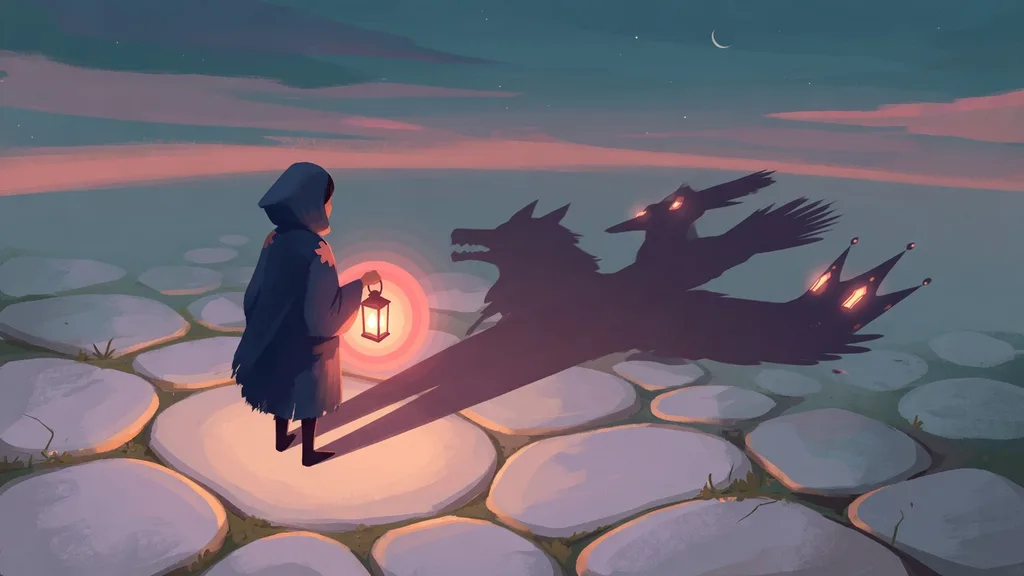
Real etymologies, not vibes: names meaning shadow, darkness and night across Greek, Norse, Japanese, Arabic and more — and a list of the ones every other site gets wrong.
Shadow, darkness and night are not the same word
Almost every list of shadow names treats four different ideas as one. A cast shadow, the dark it falls into, the night as a stretch of time, and the colour black are separate words in every language here, and they were separate ideas to the people who coined the names. Greek has skia for the shape on the ground and erebos for the gloom beneath the world. Japanese has kage 影 for a silhouette and yami 闇 for darkness with a moral edge to it. Arabic has zill for the shadow of a body and layl for the night.
That distinction is not pedantry when you are naming a character. A shadow needs a source, so a shadow name implies something the character follows, doubles or escapes. Darkness is an absence, which reads as void, ignorance or grief. Night is a time of day, and night names come out gentler than either of the other two: Layla and Nótt are not sinister names, whatever a list of gothic baby names might suggest. Every entry below is tagged with the sense it actually carries.
The other thing worth knowing before you scroll: a large group of names people file under shadow only ever meant dark-haired. Ciara, Ciarán, Donovan and their relatives describe a person's colouring, the way Blondie or Rousseau do. They are good names. They are not shadow names, and they are listed here as what they are.
Greek names that mean shadow
Greek separates the shadow itself from the dark it belongs to. Skia is the cast shadow, the shape on the ground; Erebos is the deep gloom between the living world and Hades; Nyx is night as a goddess old enough that Zeus was wary of her. Names from this group carry weight, which is why so much fantasy borrows them.
| Name | Used for | Literally | Where it comes from |
|---|---|---|---|
| Nyx Νύξ NIKS | female | “night” night | Greek νύξ (nyx), 'night', from the same Indo-European root as Latin nox and English night. In Hesiod's Theogony Nyx is a primordial goddess born of Chaos, mother of Hypnos (Sleep) and Thanatos (Death); Zeus himself is said to fear her. On a character: One syllable, hard consonants, instantly readable as a night power — works for a sorceress, an assassin, or a starship. |
| Erebus Ἔρεβος EH-ruh-bus | male | “deep darkness, the gloom of the underworld” darkness | Greek Ἔρεβος (Erebos), sometimes linked to Hebrew erev 'evening', though that connection is a disputed wandering root rather than an established cognate. In Hesiod, Erebos is the primordial personification of the darkness between the earth and Hades, and consort of Nyx. On a character: The heavyweight of the set: an underworld god's name, not a person's. Suits a demon lord or a black hole. |
| Achlys Ἀχλύς AK-lis | female | “mist, the death-mist that clouds a dying person's eyes” darkness | Greek ἀχλύς, the mist Homer repeatedly says is 'shed' over the eyes of a dying warrior. In the pseudo-Hesiodic Shield of Heracles she appears as a gaunt daimon of misery. Strictly it is 'mist/dimness', not 'shadow' — an important distinction. On a character: Reads as plague, poison, and slow decay rather than clean darkness. |
| Orphne Ὄρφνη ORF-nee | female | “the darkness of night, murk” darkness | From Greek ὄρφνη 'darkness, night-gloom'. Orphne is a nymph of the underworld, mother of Ascalaphus by the river Acheron; she is sometimes identified with Gorgyra and with Nyx. Genuinely obscure and genuinely attested — a rare combination. On a character: Soft-sounding for its meaning; good for a quiet, unsettling character. |
| Melaina Μέλαινα meh-LY-nuh | female | “black (feminine of melas)” black | Feminine of Greek μέλας 'black'. Used as a cult epithet: Demeter Melaina, 'Black Demeter', worshipped at Phigalia in Arcadia, where the goddess withdrew into a cave in mourning. Also the name of a nymph in Pausanias. |
| Melania meh-LAH-nee-uh | female | “blackness, darkness (from melas, 'black')” black | From Greek μελανία 'blackness'. Borne by two Roman saints, Melania the Elder and Melania the Younger (4th–5th c.). Same root as melanin and melancholy — literally 'black bile'. |
| Melanthe Μελάνθη meh-LAN-thee | female | “dark flower” black | Greek μέλας 'black' + ἄνθος 'flower'. The masculine Melanthios/Melanthius appears in the Odyssey as the goatherd who betrays Odysseus. |
| Celaeno Κελαινώ seh-LEE-noh | female | “the dark one, the black one” black | From Greek κελαινός 'black, murky, sombre'. Two mythological bearers: one of the Pleiades (a genuinely faint star in the cluster) and one of the Harpies, who in the Aeneid prophesies famine to Aeneas. On a character: Storm-and-omen flavour; strong for a harbinger or a witch. |
| Melanippe Μελανίππη meh-luh-NIP-ee | female | “black mare” black | Greek μέλας 'black' + ἵππος 'horse'. The name of an Amazon in several myths and of the heroine of two lost Euripides tragedies. Note it is 'black horse', not 'shadow' — the horse element is the whole second half of the name. |
| Skia σκιά SKEE-ah | female | “shadow, shade; the shade of a dead person” shadow | This is the plain Greek noun σκιά 'shadow' — the word behind English skiagraphy and, indirectly, Skiathos. Be honest about it: it is not an attested ancient personal name, it is a modern coinage from a real word, the way English 'Shadow' is. On a character: Clean and usable as a codename or an alias. |
| Hades Ἅιδης HAY-deez | male | “the unseen one (traditional derivation)” underworld | Usually explained as ἀ- 'not' + ἰδεῖν 'to see', i.e. 'the unseen'; this derivation is ancient but linguistically contested and the true etymology is unknown. Hades is the god of the dead and, by extension, his realm — the name never meant 'hell' in the Christian sense. |
Latin names that mean shadow
Latin gives us the vocabulary the rest of Europe still uses: umbra for shade, nox for night, caligo for a thick murk. These read formal and cold on a character, and they sit naturally in Gothic, academic or ecclesiastical settings.
| Name | Used for | Literally | Where it comes from |
|---|---|---|---|
| Nox NOKS | female | “night” night | Latin nox, noctis 'night' — the Roman counterpart of Greek Nyx, and the source of nocturnal, equinox and midnight. Used by Roman poets as a divine personification rather than as a woman's name. On a character: Blunt and modern-sounding despite being ancient; heavy use in games and comics. |
| Umbra UM-bruh | female | “shadow, shade” shadow | The Latin noun umbra 'shadow' — source of umbrella ('little shade'), umbrage and penumbra. It was a common noun and, in poetry, a word for a ghost; it is not attested as a Roman personal name, so treat it as a modern coinage from a real word. On a character: The default 'shadow name' in fantasy for a reason — nothing else is this direct in a European language. |
| Caligo kuh-LEE-goh | unisex | “fog, murk, gloom; dimness of sight” darkness | Latin caligo, caliginis 'thick darkness, mist' — the root of caliginous. A real Latin word, not a Roman name. Do not connect it to the emperor Caligula, whose nickname comes instead from caliga, an army boot. |
| Nigella ny-JEL-uh | female | “little black one” black | Feminine diminutive of Latin niger 'black'. Used as a medieval given name and later as the botanical name of love-in-a-mist, whose seeds (nigella / black cumin) are jet black. |
| Niger NY-jer | male | “black” black | A genuine Roman cognomen meaning 'black, dark' — borne by the emperor Pescennius Niger and by Simeon called Niger in Acts 13:1. Included for etymological completeness; in modern English it is effectively unusable. |
| Fusca FUS-kuh | female | “dark, dusky, swarthy” darkness | Feminine of the Roman cognomen Fuscus, from fuscus 'dark-coloured, dusky' — the root of obfuscate, literally 'to darken'. Attested as a real Roman name, unlike Umbra or Caligo. |
| Vesper VES-per | unisex | “evening; the evening star” dusk / twilight | Latin vesper 'evening', cognate with Greek hesperos. It names the evening star (Venus) and gave English vespers, the evening office. Strictly dusk, not darkness — the light is fading, not gone. On a character: Best-known modern bearer is Vesper Lynd in Casino Royale; reads elegant rather than sinister. |
| Maurus MOR-us | male | “Moorish; dark-skinned” black | Latin Maurus 'a Moor, a North African', which came to be used of anyone dark-complexioned; the source of Maurice, Morris, Mauro and Maurizio. So Maurice literally means 'dark-skinned', not 'shadow' — a meaning most name sites soften into 'dark'. |
| Corvus KOR-vus | male | “raven” black | Latin corvus 'raven', a real Roman cognomen — Marcus Valerius Corvus was a 4th-c. BC consul said to have fought with a raven on his helmet. It means the bird, not blackness or shadow; the dark association is entirely by way of the raven's plumage. On a character: Reads as a house name or a callsign; also a constellation. |
Old Norse names that mean shadow
Old Norse names for darkness come mostly from cosmology rather than description. Night is a person, Nótt, who rides across the sky before her son the day. Names in this group tend to be short, hard-edged, and immediately readable as Norse.
| Name | Used for | Literally | Where it comes from |
|---|---|---|---|
| Nótt Nótt NOHT | female | “night” night | Old Norse nótt 'night', cognate with nox and nyx. In the Prose Edda, Nótt is a jötunn, daughter of Nörvi, who rides across the sky on the horse Hrímfaxi ahead of her son Dagr (Day). |
| Nörvi Nǫrvi NUR-vee | male | “uncertain; possibly 'narrow' or 'constrictor'” night | The jötunn father of Nótt (Night) in Snorri's Edda, also spelled Narfi or Nörr. Included for the night connection through his daughter — the name's own etymology is genuinely unresolved, and any site giving it a confident 'darkness' gloss is guessing. |
| Hel Hel HEL | female | “the hidden, the concealed place” underworld | From a Proto-Germanic root *haljō 'concealed place', related to the verb 'to hide' (compare English hull, hall, and to conceal). Hel is Loki's daughter and ruler of the realm of the dead that shares her name; English 'hell' is the same word. |
| Skaði Skaði SKAH-thee | female | “contested: 'harm' or 'shadow'” shadow | Two rival etymologies, and honest sources say so: either Old Norse skaði 'harm, damage' (from Proto-Germanic *skaþô), or the separate Germanic root behind Gothic skadus and Old English sceadu, both 'shadow'. The 'shadow' reading is a real scholarly proposal, not a blog invention, but it is not settled. Skaði is the ski-going jötunn goddess of winter and hunting. On a character: Snow, bow, vengeance — she is the winter half of the shadow theme. |
| Svartr Svartr SVART | male | “black” black | Old Norse svartr 'black', the same element in Svartálfar ('black elves') and Svartálfheimr. Attested as a byname for dark-haired or dark-complexioned men; the modern Scandinavian surname Svart continues it. |
| Kolr Kolr KOL | male | “coal, charcoal” black | Old Norse kol 'coal', used as a personal name and byname for a black-haired man; it stands behind Kolbeinn and a range of Scandinavian surnames. 'Coal-black', not 'shadow'. |
Japanese names that mean shadow
Japanese distinguishes carefully. Kage 影 is the shadow or silhouette a body casts; yami 闇 is darkness as an absence of light, with a moral shading; yoru 夜 is simply night. Anime and manga lean heavily on the first two, which is why some of these read as fiction names rather than everyday ones — each entry says which is which.
| Name | Used for | Literally | Where it comes from |
|---|---|---|---|
| Kage 影 KAH-geh | unisex | “shadow; silhouette; also 'light, reflection' in older usage” shadow | The ordinary Japanese noun 影 kage 'shadow'. It is essentially never given to a child; it lives in compounds (kagemusha 影武者 'shadow warrior', a body double) and in fiction. Note the old semantic range: in classical Japanese kage could also mean the light that casts the shadow, as in tsukikage 月影 'moonlight'. On a character: The single most on-the-nose ninja/anime shadow name. |
| Yami 闇 YAH-mee | unisex | “darkness, the dark” darkness | The noun 闇 yami 'darkness'. Real Japanese parents do not register this kanji for a child — it is too ominous — so treat Yami as a fiction/anime name, not a given name. (Yami Yugi of Yu-Gi-Oh! is where most English speakers meet it.) |
| Yoru 夜 YOH-roo | unisex | “night” night | 夜 'night', read yoru on its own and ya/ yo in compounds. As a standalone given name it is rare and modern; the kanji is far more common inside names and surnames than by itself. Yakou 夜行 'night-travelling' and yoake 夜明け 'dawn' use the same character. |
| Yoi 宵 YOH-ee | female | “early evening, nightfall” dusk / twilight | 宵 yoi is the specific word for the first part of the night, the hours just after dark — a genuinely used, gentler name element than 闇 or 夜, appearing in words like yoiyami 宵闇 'evening dusk'. |
| Kuro 黒 KOO-roh | unisex | “black” black | 黒 kuro 'black'. Not a given name — it functions as a name element and a nickname (typically for a black animal), and as the first half of surnames like Kurosawa 黒沢 and Kuroki 黒木. The adjective form is kuroi; 'Kurai' 暗い, which some lists give as a name, is a different word meaning 'dark' and is not a name at all. |
| Kuroki 黒木 koo-ROH-kee | unisex | “black tree” black | A real Japanese surname (黒 'black' + 木 'tree'), common in Kyushu. Included because Western readers meet it as a character name; as a personal name in Japan it is a family name, not a given one. |
Celtic and Gaelic names that mean shadow
Irish and Scottish Gaelic build a large family of names on one root: dubh, black, and ciar, dark. Almost all of them originally described hair or complexion rather than shadow. That is worth knowing before you attach one to a character who lives in the dark.
| Name | Used for | Literally | Where it comes from |
|---|---|---|---|
| Ciar KEER | male | “black, dark” black | Old Irish ciar 'black, dark'. In legend Ciar was a son of Fergus mac Róich and Medb and ancestor of the Ciarraige, the people who gave County Kerry its name. This is the root behind the whole Ciarán/Ciara family. |
| Ciarán Ciarán KEER-awn | male | “little dark one, little black-haired one” black | Ciar 'black' plus the diminutive -án, so literally 'little dark one' — a description of hair or complexion, not of shadow. Two of the Twelve Apostles of Ireland bore it: Ciarán of Saighir and Ciarán of Clonmacnoise. Anglicised Kieran, Kieron, Ciaran. |
| Ciara Ciara KEER-uh | female | “dark-haired, black” black | Feminine of Ciar/Ciarán; Saint Ciara was a 7th-century Irish abbess. Worth being precise: it means 'dark' of hair and complexion. The spelling Kiera/Keira is an English respelling, and Keira Knightley's name comes from this root. |
| Dubhán Dubhán DOO-vawn | male | “little black one” black | Irish dubh 'black' plus diminutive -án; Saint Dubhán founded a monastery at Hook Head in the 5th century. Anglicised as Duane and Dwayne, via the surname Ó Dubháin — so Dwayne literally means 'descendant of the little dark one'. |
| Donovan DON-uh-vuhn | male | “little dark brown one” black | From Ó Donndubháin, 'descendant of Donndubhán', a name built from donn 'brown' + dubh 'black' + the diminutive -án. So the colour is specifically dark brown hair, not shadow — a detail most baby-name pages drop. |
| Doyle DOYL | male | “dark stranger” black | From Ó Dubhghaill, 'descendant of Dubhghall', from dubh 'black' + gall 'foreigner'. The Irish used dubhghall for the Danish Vikings and finngall ('fair foreigner') for the Norwegians, so the name encodes a real ninth-century distinction. Dougal and MacDougall come from the same word. |
| Douglas DUG-lus | male | “black stream” black | Scottish Gaelic dubh 'black' + glas 'stream, water' — originally a river name in Lanarkshire, then a great Scottish family name. The 'black' is the peat-dark colour of the water. |
| Delaney duh-LAY-nee | female | “descendant of the dark challenger” black | From Ó Dubhshláine: dubh 'black' + Sláine, either a personal name or the river Sláine. The 'dark' element is real and is the first half of the name, though the second half is disputed between 'challenger' and the river. |
| Morrigan Mórrígan MOR-ee-gun | female | “contested: 'phantom queen' or 'great queen'” underworld | Irish; the second element rígan 'queen' is certain, the first is not. Mór- would give 'great queen'; Mor- from Old Irish mor 'phantom, nightmare' (cognate with the -mare of nightmare) gives 'phantom queen', which is the reading most modern scholars prefer. She is the war and death goddess who appears as a crow over the battlefield. On a character: Crow, prophecy, battlefield — the closest Irish myth comes to a shadow deity. |
Arabic names that mean shadow
Arabic makes the same distinction Greek does. Zill (ظل) is the shadow that falls from a body, and layl (ليل) is night. Layla is one of the oldest and most widely used names in this whole list, and the beloved of the Layla and Majnun story most people have met through the poem or the song.
| Name | Used for | Literally | Where it comes from |
|---|---|---|---|
| Layla ليلى LAY-luh | female | “night” night | Arabic ليلى, from layl 'night'; classically it suggests the darkest night of the month. The 7th-century poet Qays went mad for Layla, becoming Majnun Layla, the story that reached the West through Nizami and, eventually, Eric Clapton. |
| Layal ليال lay-YAAL | female | “nights (plural of layl)” night | The broken plural of layl 'night', used as a feminine given name mainly in the Levant. Distinct from Layla, though the two are constantly conflated in English lists. |
| Zilal ظلال zi-LAAL | male | “shadows, shades (plural of zill)” shadow | Arabic ظلال, plural of ظل zill 'shadow, shade'. Sayyid Qutb's famous Qur'an commentary is Fi Zilal al-Qur'an, 'In the Shade of the Qur'an'. Note the cultural weight: in Arabic, being in someone's zill means being under their protection, so the word reads as shelter as much as darkness. |
| Duja دجى DOO-jah | female | “the darkness of night” darkness | Arabic دجى duja 'darkness, gloom of night' (also transliterated Douja, Dhuja). Best known from the compound epithet badr ad-duja, 'full moon of the dark night'. Used as a feminine name chiefly in the Maghreb and sometimes as a hypocorism for Khadija. |
| Sawda سودة SOW-dah | female | “black (feminine of aswad)” black | From the root s-w-d 'to be black'. Sawda bint Zam'a was a wife of the Prophet Muhammad, which keeps the name in use across the Muslim world. |
| Aswad أسود AS-wad | male | “black” black | The masculine colour adjective 'black', used historically as a byname — al-Aswad. The same root gives the Hajar al-Aswad, the Black Stone of the Kaaba. |
Hebrew names that mean shadow
Hebrew shadow names come from tsel (צל), shade or shadow, and they often carry a protective sense rather than a sinister one: the shadow of a hand or a wing is shelter from the sun, not a threat.
| Name | Used for | Literally | Where it comes from |
|---|---|---|---|
| Zillah צִלָּה ZIL-uh | female | “shade, shadow” shadow | Hebrew צִלָּה Tsillah, from צֵל tsel 'shadow', root צלל 'to grow dark'. She is one of Lamech's two wives in Genesis 4:19 and the mother of Tubal-cain, the first smith. This is the oldest genuinely attested personal name in any language that plainly means 'shadow'. On a character: Biblical weight plus a literal shadow meaning — the strongest 'real name' option on this page. |
| Lailah לַיְלָה LY-luh | female | “night” night | Hebrew לַיְלָה laylah 'night', a cognate of Arabic layl rather than a borrowing from it. In Talmudic and later Jewish tradition Lailah is the angel of conception who watches over a soul as it enters the world. Spelled Laila, Leila and Lilah in English. |
| Lilith לִילִית LIL-ith | female | “night-spirit — but from Akkadian lilitu, a wind demon, not from Hebrew 'night'” night | The correction worth reading: Lilith is not built on Hebrew laylah 'night'. It comes from Akkadian lilitu, a class of storm or wind demon, from lil 'air, wind'. Hebrew speakers later heard laylah in it, and the folk etymology stuck so hard that 'night' is now the standard gloss. She appears once in the Bible (Isaiah 34:14) and becomes Adam's first wife in the medieval Alphabet of Ben Sira. On a character: Carries more accumulated myth than any other name here. |
| Kedar קֵדָר KEE-dar | male | “dark, swarthy” black | From the Hebrew root קדר qadar 'to be dark, to mourn'. Kedar is a son of Ishmael (Genesis 25:13) and the ancestor of a north Arabian tribe; the Song of Songs 1:5 has 'I am black, like the tents of Kedar', which are woven from black goat hair. |
Sanskrit names that mean shadow
Sanskrit has one of the strongest shadow figures in any mythology. Chhaya is the shadow Saranyu left behind in her place when she could no longer bear her husband Surya, the sun — and the substitute lived as his wife without being noticed. Names in this group tend to mean the shadow as a being rather than as a phenomenon.
| Name | Used for | Literally | Where it comes from |
|---|---|---|---|
| Chhaya छाया CHAH-yah | female | “shadow, shade, reflection” shadow | Sanskrit छाया 'shadow'. In Hindu myth Chhaya is literally a shadow made flesh: Saranyu, unable to bear Surya's heat, creates a shadow-double of herself and leaves it in her place. Chhaya becomes the mother of Shani (Saturn). A real, currently used Indian given name that genuinely means shadow. On a character: A doppelgänger origin story built into the name. |
| Ratri रात्रि RAH-tree | female | “night” night | Sanskrit रात्रि 'night'. Ratri is the goddess of night in the Rigveda, addressed in a hymn (10.127) as a benevolent star-filled presence who is asked to keep the wolf and the thief away — not a sinister figure. |
| Nisha निशा NEE-shah | female | “night” night | Sanskrit निशा 'night'. One of the most common modern Indian feminine names on this list — an ordinary, well-used name that happens to mean night outright. |
| Yamini यामिनी YAH-mi-nee | female | “night” night | Sanskrit यामिनी 'night', from yāma, a three-hour watch of the day. Nothing to do with Yama, the god of death, despite the resemblance — a distinction worth making since the two are often merged online. |
| Krishna कृष्ण KRISH-nuh | male | “black, dark, dark blue” black | Sanskrit कृष्ण 'black, dark'. The god's name is the colour word itself, which is why he is depicted dark blue or black. Draupadi is called Krishnaa, the feminine of the same adjective. |
| Shyam श्याम SHYAAM | male | “dark, dark blue, black” black | Sanskrit श्याम 'dark-coloured', an epithet of Krishna. The feminine Shyama is used both as a name and as an epithet of Kali. It denotes a colour, not shade or shadow. |
| Kali काली KAH-lee | female | “the black one (feminine of kala, 'black')” black | From Sanskrit काल kāla. Here is the trap: kāla is two words — 'black, dark' and 'time'. Kālī as the goddess's name is the feminine of the colour word, 'the black one', though the pun with 'time' is played on constantly in devotional literature and is why she is also read as the goddess of time and destruction. |
| Tamas तमस् TUH-mus | unisex | “darkness, gloom” darkness | Sanskrit तमस् 'darkness', and in Samkhya philosophy the guna of inertia and ignorance. It is a noun and a technical term rather than a given name in India. Do not confuse it with Hungarian Tamás, which is simply Thomas. |
Persian names that mean shadow
Persian keeps shab for night and sayeh for shadow, and both appear in classical poetry constantly. These names read lyrical rather than menacing.
| Name | Used for | Literally | Where it comes from |
|---|---|---|---|
| Sayeh سایه SAH-yeh | female | “shadow, shade” shadow | Persian سایه 'shadow'. A current Iranian feminine given name, and the pen name of the poet Houshang Ebtehaj, who published as H. E. Sayeh — 'Shadow'. As in Arabic, the word carries shelter and protection alongside darkness. |
| Shabdiz شبدیز shab-DEEZ | male | “night-coloured” night | Persian shab 'night' + dīz 'coloured'. Shabdiz was the black horse of the Sasanian king Khosrow II, famous in the Shahnameh and in the Khosrow and Shirin romance, and carved at Taq-e Bostan. A horse's name rather than a person's, but a genuine one. |
| Shabrang شبرنگ shab-RANG | unisex | “the colour of night; jet black” night | Persian shab 'night' + rang 'colour'. A real Persian epithet used for black horses and, poetically, for black hair. Note that plain 'Shab' on its own is a common noun and is not used as a Persian given name — only the compounds are. |
| Siyavash سیاوش see-yah-VASH | male | “one with black stallions” black | From Avestan Syāvaršan, from syāva 'black, dark' + a word for a stallion. The tragic prince of the Shahnameh who rides through fire to prove his innocence and is murdered in Turan; a widely used modern Iranian name. |
Slavic names that mean shadow
Slavic languages use forms of tma, mrak and noch — darkness, gloom, night. Many of these appear more often in folklore and literature than on birth certificates, and the entries say so where that is the case.
| Name | Used for | Literally | Where it comes from |
|---|---|---|---|
| Charna CHAR-nuh | female | “black, dark” black | A Yiddish feminine given name taken from the Slavic root čьrnъ 'black' (Polish czarna, Russian chornaya). It was a real Ashkenazi name, often paired as a translation-name with Hebrew Shifra or used for a dark-haired daughter. |
| Chernava Чернава cher-NAH-vah | female | “the black/dark one” black | From Proto-Slavic *čьrnъ 'black'. Chernava is the name of the river maiden whom Sadko marries at the bottom of the sea in the Novgorod bylina, and also a river name — the East Slavic pattern of naming dark water. |
| Chernobog Чернобог CHER-nuh-bog | male | “black god” black | *čьrnъ 'black' + *bogъ 'god'. Recorded once, by the 12th-century German chronicler Helmold, as a deity of the Polabian Slavs; how much of the later 'Slavic god of darkness' picture is genuine and how much is Christian framing is genuinely disputed. Most modern audiences know him from Fantasia's Night on Bald Mountain. |
| Czerny Czerny / Černý CHER-nee | male | “black” black | The most common surname in the Czech Republic in its Černý form, and widespread as Czarny, Cherney and Čierny. Originally a nickname for a dark-haired or dark-complexioned man — the Slavic equivalent of Black, Schwarz and Le Noir. |
Turkic names that mean shadow
Turkish has gölge for shadow, but it stays a common noun. The names that exist use kara, black, and gece, night — Kara in particular turns up everywhere as a name element and an epithet, and it is descriptive rather than ominous.
| Name | Used for | Literally | Where it comes from |
|---|---|---|---|
| Kara Kara kah-RAH | male | “black, dark” black | Turkish and Old Turkic kara 'black'. Enormously productive as a name element and Ottoman byname — Kara Mustafa Pasha, Karagöz ('black eye', the shadow-puppet hero), Karadeniz ('Black Sea'). As a byname it often meant 'brave' rather than literally dark. Unrelated to the Irish-derived English girls' name Kara/Cara, which is from Italian cara 'beloved'. |
| Gece Gece geh-JEH | female | “night” night | The Turkish noun gece 'night', used as a rare modern feminine given name. Turkish naming happily uses plain nouns this way, which is why it works where an English 'Night' would not. |
| Esmeray Esmeray es-meh-RYE | female | “dark moon” darkness | Turkish esmer 'dark, brown-skinned' + ay 'moon'. A genuine modern Turkish feminine name, borne by the singer Esmeray (1949–2002). |
Chinese names that mean shadow
Chinese yǐng 影 (shadow) and hēi 黑 (black) work as name elements rather than standalone given names. Where a form is mainly a fiction name, the entry says so.
| Name | Used for | Literally | Where it comes from |
|---|---|---|---|
| Ying 影 YING | unisex | “shadow, silhouette, reflection” shadow | 影 yǐng 'shadow' — the word in 电影 diànyǐng 'film' (literally 'electric shadows') and 皮影戏 'shadow-puppet play'. It is rare in real given names; when English speakers meet it as a name it is usually a wuxia or game character. Note that the far more common given-name Ying is a different character, 英 'flower, hero', or 颖 'clever'. |
| Xuan 玄 SHWEN | unisex | “dark, black; profound, mysterious” darkness | 玄 xuán means both 'black' and 'mysterious, abstruse' — the Daodejing uses it for the unfathomable depth of the Dao. It is a real and well-used given-name character, especially in Daoist contexts, and appears in Xuanwu 玄武, the Black Tortoise of the north. On a character: The one East Asian entry where 'dark' means profound rather than sinister. |
| Ye 夜 YEH | unisex | “night” night | 夜 yè 'night'. A rare surname and an uncommon given-name element; most Chinese people named Ye have 叶 'leaf' or 業/业 instead. Common in fiction — the wuxia and xianxia genres love 夜 for clan and character names. |
| Hei 黑 HAY | unisex | “black” black | 黑 hēi 'black'. Say this plainly: it is not a Chinese given name. It is a rare surname and a normal adjective, and Western lists that present 'Hei' as a Chinese name meaning black are generalising from Darker than Black's protagonist. |
| Mo 墨 MOH | unisex | “ink; ink-black” black | 墨 mò 'ink', hence 'black' by extension. A genuine, if uncommon, Chinese surname — the philosopher Mozi 墨子 founded Mohism — and a frequent choice for scholarly or brooding characters in fiction. |
Korean names that mean shadow
Korean given names are usually built from two syllable-blocks written in hanja, so a shadow or night element combines with something else. These entries note the element rather than pretending it is a whole name.
| Name | Used for | Literally | Where it comes from |
|---|---|---|---|
| Hyeon 현 玄 HYUN | unisex | “dark, black; profound, mysterious” darkness | The hanja 玄, read hyeon in Korean, is a real Korean surname (Hyun) with exactly this meaning, and appears in given names. Important caveat: the syllable hyeon is far more often written with other hanja — 賢 'wise', 顯 'manifest', 鉉 — so a Korean named Hyeon almost certainly does not mean 'dark'. Only the 玄 spelling does. |
African names that mean shadow
Names here come from several unrelated languages, so each entry names the specific language rather than the continent.
| Name | Used for | Literally | Where it comes from |
|---|---|---|---|
| Mthunzi m-TOON-zee | male | “shade, shadow” shadow | Zulu and Xhosa umthunzi 'shade, shadow'. A current South African masculine given name — the singer Mthunzi and the actor Mthunzi Ntoyi both carry it. In Nguni usage the connotation is shelter from the sun, i.e. protection. |
| Amalu ah-MAH-loo | male | “shade, shadow; the shaded northern slope” shadow | Tamazight (Berber) amalu 'shade, shadow', used specifically of the shaded side of a mountain — hence also 'the west/north' in some dialects. Used as a Berber given name in North Africa. |
Germanic names that mean shadow
Continental Germanic contributes fewer shadow names than you would expect. What exists tends to be modern coinage or a byname, and each entry says which.
| Name | Used for | Literally | Where it comes from |
|---|---|---|---|
| Schwarz SHVARTS | male | “black” black | German schwarz 'black', from Proto-Germanic *swartaz — the same root as English swart and swarthy. A very common German and Ashkenazi surname originating as a nickname for a dark-haired man; it is a family name, not a German given name. |
| Swart SWART | male | “black, dark-complexioned” black | Old English sweart / Middle Dutch swart 'black', continued in the English adjective swarthy and in Dutch and Afrikaans surnames (Swart, Swarts). Same Germanic root as Old Norse svartr and German schwarz. |
| Raban RAH-bahn | male | “raven” black | Old High German hraban 'raven', an element in many early Germanic names. Hrabanus Maurus, the 9th-century archbishop of Mainz, carried both halves of this page's theme in one name: 'Raven the Moor'. It means the bird, not darkness. |
Modern English names that suggest shadow
The modern English group is where most name lists lose their footing. Some of these are genuine words used as names, some are gemstones and birds that only suggest darkness, and one or two are pure fantasy coinage. The literal column keeps them honest.
| Name | Used for | Literally | Where it comes from |
|---|---|---|---|
| Shadow SHAD-oh | unisex | “shadow” shadow | Old English sceadu 'shade, shadow', from Proto-Germanic *skadwaz. Used in English almost entirely as an animal name, a codename or a fictional name rather than a birth name; the best-known bearer is Shadow Moon in Neil Gaiman's American Gods. |
| Blake BLAYK | unisex | “either 'black' or 'pale' — the two Old English words merged” black | The best etymological joke in English naming. Old English blæc 'black' and blāc 'pale, shining' both fell together as Middle English blake, so a medieval Blake was nicknamed for being either very dark or very fair, and there is usually no way to tell which. Anyone who tells you Blake simply means 'black' is giving you half the story. On a character: Neutral and modern — the meaning does the work only if the story points at it. |
| Cole KOHL | male | “coal; coal-black” black | From the Old English byname Cola, from col 'charcoal, coal', given to a swarthy or black-haired man. (A separate strand derives it from Nicholas, so not every Cole is a dark one.) |
| Raven RAY-vun | unisex | “raven (the bird)” black | Old English hræfn, the bird — not 'darkness' and certainly not 'shadow', despite where it sits on every list like this. The dark association is borrowed entirely from the bird's plumage and its carrion role in Germanic and Celtic battle imagery. Used as a modern English name from the 20th century onward. |
| Sable SAY-bul | female | “the sable, a marten; hence black in heraldry” black | From Old French sable, ultimately from a Slavic word for the marten. Heraldry adopted it as the name of the tincture black — probably from the animal's dark winter fur — and English inherited 'sable' as a poetic word for black from there. So the literal root is an animal, and the colour sense is second-hand. |
| Ebony EB-uh-nee | female | “ebony wood” black | From Greek ebenos, from Egyptian hbny, the name of the dense black heartwood. In use as an English given name since the 1970s. The meaning is the wood; 'black' is the wood's colour. |
| Onyx ὄνυξ ON-iks | unisex | “claw, fingernail” black | A correction worth printing: Greek ὄνυξ means 'fingernail, claw'. The stone was named for the pink-and-white banded variety, which looks like a nail. Only later did 'onyx' come to mean the black stone in English. So Onyx does not literally mean 'black' — it means 'nail', and picked up blackness by accident of gemmology. |
| Jet JET | unisex | “stone from Gagai” black | Another accidental one: 'jet' comes through Old French jaiet from Latin gagates, 'stone of Gagai', a town in Lycia where the black lignite was mined. The word names a place, not a colour; 'jet black' is a nine-hundred-year-old shortcut. |
| Corbin KOR-bin | male | “little raven” black | Norman French corbin, a diminutive of corb 'raven' (Latin corvus), used as a nickname for a black-haired man and now a common American given name. Again: the bird, then the hair, then the darkness — not shadow. |
| Merle MURL | unisex | “blackbird” black | From French merle, from Latin merula 'blackbird' — the same bird as the German Amsel. Used for both sexes in English; the actress Merle Oberon is the best-known bearer. It names a bird whose male is glossy black. |
Names commonly listed as meaning shadow (that don't)
These turn up on shadow name lists everywhere. Each one is a real name worth using, but not for this meaning. Knowing what a name actually says matters most when a character is going to be introduced with it.
| Name | Commonly claimed | What it actually means |
|---|---|---|
| Sorcha | dark, dark-haired | Irish sorcha means bright, radiant — the exact opposite. One of the most persistent errors on Irish name lists. |
| Nigel | dark champion | Gaelic Niall, of uncertain meaning. Norman clerks Latinised it as Nigellus by false association with niger, black — the darkness is a documented medieval clerical error, not an etymology. |
| Silvanus / Sylvan | shadow, dark woods | Latin silva, forest — the Roman god of woodland. Forest, not shade. |
| Shizuka | quiet shadow | Japanese 静 quiet, calm + 香 fragrance. No shadow element at all. |
| Kagerou | shadow | Heat haze (陽炎) or mayfly (蜉蝣). It looks like kage, but the 陽 in it means sun. |
| Sindri | shadow | Old Norse sindr, slag or forge-spark. The dwarf smith of the Eddas is named for his forge, not for darkness. |
| Caligula | darkness | From caliga, a Roman soldier's boot — Little Boots. Confused with caligo, murk. |
| Kane | dark, black | From Ó Catháin, from cathán, little battler. There is no dubh anywhere in it. |
| Zorya / Zora | dark, night | Slavic zorya, dawn or aurora. These are dawn goddesses, not night ones. |
| Tariq | night visitor, darkness | Arabic ṭāriq, one who knocks by night — and in Surah 86 the referent is the morning star, a bright object. |
| Ash / Ashley / Asher | ashes, dark | Ash is the tree (Old English æsc), Ashley is ash-tree meadow, and Asher is Hebrew for happy or blessed. Nothing to do with soot. |
| Duana | dark one | A twentieth-century feminine coinage from Duane invented by name books. The masculine Dubhán is real, so that is what this page lists. |
| Ophel | darkness | Two Hebrew words are being merged. The biblical Ophel is a Jerusalem place name meaning mound or swelling, not the separate word for gloom — and it was never a personal name. |
| Persephone, Charon, Hecate | shadow, darkness | Underworld figures, but their names do not carry the meaning: Persephone's etymology is unknown, Charon's relates to keen-eyed brightness, Hecate's to far-reaching. Being associated with the dark is not the same as being named for it. |
| Gölge, Shab, Zill, Ghasaq, Bam, Mrak, Noc | shadow / night names | Real words for shadow or night in Turkish, Persian, Arabic, Korean and Slavic — but not used as given names in those languages. This page lists the compounds and derived forms that genuinely are: Shabdiz, Shabrang, Zilal, Gece. |
| Dunkel / Schatten | German dark and shadow names | Dunkel is a surname (and a beer style); Schatten is not a name at all. Of the German group only Schwarz is a real name, so that is the one listed. |
Choosing one for a character
Start with the sense rather than the sound. If the character is a follower, a double, a spy or someone living in another person's wake, a true shadow name earns its place: Skia, Kage, Chhaya, Zilal. If the character is grieving, lost or morally unlit, the darkness group fits better: Erebus, Caligo, Yami. If you want atmosphere without menace, the night names do that work quietly, and they age better on a protagonist than anything with a hard edge.
Then check the register. Latin and Greek names read formal and a little cold, which suits aristocrats, scholars and villains who think of themselves as reasonable. Gaelic and Norse names read grounded and old. Japanese names carry the strongest association with modern fiction, so they land differently depending on your setting. Arabic and Persian names bring the lyrical weight of the poetry they come from, and they deserve better than being used as set dressing.
Last, say it out loud with the character's other names. Umbra Vance works. Umbra Umbrose does not. A name that means shadow does not need a surname that means the same thing, or a title that repeats it — the meaning is doing its job already, and doubling it turns a character into a costume.
FAQ about names that mean shadow
What name literally means shadow?
Several do, in different languages: Skia in Greek, Umbra in Latin, Kage in Japanese, Zilal in Arabic, Zillah in Hebrew, Chhaya in Sanskrit, Sayeh in Persian, Ying in Chinese and Mthunzi in Zulu all mean the cast shadow itself rather than darkness or night. Most of the names on longer lists elsewhere mean night, black or dark-haired instead, which is a different thing.
Is there a difference between names meaning shadow and names meaning darkness?
Yes, and it matters for a character. A shadow is cast by something, so those names imply a source, a double or a follower. Darkness is an absence, so those names imply void, ignorance or the unknown. Night is neither: it is a time, and night names are usually the gentlest of the three. Every entry on this page is tagged with which sense it carries.
Are these real names or invented ones?
They are real names in use or attested in mythology, literature and historical records, with the exception of a small modern group at the end that is clearly marked. Where a name is mainly known from fiction rather than everyday use, the entry says so rather than leaving you to find out later.
Which of these work for a girl, and which for a boy?
Each entry lists how the name is used in its own language. Some are strongly gendered by their grammar — Latin and Greek endings in particular — and some, like Kage, Vesper, Blake or Raven, are used freely. If you are writing fiction rather than naming a child, you can move a name across, but it helps to know which way it leans first.
Why do other lists include names this page leaves out?
Because most name lists are compiled from other name lists, and an error copied often enough starts to look like a fact. The section on names commonly listed as meaning shadow covers the frequent offenders and what each one actually means. Where sources genuinely disagree, the entry says the origin is disputed rather than picking the more dramatic option.
Can I use one of these for a Dungeons & Dragons character?
Yes, and the fiction note on each entry is written with that in mind. A rogue or shadow sorcerer suits the Greek and Japanese entries; a warlock or necromancer suits the Latin and underworld ones; a ranger or druid suits the night and dusk names, which are quieter. The generators linked at the bottom of this page build full names around these roots.
Sources
Every etymology on this page was checked against reference works rather than other name lists. Where sources disagree, the entry says so.
- Behind the Name — names by meaning: dark, black, shadow, night
- Wiktionary — Old Norse skaði and Proto-Germanic *skaþô
- Theoi Project — Akhlys, the death-mist
- Theoi Project — gods of the underworld (Orphne, Gorgyra)
- Bible Hub / Strong's H6741 — צִלָּה Tsillah
- Bible Hub / Strong's H652 — אֹפֶל ophel
- American Name Society — Blake could mean black or white
- Etymonline — Nigel
- Wikipedia — Chhaya, the shadow of Saranyu
- Wikipedia — Skaði
- Wikipedia — Lailah, the angel of night
- Dong Chinese — the character 玄
Generators that use these names
Every tool below is free and needs no sign-up.
 Vampire Immortal names with bite — for vampires, dhampirs and ancient bloodlines.
  Necromancer Death-mage names by archetype and title.
  Dark Elf Dunmer Houses and Ashlander clans, plus drow and Warhammer-style takes.
  Gothic Elegant, brooding names for the shadows.
  Witch Witch names by craft, coven and epithet.
  Demon Infernal names by rank and domain.