Female Necromancer Name Generator — Dark & Elegant Death-Magic Names

This female necromancer name generator builds names that sit at the precise edge where elegance meets death — names fit for bone-sorceresses, lich-queens, and shadow-callers across D&D, dark fantasy fiction, and RPG campaigns. Five styles, from Gothic and eldritch to plague-touched and regal, with optional dark titles for the full dark-lady effect. Looking for a male character, a non-lich archetype, or names across every gender? Try the broader necromancer name generator.
👇 Click any name to copy it
A necromancer's name is a spell before the spellcasting starts. It enters the room before she does. Opponents who hear it for the first time should feel a faint drop in temperature. The right name carries the weight of old death — it sounds like it was carved into a forgotten tomb, not invented at a character sheet.
That's the standard this generator aims for. Not just dark. Dark and precise.
What Makes a Necromancer's Name Sound Right
Names in necromantic traditions — whether invented for fiction or built from historical dark-magic folklore — share a handful of phonetic traits. Knowing them lets you pick or adapt names with intention.
Liquid consonants over harsh ones. A female necromancer name leans on l, r, v, and n — sounds that flow like a chant. Sharp stops (k, x, g) appear, but they punctuate rather than dominate. The result is something melodic on the surface and cold underneath: Mortivaine, Umbravel, Tenebrissa.
Death and shadow in the roots. The best names carry meaning even when the listener can't place it. Latin roots like mort- (death), umbr- (shadow), nox- (night), oss- (bone), and nec- (dead) wire death-imagery directly into the phonetics. Old-tongue constructions do the same thing with compound words: Gravewyn, Duskeld, Shadowvael.
Formal endings. Endings like -avel, -vael, -issa, -ael, -rith, and -wyn read as archaic and formal — these names weren't given at birth, they were earned, inscribed, or bestowed by something older than the caster. Avoid modern diminutives. A necromancer named "Becky" has a hard road ahead of her at the table.
Deliberate rhythm. Three or four syllables hit the sweet spot. Say Seraphax aloud: Se-ra-phax. The stress lands on the final syllable — an unusual weight that feels like a command stopping short. Ossiandra: Os-si-an-dra. Four syllables, smooth then stopped. Rhythm is the hidden work of a great fantasy name.
The Five Naming Styles — A Quick Reference
The generator groups names by the archetype they serve. Use this table to pick the style that matches your character's lore before you hit Generate.
| Style | Feel | Example Name |
|---|---|---|
| Gothic | Victorian-dark, sorrowful aristocracy, mourning weight | Mortivaine the Pale |
| Ancient / Eldritch | Pre-kingdom, inhuman cadence, older than the word "death" | Nekrathia the Ageless |
| Plague / Decay | Slow rot, miasmatic, the harvest that never ends | Pestivara the Blight-Touched |
| Shadow | Void-dark, whisper-thin, the absence of light made sovereign | Umbravel the Unseen |
| Regal / Lich-Queen | Imperious, cold, undying sovereign of the bone throne | Ossiandra Mistress of Bone |
Latinate vs Old-Tongue — Which Flavour to Choose
Within each style, the Language Flavour filter splits names into two phonetic families.
Latinate names draw on Latin-derived roots. They carry a scholarly, ecclesiastical feel — as if the name was written in a grimoire before it was spoken aloud. Multi-syllabic, flowing, formal. These suit Wizard necromancers who mastered death through study, Death Clerics with priestly titles, or any character whose power comes from knowledge rather than raw pact.
Old-tongue names use compound Anglo-Saxon and Germanic construction: Gravewyn, Duskeld, Shadowvael. Shorter, starker, built from root-concepts rather than conjugated roots. These suit older, rawer practitioners — hedge-witches who learned necromancy from the land itself, warlocks bound to ancient barrow-spirits, or casters who predate the formal tradition.
Either is valid. The choice tells the table something about how your character learned what she knows.
Dark Titles — When the Name Alone Isn't Enough
Some necromancers pick up epithets the way others pick up scars. "The Pale" says something clinical. "Mistress of Bone" says something imperial. "of the Festering Gift" says something about her bedside manner.
Switch the Form filter to Name + dark title and the generator pairs each name with a style-matched epithet. Gothic titles lean Victorian-sorrowful. Shadow titles read like whispered warnings. Regal titles read like official decrees from a court where everyone is dead.
Dark titles work best when they describe what others call the character, not what she calls herself. An epithet that grew from reputation carries more dread than one she chose.
Naming for D&D, Pathfinder, and Tabletop Play
In D&D 5e, necromancer is a Wizard subclass — but the naming conventions spread across any death-adjacent build. Warlocks with the Undead patron, Death Domain Clerics, Oathbreaker Paladins, and Spore Druids all benefit from names that carry necromantic weight without shouting the subclass.
A useful rule: match name complexity to character background. A scholar who spent decades in a university necromancy program (yes, those exist in some settings) might have a long Latinate name that reads like a degree parchment. A hedge-witch who learned her art from a cursed graveyard at the edge of a dying village might carry something shorter, worn, Old-tongue — Rotwyn, Blighteld, Gravewyn.
For Pathfinder 2e, the same logic applies. Undead-controlling Champions, Witches with death patrons, and the Animist class all suit names from this generator's Shadow or Ancient style pools.
For video game character creators — Dark Souls, Elden Ring, or any game where naming actually appears on screen — Latinate names hold up visually because the letter-to-letter transitions are smoother. Test your chosen name as uppercase. If it reads like an inscription, it works.
The Lich-Queen Archetype
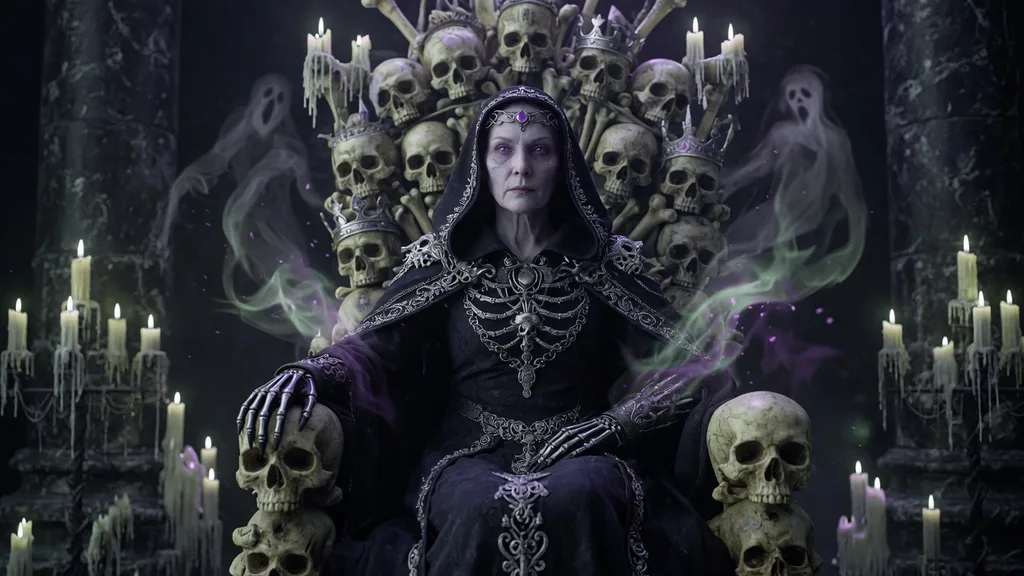
At the top of necromantic power sits the lich-queen: an immortal who solved the death problem by making death work for her. Not a ghost, not a vampire — something colder. She chose undeath deliberately, paying a price most practitioners refuse to name, and she rules now from a throne no living challenger has reached.
Names for lich-queens carry a particular weight. They tend toward the formal and polysyllabic — Ossiandra, Mortivaine, Lichessa, Regnavel. These are names that function as titles even when used as names. The court doesn't say "your Majesty." It says the name, and the name is already a title.
If you're writing or playing a lich-queen, consider adding a paired epithet for formal occasions: Ossiandra, Sovereign of the Unliving. Shorter for everyday use, full title for the moment she enters a scene.
Famous Female Necromancers in Fiction — What the Names Tell Us
Strong fictional necromancers tend to have names that do work. Morgause from Arthurian tradition carries the mor- (death/dark) prefix and a soft suffix — elegant, ambiguous, ancient. Kel Drakken and Miriam Black (from Chuck Wendig's Miriam Black series) operate differently — shorter, sharper, less mythological but no less menacing.
The pattern: names that have aged well tend to carry phonetic meaning alongside their aesthetic appeal. They were built, even unconsciously, from the right raw materials.
When naming a necromancer for original fiction, resist the pull toward obvious compound words (Deathmage, Shadowweaver — these read as labels, not names). Let the phonetics do the signalling. A reader who hears Sephrena doesn't consciously think "death magic" — they feel it in the sounds, and that's more effective.
Example Female Necromancer Names by Style
Gothic
- Mortivaine the Pale
- Seraphax the Mournful
- Corvindra of the Open Tomb
- Umbriela the Black-Veil
- Nocturna the Ashen Lady
- Vaelissa the Cold Bride
- Moressa the Weeping Specter
- Desparina of Wychwood
- Sephiravel the Grave-Marked
- Lucravel the Hollow
- Eirveth the Mourne
- Sorwynn the Undying Sorrow
Ancient / Eldritch
- Nekrathia the Ageless
- Thanatris the Primordial Dread
- Charonael of the First Death
- Persepha the Bone-Reader
- Stygiana the Sealed
- Ossuaria the Forgotten Name
- Aethvyndra the Undying Memory
- Vornatheld Echospeaker of the Dead
- Hecatessa the Aeonbound
- Lethedra of the Before-World
- Skaarwyn Keeper of Old Screams
- Gaeldrith the Bone-Reader
Plague / Decay
- Pestivara the Blight-Touched
- Miasmora Bringer of the Long Sickness
- Blightissa the Rot-Weaver
- Corrovel of the Black Miasma
- Virulessa the Pestilent
- Fetorael Mistress of Carrion
- Rotwyn the Wilt
- Festwyn the Sporebringer
- Gangreld of the Hollow Harvest
- Scourwyn the Miasmancer
- Blightwyn of the Festering Gift
- Poxeld the Pestilent
Shadow
- Umbravel the Voidborn
- Tenebrissa of the Sunless Court
- Noctivara the Night-Spoken
- Nyxivael the Shade-Caller
- Penumbrix the Gloaming
- Obscurina Mistress of the Dark Between
- Voidwyn the Pale Absence
- Duskeld the Noctual
- Shadowvael the Inkweave
- Gloamwyn the Unseen
- Mirkvael of the Last Light
- Darkveth the Pale Absence
Regal / Lich-Queen
- Ossiandra Mistress of Bone
- Mortivaine the Lich-Queen
- Lichessa of the Bone Throne
- Regnavel Sovereign of the Unliving
- Soverena the Cold Crown
- Imperavel Queen of Dust
- Throneeld the Eternal Regent
- Crowneth Empress of the Barrow
- Lichwyn the Undying Throne
- Bonewyn of the Ivory Crypt
- Deathroth the Pale
- Queenseld the Cold Crown
How to Use Female Necromancer Name Generator
Pick a Style that matches your character's lore — or leave it on Any to pull from all five pools. Set Form to Name only for a clean result, or Name + dark title for a full epithet. Choose a Language flavour if you want Latinate or Old-tongue specifically; Any mixes both.
Use the slider to set how many names to generate, then hit Generate. Each card shows the name, its style badge, and a one-line lore note. Click any card to copy. Generate again as many times as you need — the pools are large enough to give you fresh results across many runs.
For D&D or Pathfinder: pick a name, pick an epithet, decide which one the world knows and which one only the party uses. For fiction: take the base name, run it through two or three style passes, and see which phonetic shape fits the character you already know.
Cross-Craft — Related Dark Magic Generators
If this generator serves your dark-magic naming needs, several related tools on this site work well alongside it. For a broader cast — male necromancers, unisex names, and archetypes beyond the lich-queen register, such as bone-shapers, grave-tenders, and plague-callers with meaning-bearing titles — see the necromancer name generator. The witch name generator covers five styles from Wicked and Gothic to Cottage and Mystical — useful for practitioners who sit outside the necromancer archetype but share its dark-feminine aesthetic. The sorcerer name generator handles arcane and dark traditions for casters of any gender, with a dedicated Dark/Warlock tradition that pairs well with undead-patron builds. Note the line between crafts: a necromancer is a mortal spellcaster who commands the dead, not an infernal entity — if you need a demon defined by seduction and shapechanging instead, with its own true-name mechanic, see the succubus name generator.
FAQ for Female Necromancer Name Generator
What makes a good female necromancer name?
The best necromancer names balance elegance with menace. Liquid consonants (l, r, v) and dark vowel clusters create a melodic surface that hides something cold underneath. Latinate endings like -avel, -issa, or -vael feel ancient and formal; Old-tongue constructions with shadow-word roots feel rawer. Either way, the name should sound like it belongs on a tombstone — beautiful and final.
Which D&D classes suit a female necromancer name?
Necromancer is a Wizard subclass in D&D 5e, but the naming style works equally for Warlocks with undead patrons, Death Clerics, Oathbreaker Paladins, and even Dark Druids. The key is matching the phonetics to the backstory: a scholarly Wizard necromancer might wear a Latinate name, while a warlock bound to an eldritch pact fits an Old-tongue construction.
Where can I use the Female Necromancer Name Generator?
It works well beyond the tabletop — D&D and Pathfinder characters, fantasy novels and short stories, video game character creators, forum handles, and cosplay personas. Because every result is an original construction, you're free to use them in published work without attribution or licensing concerns.
What is the lich-queen archetype?
A lich-queen is a necromancer who has transcended death itself — an immortal sovereign ruling over undead armies from a bone throne. The archetype sits at the top of necromantic power: regal, cold, untouchable. Names in this style carry an imperious weight: multi-syllabic, formal, and shaped like a decree rather than an introduction.
How do dark titles work in the generator?
Switch the Form filter to 'Name + dark title' and each result pairs a base name with a grim epithet like 'the Pale', 'Mistress of Bone', or 'of the Bone Throne'. The title matches the style you selected — Gothic titles read Victorian-sorrowful, Regal titles read imperious, Plague titles read deliberately unsettling.
What makes female necromancer names sound authentic across different settings?
Authenticity comes from consistency, not lore-accuracy — a name that draws on the same root pool (Latinate or Old-tongue) as the rest of a setting's necromancers will feel like it belongs, even in a world with no fixed history for death magic. Historical folklore about witches, plague-doctors, and death-cult priestesses supplies the raw phonetic material; this generator recombines it so every name carries that weight without repeating a specific character.
Can I use these names in published fiction or games?
Yes. Every name in this generator is an original construction built from phonemic patterns — not lifted from any franchise, sourcebook, or existing character. You can use them freely in tabletop campaigns, novels, video games, or any other creative work.
What is the difference between Latinate and Old-tongue flavour?
Latinate names draw on Latin-derived sounds and endings — multi-syllabic, flowing, and carrying a scholarly or ecclesiastical weight (think: Mortivaine, Ossuaria, Tenebrissa). Old-tongue names use Anglo-Saxon or Germanic-inspired construction, often compound words built from root concepts like 'grave', 'ash', 'dusk', or 'wight' (think: Gravewyn, Duskeld, Shadowvael). Both feel dark; they just choose different flavours of darkness.