
Species Name Generator — Sci-Fi & Fantasy Race Names

This species name generator builds original names for whole fictional peoples — sci-fi aliens, fantasy races, beastfolk, insectoid hives, and elemental beings — with the singular form and a matching plural demonym ready to drop into your setting bible, codex entry, or game script.
👇 Click any name to copy it
A species name carries more weight than a character name. Characters change. Species names persist through empires, extinction events, and a thousand years of retcon. Get it right and it becomes a shorthand for an entire culture: one word that signals biology, history, and attitude before the reader meets a single individual.
That compression is the challenge. The name has to work as a noun, a plural, and an adjective. It should be pronounceable at the table, distinct on the page, and feel like it belongs to the kind of being that carries it.
Building a specifically sci-fi alien civilization and want the name a human first contact team actually used, not just the species' own word for itself? The alien species name generator is the deeper tool for that — it pairs an endonym (self-name) with a human-given exonym and explains where the second one came from.
What Makes a Species Name Work
The best species names do three things at once: they imply something about physiology, suggest cultural character, and survive casual pronunciation. Drop one of those three and the name starts to feel borrowed from somewhere else — or just arbitrary.
Phonetics that signal biology
A species built around a gas giant's atmosphere, with no solid vocal cords, probably doesn't have names full of hard stops. Conversely, an insectoid with mandibles clicks, hisses, and chitters — its name should reflect the sounds its body can actually produce. This matters even in fantasy, where you have more latitude: a deep-sea race sounds fluid and rolling; a stone giant sounds ground and heavy.
You don't need a full xenolinguistics paper. You need one consistent phoneme palette and the discipline not to mix it with sounds that don't belong. Pick three or four consonant clusters and two or three vowel patterns, then stay in that lane for every individual name in the species.
Singular, plural, and adjective — all three
Test any species name before you commit: say it singular ("a Vorrn"), plural ("the Vorrnai"), and as an adjective ("a Vorrn cruiser," "Vorrn culture"). If one of those three buckles, adjust the suffix. The demonym form matters especially in fiction — you'll write "the Aelori homeworld" far more often than you'll write "one Aelorian," and the name needs to carry both.
Length and rhythm
Two syllables is the sweet spot. Short enough to use constantly in prose; long enough to feel like a real word rather than a grunt. Three syllables works for ancient or noble species where the gravitas earns the extra beat. One syllable is a deliberate choice — it reads as blunt, military, or hive-designatory. Four or more syllables and you're writing an honorific, not a species name.
Phoneme Patterns by Kind
Each category in the generator draws from a distinct phoneme pool. The table below shows the characteristic sounds, so you can extend the palette manually if you need more names in a particular style.
| Kind | Characteristic sounds | Example |
|---|---|---|
| Sci-fi alien | Compressed consonant clusters (Vr-, Kh-, Nx), short vowels, hard terminals (-x, -xt, -sk) | Vrethox, Khaeln, Zarnyx |
| Fantasy race | Melodic onset (Ae-, Val-, Sel-), long vowels, liquid endings (-iel, -ath, -yn) | Aelori, Valdren, Seluith |
| Beastfolk | Guttural stops (Krag-, Var-, Brak-), back vowels (-ar, -ur, -aw), rolling codas (-rr, -ng) | Kragmaw, Varkoth, Grulnar |
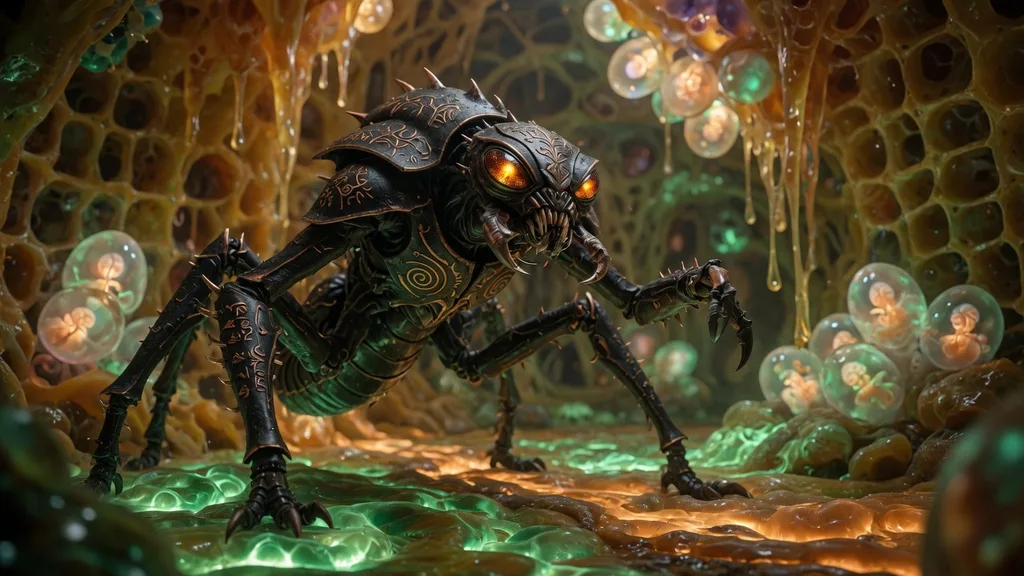
| Insectoid / hive | Fricatives and clicks (Zik-, Skra-, Tch-), tight vowels (-i, -ix, -ee), hard stops with clusters (-kt, -tz, -kk) | Zik-Tcha, Skranii, Veztrk |
| Elemental being | Open diphthongs (Ae-, Lyo-, Sael-), resonant vowels (-aa, -ia, -oa), soft endings (-el, -yn, -ae) | Saelium, Lyoael, Ethuil |
Singular Names vs. Demonyms — When to Use Each
The singular form — "a Vorrn," "one Kragmaw" — appears whenever you focus on an individual or refer to the species in the abstract. The demonym — "the Vorrnai," "the Kragmaw Collective" — appears for the group as a cultural or political entity.
Some settings make these identical (the Klingon / the Klingons). Others use entirely different words. The middle path — a shared root with a distinguishing suffix — is easiest to write consistently: "Threx" singular, "the Threxai" collective, "Threxai warships" adjectival. The generator follows this logic by default; the demonym form appends an appropriate suffix based on the kind's phoneme conventions.
Real-World Roots (and When to Lean On Them)
Human languages are a legitimate toolbox. Tolkien built Elvish on Finnish and Welsh. Klingon borrowed from Tibetan and Arabic. This isn't laziness — it's the fastest way to give a species name genuine phonetic depth without inventing an entire conlang.
The rule is transformation, not transliteration. Take a root from a real language and break it: swap consonants, shift the vowel, reverse a syllable. The result should feel familiar without being identifiable. "Aelori" has a Mediterranean vowel flow but doesn't map to any real word. "Kragmaw" has the Germanic guttural without sounding like a German word.
Avoid directly lifting place names, deities, or culturally significant words from living languages and handing them to aliens. It reads as careless at best and disrespectful at worst. Transform, don't transcribe.
Example Species Names
Below are examples grouped by kind — each with a singular name, a possible demonym, and a one-line note on what they'd be like. Use these as a tone reference, not a starting point for copy.
Sci-fi Alien Names
- Vrethox — the Vrethoxai — cold-logic processors; no word for mercy
- Khaeln — the Khaelni — navigators; charted stars before humanity had fire
- Zarnyx — the Zarnyxan — migratory; follow gamma-burst patterns across galaxies
- Skryn — the Skryni — dense gravity-adapted; walk heavy on standard worlds
- Nexorl — the Nexorlan — hive-adjacent; consensus before individual
- Uxmor — the Uxmorai — reclusive; their silence reads as threat
Fantasy Race Names
- Aelori — the Aelori — long-lived; their wars last a human lifetime
- Valdren — the Valdreni — mountain-bound; carve law into stone, literally
- Seluith — the Seluith — tidal magic users; names shift with the moon
- Nurath — the Nurai — exiled twice; carry neither homeland nor grievance lightly
- Galior — the Galiorai — traders first; they learned seventeen languages before they learned war
- Caelis — the Caelisi — oracular culture; names given at the third prophecy
Beastfolk Names
- Kragmaw — the Kragmawkin — bear-adjacent; territorial, but generous to guests
- Varkoth — the Varkothfolk — wolf-descended; pack hierarchy, no written code
- Grulnar — the Grulnarborn — boar-kin; charge first, negotiate from position
- Morax — the Moraxkin — corvid-folk; collect grudges the way others collect coin
- Raxtu — the Raxtufolk — lizard-adjacent; read stillness as respect
- Hulgar — the Hulgarborn — bull-folk; city-builders; walls mean everything
Insectoid / Hive Names
- Zik-Tcha — the Zik-Tcha Collective — clicks communicate danger; silence communicates death
- Skranii — the Skranii Swarm — no singular concept; every "I" is editorial
- Veztrk — the Veztrk-Kin — sub-sonic chirp language; humans need a device
- Krezik — the Krezik Brood — architects; their cities are also their exoskeletons
- Tching — the Tching Collective — spore-communication as backup channel
- Xrika — the Xrika Swarm — bioluminescent; negotiation is a light show
Elemental Being Names
- Saelium — the Saeliumae — fire-adjacent; their philosophy is entropy
- Lyoael — the Lyoaelian — wind-current beings; location is a concept, not a fact
- Ethuil — the Ethuilan — deep-water pressure entities; communicate via resonance
- Oalvae — the Oalvaeian — light-spectrum beings; invisible in standard wavelengths
- Syluith — the Syluithae — storm elemental; count lightning strikes instead of years
- Naelorn — the Naelornori — void-pressure entities; exist between gravitational fields
Building a Species for D&D, Pathfinder, and Tabletop RPGs
Tabletop games need species names that work at the table — spoken aloud, improvised, joked about by players who will mispronounce them cheerfully for three years. A name with an apostrophe in a difficult position is asking for trouble. A name that's five syllables will get abbreviated to a nickname within a session.
Design principle: give the species a name your players will use correctly without thinking. Two syllables. One or two distinctive sounds. A clean plural. Then give the lore-accurate full name as an in-world fact that almost nobody bothers with — "technically they're the Vel'athoran, but everyone says Velar."
For homebrew races in D&D 5e and 2024, the species name also needs to carry racial ability context implicitly. "Kragmaw" signals brute-adjacent traits. "Aelori" signals something graceful and old. Players read these signals before the stat block.
Species Names in Science Fiction Writing
Sci-fi has an enduring tension between alien names that feel genuinely alien and names that readers can parse without stopping. Ursula Le Guin solved this by keeping names short and consistent within a culture. Frank Herbert frontloaded the glossary and trusted readers to catch up.
The practical answer for shorter work: one species per novel needs a phonetically careful name; secondary species can get a quick shorthand. "The Khar" is fine for a species that appears in three scenes. "The Khar — formally the Khar-Nexathi — the first civilization humanity contacted and subsequently ignored for a century" can afford more precision.
Avoid accidental Earth-language resonances in alien names. If your fierce warrior species is called the "Kri," every German-speaking reader is thinking of something else. Run your names past a translator and a few native speakers of major languages before committing.
How to Use Species Name Generator
Set a Kind to target a specific phoneme palette — Sci-fi alien for compressed consonant clusters, Fantasy race for melodic long-vowel sounds, Beastfolk for guttural stops, Insectoid/hive for clicks and hard terminals, Elemental being for open diphthongs. Leave it on "Any Kind" to mix.
Tone shapes the feel: Noble lengthens syllables and adds honorific decoration; Savage clips and hardens; Strange/exotic inserts unexpected phonemes; Ancient deepens the pool toward older-sounding constructions. Form controls whether you see just the singular name or the singular name plus a plural demonym alongside it.
Move the count slider, hit Generate, and click any card to copy the name. Generate as many times as you need — the pools are large and deduplicated per batch.
FAQ for Species Name Generator
What is a species name in worldbuilding?
A species name is the label a whole fictional people carries — what outsiders call them and what they call themselves. It covers the singular form (one Vorrn) and often a plural demonym (the Vorrnai or the Vorrn Collective). A strong species name implies biology, culture, and history without spelling any of it out.
How is a species name different from a character name?
Character names belong to individuals; species names belong to entire peoples. A species name tends to be shorter, harder to vary, and phonetically consistent across the whole group. It also needs to work grammatically — you'll use it as a singular noun, a plural, and an adjective (a Kragmaw weapon, two Kragmaw warriors, the Kragmaw homeworld).
Where can I use the Species name generator?
It works for D&D and Pathfinder homebrew races, sci-fi novel manuscripts, tabletop campaign setting bibles, and video game codex entries — anywhere a whole fictional people needs a name before a single character does. Set a kind and tone, generate a batch, and grab the singular-plus-demonym pair that reads best in your world. Every result is original, so it's yours to adapt, rename, or build a language around.
Can I use these names in D&D, video games, or published fiction?
Yes. All names generated here are original — no trademarked races or franchise-specific terms. They're yours to use, adapt, rename, and build on freely in personal projects, tabletop campaigns, novels, or games.
What does the demonym form do?
When you select 'Singular + demonym,' each result shows the base species name alongside a collective plural — 'the Vorrnai,' 'the Kragmaw Collective,' etc. This is useful for setting bibles, codex entries, and any writing where you need the group name ready.
Where do believable species names come from?
A believable species name isn't picked at random — it draws from a narrow, consistent phoneme palette that implies biology and culture the way real ethnonyms do, from a hard consonant cluster that suggests an exoskeleton to a rolling vowel that suggests a fluid, aquatic voice box. It also has to survive three grammatical jobs at once: singular, plural, and adjective. This generator builds each kind — sci-fi alien, fantasy race, beastfolk, insectoid, elemental — from its own narrow phoneme pool and appends a matching demonym, so every result already passes that authenticity test.
How do I make a species name sound believable?
Keep the phoneme palette narrow and consistent — every member of the species should feel like they belong to the same name pool. Avoid mixing hard stops and liquid vowels randomly. Then make sure the name works in all three grammatical roles: singular, plural, and adjective. If one of them sounds awkward, tweak the suffix.
What is the difference between a fantasy race name and a sci-fi alien name?
Functionally, very little — both describe invented peoples. The phonetic conventions differ: fantasy races tend toward melodic, vowel-heavy syllables rooted in medieval European and Tolkien-influenced sounds; sci-fi aliens lean on compressed consonant clusters, unusual vowels, and the occasional apostrophe or hyphen that signals a non-human larynx. This generator keeps those palettes separate so results feel genre-appropriate.