
Alien Species Name Generator — Endonym vs. Human Exonym

This alien species name generator builds names for whole civilizations, not single characters — and it builds them in pairs: the endonym (what the species calls itself) and the exonym (what humans ended up calling them), with the first-contact story that explains why the two don't match.
👇 Click any name to copy it
Real ethnonyms almost never agree with themselves. The people who live in Deutschland call themselves die Deutschen; English calls them Germans, from a Roman tribal label that predates the country by a millennium. The French call Germany Allemagne, after a different tribe entirely. Japan calls itself Nihon; the English word comes from a Chinese reading of that same name, filtered through Portuguese traders. None of this is an accident or an error — it's just what happens when two languages meet and only one of them gets to write the history books.
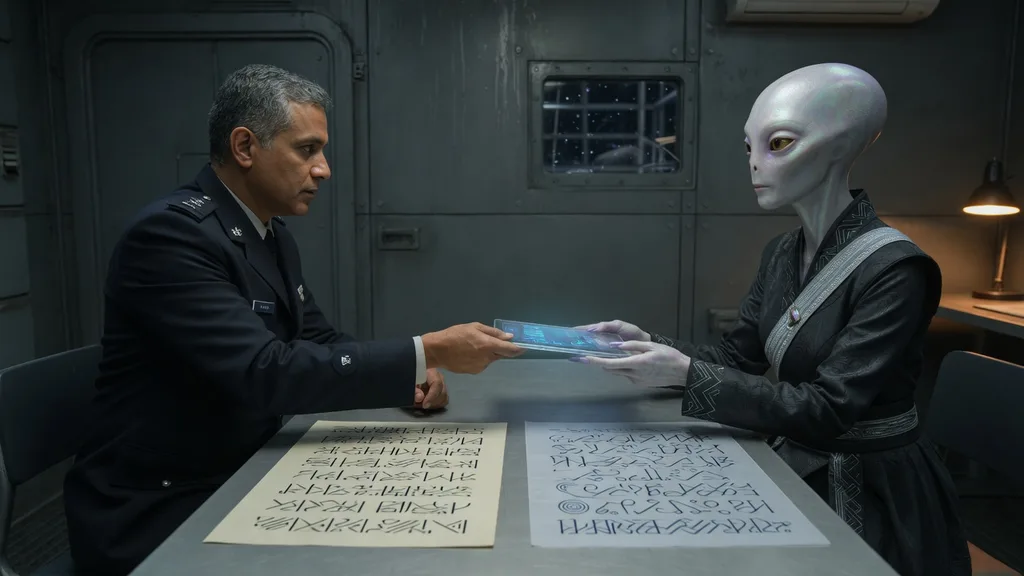
Alien contact would work the same way, and almost no sci-fi story bothers to show it. Most alien species in fiction have exactly one name, used by everyone, including themselves, in perfect English. This generator assumes first contact was messier than that — because it always is.
Alien Species vs. Alien Character vs. Species — Which Generator Do You Need?
We run three related tools and they answer three different questions. Picking the right one saves you a rewrite later.
| You need a name for… | Use this generator | What you get |
|---|---|---|
| One alien character — a single crew member, NPC, or protagonist | Alien Name Generator | One name, tuned by species type and vibe |
| A whole invented people, in any genre — fantasy, sci-fi, or unspecified | Species Name Generator | Singular name + plural demonym |
| A sci-fi species' self-name AND the separate human name for them, with the backstory | Alien Species Name Generator (this page) | Endonym + exonym + origin story |
Short version: character first, use Alien. Any invented people, use Species. Sci-fi civilization where the point is that humans and the species itself don't use the same word — that's here.
How to Use the Alien Species Name Generator
Pick a biology — humanoid, insectoid, aquatic, gaseous, silicon, hive/collective, or synthetic — and the self-name's whole sound palette shifts to match. Pick a contact tone: scientific tends toward catalog designations and system coordinates, militaristic toward mission codenames, poetic toward descriptive epithets, derogatory toward the blunt, unflattering label that stuck anyway.
Set Show to "Endonym + human name" for the full pair with the origin story, or "Endonym only" if you just want the species' own word for itself. Move the count slider, hit Generate, and click any card to copy it.
Why Endonyms and Exonyms Drift Apart
An endonym comes from inside a culture, built to fit that culture's own mouth and own values. An exonym comes from outside, built by whoever needed to refer to the group before anyone asked them what they call themselves. Four mechanisms account for most real-world exonyms, and this generator models all four:
| Mechanism | How it happens | Real-world example |
|---|---|---|
| Mishearing | Outsiders hear the self-name and write down the closest sound their own language has | "Wales" from Anglo-Saxon wealh, roughly "foreigner" — not what the Welsh call themselves (Cymru) |
| Appearance descriptor | Outsiders name what they see before they learn what the people call themselves | "Eskimo," widely believed (though contested) to derive from an Algonquian word for "eaters of raw meat" |
| Planetary / place designation | The place gets named and mapped before the people do; the exonym rides along | "American," from a mapmaker's Latinized version of Amerigo Vespucci's first name, applied to two continents' worth of nations that never chose it |
| Military codename | First contact is a conflict, not a conversation, and the wartime label outlives the war | Wartime nicknames for enemy forces that stay in casual use for decades after a peace treaty formally renames everyone |
Planetary designations only work if the planet has a name to lend in the first place — if you're building that homeworld from scratch, our planet name generator handles the system and world name that a "Kesh-9 Settlers" style exonym would actually be borrowing from.
Every result from this generator picks one of those four mechanisms — weighted by the contact tone you chose — and explains it in a line under the name. Roughly half the time, it adds a second layer: how the exonym held up (or didn't) after formal contact, a war, or a treaty. Militaries keep using old callsigns after peace is signed. Poets keep using an epithet because it scans better than the correct name. Old field data never gets fully purged from the archive. Names, once spoken enough times, are hard to kill even after they're wrong.
Alien Species by Biology
Biology sets the self-name's sound palette and, when an exonym comes from a description rather than a mishearing, the words that description reaches for.
| Biology | Self-name sounds like | Typical descriptor exonym |
|---|---|---|
| Humanoid | Near-human, off by a syllable | the Near-Kin, Two-Walkers |
| Insectoid | Clicking, segmented, hard stops | Chitin-backs, the Clickers |
| Aquatic | Fluid, rolling, doubled vowels | Gillfolk, the Depth-born |
| Gaseous | Open vowels, barely a consonant | the Cloudkin, Vapor-things |
| Silicon | Heavy, ground, guttural stops | Rock-skins, Glassbacks |
| Hive / collective | Blunt, node-like, plural by default | the Collective, One-Mind |
| Synthetic | Clipped, code-like, numbers attached | Chrome-skins, the Built |
Humanoid species get self-names that sit close to ours, since the body that makes the sounds is close to ours too. Insectoid and silicon biologies push toward hard consonants — mandibles and crystalline vocal structures don't do soft vowels easily. Aquatic and gaseous species drift the other way, toward rolling or nearly vowel-only sounds a pressure-driven or bodiless voice could actually produce. Hive species barely have individual self-names at all — the whole point of a hive-mind is that "I" is a strange concept, so the self-name usually reads more like a network address than a word for "us." Synthetic species split the difference: built, not evolved, so their self-name often carries something closer to a build tag than a term of identity.
Naming Convention: Singular, Plural, and the Civilization Scale
This is a species-scale tool, not a character-scale one — the difference matters for how you use the output. A character name gets said constantly, in dialogue, at speed; it needs to be short and forgiving. A species name gets used less often but carries more weight: it shows up in treaties, star charts, history books, and news reports written by people who've never met a single member of the species in person. That's why the endonym here comes with a gloss of what it means (usually some version of "the People," "the Many," or "the Made") — species self-names across real human cultures overwhelmingly translate to some variant of "us," because every culture's first linguistic act is drawing a line between itself and everyone else.
For a deeper pass at building the naming system underneath results like these — not just one species' pair of names, but a whole invented language's worth of consistent sound and grammar — see our guides on building a naming language and keeping consistent names for a culture. If you want to see this taken all the way to a real, documented conlang for a single species, our Na'vi name generator covers Avatar's Na'vi phonology and grammar in depth — a rare case where a franchise actually built the linguistics instead of hand-waving it.
Example Alien Species — Endonym and Human Exonym
Static examples below, one per biology, so you can see the pattern before you generate your own.
- Sael'or (self: "the People") — humans call them the Vantirans, after the star system charted first
- Zik'tek (self: "the Many") — humans call them Chitin-backs, a description that stuck before anyone learned the real name
- Maelua (self: "the Tide-Born") — humans call them the Deep Ones, poetic tone, kept in use after three treaties
- Fyoae (self: "Breath of the Void") — humans call them Ghost-gas, a name flagged outdated in official channels but still common
- Kragthor (self: "the Enduring") — humans call them "Contact Designation Iron Veil," a wartime label from the border skirmish that opened relations
- Vesh-Nine (self: "the One Voice") — humans call them the Networked, a scientific-register catalog term
- Vexor (self: "the Made") — humans call them Machine-kin, a description filed before anyone confirmed they were built, not born
Tips for Writing an Endonym/Exonym Pair
- Pick the mechanism on purpose. A war-first contact should produce a codename exonym, not a poetic one. Let the history of the relationship choose the tone.
- Let the gap say something. A species whose exonym is still an old wartime slur, decades after peace, tells the reader something about how thoroughly (or not) that peace actually settled.
- Use the endonym for interiority. When you write from the species' point of view, or when they speak to each other, use their own name. Reserve the exonym for human-perspective scenes and documents.
- Don't over-explain it on the page. One line of context is usually enough — "the Kesh-9 Settlers, though they call themselves the Sael'or" — readers pick up the rest from how each name gets used going forward.
- Keep the endonym pronounceable, even if the exonym isn't meant to be flattering. The self-name is the one your reader needs to say in dialogue most often.
How the Name Changes After Contact — War, Treaty, and Bureaucracy
An exonym born at first contact rarely survives unchanged. Real diplomatic history is full of names that got formally corrected and kept limping along anyway — because bureaucracies are slow, soldiers keep their own slang, and old paperwork never gets fully rewritten. This generator models that afterlife too: about half the results come with a second sentence describing what happened to the name once the dust settled, and which version — endonym or exonym — the setting eventually treats as "official."
| Contact tone | What usually happens to the exonym after formal contact |
|---|---|
| Scientific | Reclassified in the official archive once linguists review the first transcripts — but it lingers in older field data |
| Militaristic | Kept alive by veterans and old mission files long after a peace treaty adopts the endonym as the official term |
| Poetic | Outlives multiple treaties because nobody can agree on a replacement that scans as well |
| Derogatory | Formally corrected in diplomatic channels, but never fully leaves casual speech or old news archives |
This is the layer that turns a name pair into a plot hook. A character who still uses the old wartime exonym, decades after the treaty, is telling the reader something about themselves without a line of exposition. A species that insists on the endonym in every formal document, but gets called by the old name every time a human is startled, shows you exactly how settled that "peace" really is.
Endonyms and Exonyms in Science Fiction
Most published sci-fi skips this entirely — Klingons call themselves Klingons, Vulcans call themselves Vulcans, and the show moves on. That's a reasonable choice for pace; not every story has room for a linguistics footnote. But the handful of works that do lean on the gap — a species with a harsh military nickname that turns out to call itself something gentler, or a "primitive" people whose actual name translates to something more dignified than the colonizers' label — get a specific kind of payoff for free: the reveal itself becomes characterization, for both species in the exchange.
The trick is restraint. One well-placed reveal of "they call themselves X, we call them Y, and here's why" lands. A whole chapter of etymology does not. Use the pair, drop the reason in a sentence or two, and let the reader do the rest of the work.
Not every sci-fi setting needs an alien species at all — Dune runs entirely on human factions with their own naming logic instead. The Dune name generator covers that feudal, Arabic-and-Greek-rooted register: Fremen, Great Houses and the Bene Gesserit, no first-contact endonym/exonym gap required.
FAQ for Alien Species Name Generator
What's the difference between an endonym and an exonym?
An endonym is what a group calls itself — Deutsche, Nihonjin, Inuit. An exonym is what outsiders call that same group — Germans, Japanese, Eskimo. The words often come from completely different roots, because the exonym usually got coined by someone who heard the endonym wrong, described what they saw, or just needed a label before anyone asked the group's own word for itself. This generator applies that real linguistic split to alien species: every result gives you the self-name and the human-given name, plus why they don't match.
How is this different from the Alien Name Generator?
The alien name generator names one creature — a single character, sized for a cast list. This tool names the whole species and civilization that character belongs to, and it specifically outputs two names (self-name and human name) instead of one. If you need a name for an individual alien, use the alien name generator; if you need the name of the people or empire they belong to, this is the one.
How is this different from the Species Name Generator?
The species name generator covers any invented people in any genre — fantasy races, beastfolk, elementals, and sci-fi aliens among them — and outputs a singular name plus a plural demonym. This generator is sci-fi-specific and goes one layer deeper on exactly one genre's convention: the gap between how a species names itself and how humans ended up naming them after first contact.
Why do exonyms happen at all?
Usually one of four ways: someone mishears the self-name and writes down the closest human spelling, someone describes what the species looks like before anyone learns their actual word, a name gets attached to the star system or planet before the people are studied, or the first meeting is a military encounter and the name comes off a mission log instead of a conversation. All four are real-world patterns, not sci-fi invention — colonial map-making and wartime intelligence produced exonyms exactly this way.
Do exonyms have to be insulting?
No — the Derogatory exonym tone is one option among four, not the default. Scientific tone leans toward planetary designations and catalog language. Militaristic tone leans toward mission codenames. Poetic tone leans toward descriptive epithets that sound almost like praise. Derogatory is there because plenty of real exonyms started as insults (the word 'Eskimo' is a contested case), and fiction gets to use that honestly if the story calls for it.
Can I turn off the human name and just get the self-name?
Yes — set Show to 'Endonym only' and every result is just the species' own word for itself, with a short gloss of what it means in their language. Useful once you've already settled on how first contact went and just need the species' internal name for lore documents, dialogue, or lettering.
Does the biology type actually change the name, or is it decoration?
It changes the phoneme pool the self-name is built from. Insectoid species click and stop; aquatic species roll and flow; gaseous beings barely have hard consonants at all. It also changes which descriptors show up if the exonym comes from an appearance-based guess — a silicon species gets called 'Rock-skins,' not 'Gillfolk.'
Can I use these names commercially?
Yes. Every name is procedurally generated from original phoneme pools — no canon species, franchises, or real-world ethnonyms are reused. They're yours to use in fiction, games, or tabletop campaigns. Run a quick search before locking in a major species name, the same as you would for any invented word.