
Names That Mean Fire
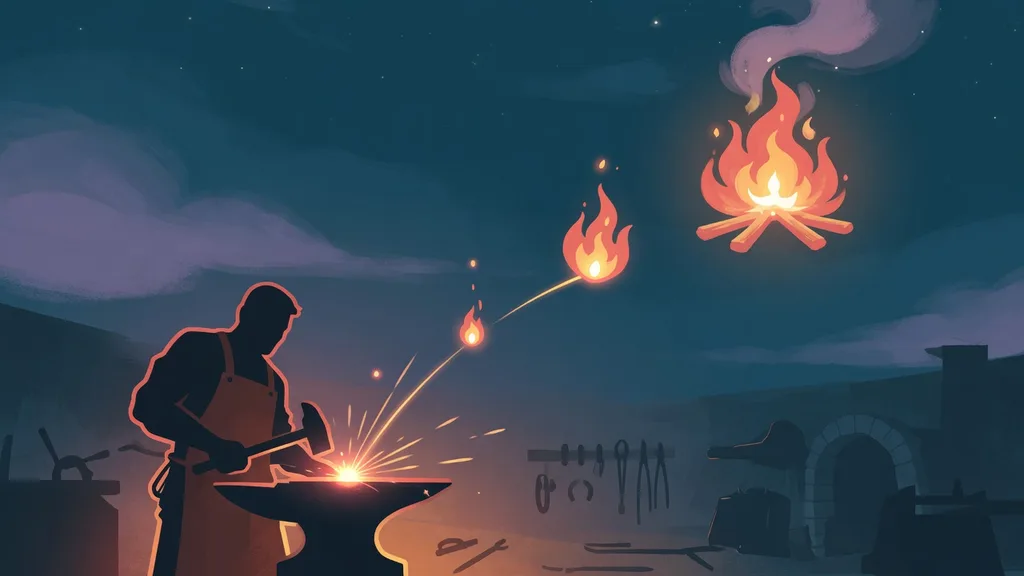
Most fire name lists are padded with names meaning red or bright. This one sorts fire from flame from ember from red, with the real root behind each — and explains why Blaise and Loki are not fire names.
Half of every fire name list isn't fire
Search this topic and you will be handed Rory, Rufus, Scarlett, Ruby, Russell and Flannery alongside the real fire names. All of those mean red, and most of them originally described somebody's hair. Red is not fire. It is the colour fire happens to be, which is a different claim about a person, and the difference matters if the name is going to introduce a character.
The second batch of padding is brightness. Robert, Bertram and the other Germanic names ending in -bert mean bright, not burning. Hebrew Uriel and Arabic Nur mean light. Arabic in particular catches people out, because nār is fire and nūr is light, and in English spelling they are one letter apart. A great many Nur names sit on fire lists purely because of that letter.
Then there are the two famous names that are simply not what everyone thinks. Blaise is not from blaze — it is from Latin blaesus, lisping. And Loki is not a fire god. The Norse fire figure is Logi, a jötunn who defeats Loki in an eating contest by consuming the bones and the trough along with the meat, because he is fire. The two were conflated in later retellings, Wagner's opera among them, and the mistake has outlived the source.
Everything below is sorted by which of these it actually is. The red group is kept on the page rather than deleted, clearly labelled, because you may well want one of those names — you should just know what it says.
Which fire does the name actually name?
Every name on this page, sorted by what it means rather than by language. Full entries with etymologies follow.
| It names | Names |
|---|---|
| fire Fire as the thing itself. The largest group, and the only one that answers the question literally. | Pyrois, Ignatius, Brandr, Brenda, Eldbjørg, Eldr, Aodh, Aodhán, Aidan, Egan, Keegan, Mackay, Conleth, Fintan, Cináed, Nar, Nuriel, Joash, Agni, Anala, Vahni, Ognyan, Ognyana, Ognjen, Vatroslav, Brand, Brando, Hildebrand, Aldebrand, Hi, Huo, Azar, Atash, Azarakhsh, Sam, Atropates, Ateş, Azər, Moto |
| flame A flame rather than a fire — a single tongue of it. These names run lighter and quicker than the fire ones. | Flamma, Fiammetta, Hálogi, Shu'la, Lahab, Lahav, Shalhevet, Jwala, Shikha, Deepak, Plamen, Plamena, Homura, Yan, Alev, Yalın, Blaze |
| ember / spark What is left glowing, or the spark that starts it. Quiet names with heat still in them. | Scintilla, Eisa, Eimyrja, Glöð, Jamra, Zhar, Ember, Flint, Cinder |
| to burn From verbs: to burn, to blaze, to be alight. The action rather than the object. | Phlegon, Phlegethon, Aethon, Muspell, Seraphina, Saraph |
| forge fire Fire that is being used. Smith names, and they carry craft and patience rather than destruction. | Faber, Sindri, Goibniu |
| fire deity Named for a fire god. The mythology arrives with the name whether you invite it or not. | Hephaestus, Hephaestion, Hestia, Vulcan, Vesta, Logi, Surtr, Brigid, Svarog, Kagutsuchi, Zhurong, Atar, Shango |
| fire of the sun Fire by way of the sun. Adjacent rather than identical, and listed separately for that reason. | Phaethon, Tapan |
| red — not fire Red, russet or flame-coloured — usually describing hair. These are NOT fire names, and they are the single biggest source of padding on other lists. They are here so you can see how many there are. | Pyrrhus, Pyrrha, Rufus, Rufina, Rutilius, Ruadh, Ruairí, Flann, Flannery, Arun, Akane, Dan, Phoenix, Russell, Reed, Scarlett, Ruby |
Celtic and Gaelic names that mean fire — the Aodh family
The largest genuine fire group in this whole list, and it is essentially one family. Old Irish Aodh was a fire god and a common given name, and it produced Aodhán, Aidan, Egan, Keegan and Mackay. Everything else offered as a Celtic fire name tends to fall apart under checking: Eithne is a grain word, and Brigid, the goddess of the forge, means the exalted one rather than anything to do with flame.
| Name | Used for | Literally | Where it comes from |
|---|---|---|---|
| Aodh Aodh AY / EE | male | “fire” fire | The richest genuine cluster in this whole topic. Old Irish Áed simply means 'fire', and it was both a god of the Tuatha Dé and one of the most common names in early Ireland — several high kings, dozens of saints. Everything from Aidan to Hughes to McKay grows from this one syllable. Traditionally Anglicised as Hugh, which is a different name with a different meaning (see exclusions). On a character: One syllable, a fire god, and almost unpronounceable to English readers — use the derivatives. |
| Aodhán Aodhán AY-dawn | male | “little fire” fire | Aodh plus the diminutive -án, so 'little fire' — and this one is real, unlike most 'little fire' claims on baby-name sites. Borne by Áedán mac Gabráin, king of Dál Riata (d. c. 609), and by Saint Aidan of Lindisfarne, the Irish monk who Christianised Northumbria from Iona. |
| Aidan AY-dun | male | “little fire” fire | The Anglicised Aodhán, and the one genuine fire name in the modern American top ranks. Worth separating from its rhyme-alikes: Hayden is an English place name ('hay valley'), Jayden is a 20th-century invention, and Braden is from a different Irish surname. Only Aidan/Aiden carries áed. On a character: The safe pick: a real fire etymology inside a name nobody has to be taught to say. |
| Egan EE-gun | male | “descendant of the little little fire” fire | From Mac Aodhagáin, 'son of Aodhagán', where Aodhagán is a double diminutive of Aodh — so the fire is twice made small. The Mac Aodhagáin were hereditary brehons, the professional lawyers of the Gaelic order, to the Butlers of Ormond in Tipperary. |
| Keegan KEE-gun | unisex | “descendant of the little little fire” fire | The same Mac Aodhagáin as Egan, Anglicised through a different regional pronunciation. Now much commoner as a given name than a surname in America, and almost never listed as a fire name — which it straightforwardly is. |
| Mackay Mac Aoidh muh-KY | male | “son of Aodh, son of fire” fire | Scottish Gaelic Mac Aoidh, 'son of Aodh'. Clan Mackay held Strathnaver in the far north of Sutherland. The same formation gives McCoy, McKee, Magee and McGee, while Ó hAodha gives Hayes, Hughes and O'Hea — an entire family of ordinary Anglophone surnames that all mean 'fire'. |
| Conleth Conláed KON-leth | male | “constant fire” fire | Old Irish Conláed, usually read as cunnail 'prudent, constant' + áed 'fire'. Saint Conláed was the metalworker-bishop of Kildare under Saint Brigid — a smith and a fire name in the household of the fire goddess's successor, which is either coincidence or the best-arranged fact on this page. |
| Fintan Fionntán FIN-tan | male | “either 'white fire' or 'white ancient' — the second element is ambiguous” fire | Flagged rather than asserted. The first element is finn 'white, bright, fair'; the second is either áed 'fire' or sen 'old, ancient', and honest sources give both. Fintan mac Bóchra is the legendary sole Irish survivor of the Flood, who lives five thousand years as a salmon, an eagle and a hawk. Dozens of Irish saints share the name. |
| Cináed Cináed KIN-ay | male | “traditionally 'born of fire'; probably a folk etymology of a Pictish name” fire | A correction with a caveat. The traditional parse is cinid 'to be born' + áed 'fire', and that is what every name site prints. Modern scholarship treats it as a Gaelicisation of the Pictish name Ciniod, with the fire reading imposed afterwards. Cináed mac Ailpín — Kenneth MacAlpin, the traditional first king of Scots — is the famous bearer. Note also that English Kenneth merges Cináed with the entirely separate Cainnech, 'handsome'. |
| Brigid Brigit / Bríd BRIJ-id | female | “the exalted one, the high one” fire deity | The most-repeated Celtic fire error. Brigid is the Irish goddess of fire, poetry, smithcraft and healing — but her name is from Old Celtic *Brigantī 'the exalted, high one' (the same root as the tribal name Brigantes and as German Berg). It means 'exalted', full stop. Saint Brigid inherited both the name and the fire: a perpetual flame was tended at Kildare into the Middle Ages and was relit in 1993. On a character: A goddess of fire whose name means status. Use her for the fire; do not use her for the etymology. |
| Goibniu Goibniu GUV-nyoo | male | “smith” forge fire | From Proto-Celtic *gobann- 'smith' (Irish gabha, Welsh gof). Goibniu is the smith of the Tuatha Dé Danann, who forges the spears that never miss for the second battle of Mag Tuired and brews the ale that keeps the gods from ageing. The forge-fire strand of the topic, and a real theonym rather than a coinage. |
| Ruadh Ruadh ROO-uh | male | “red” red — not fire | Irish and Scottish Gaelic rúad 'red', a byname for a red-haired man — Raibeart Ruadh MacGregor is Rob Roy. This is the head of the Celtic red family that fire lists constantly annex. Red hair is red hair; it is not flame. |
| Ruairí Ruaidhrí ROO-uh-ree | male | “red king” red — not fire | Old Irish Ruaidrí, from rúad 'red' + rí 'king' — Anglicised Rory and Rorie. Ruaidrí Ua Conchobair (d. 1198) was the last high king of Ireland before the Norman conquest. Every list that files Rory under fire is promoting a hair colour to an element. |
| Flann Flann FLAN | unisex | “blood red” red — not fire | Old Irish flann 'red, blood-red' — a stronger and more violent red than rúad. Flann Sinna was high king of Ireland (879–916); the novelist Brian O'Nolan wrote as Flann O'Brien. Used for both sexes in early Ireland. |
| Flannery FLAN-uh-ree | unisex | “descendant of red valour” red — not fire | From Ó Flannghaile, built on the personal name Flannghal: flann 'blood red' + gal 'valour, fury'. Best known through Flannery O'Connor. It belongs in the red bucket with Rory and Rufus, not in the fire one — although 'red valour' is arguably more flammable than most names that do get listed. |
Old Norse names that mean fire
Norse fire runs through Logi, a jötunn who is fire personified, and his daughters Eisa and Eimyrja, whose names mean glowing embers — Eimyrja is literally the same Germanic word as the modern English Ember. Brandr means both a burning brand and a sword, which is why so many Germanic names end in -brand. And the most famous Norse fire name in fiction is not here: Loki is not a fire god, and the section below explains where that idea came from.
| Name | Used for | Literally | Where it comes from |
|---|---|---|---|
| Logi Logi LOH-yee | male | “fire, flame” fire deity | The big Norse correction. Loki is NOT a fire god; Logi is. Old Norse logi means 'flame' (also used poetically for a sword), and Logi is a jötunn, son of Fornjótr and brother of Ægir (sea) and Kári (wind). In Gylfaginning he beats Loki in an eating contest at Útgarða-Loki's hall by devouring the bones and the trough as well — because he is wildfire itself. Scholars treat the Loki/Logi similarity as wordplay, not etymology; Wagner's fire-spirit Loge in the Ring fused the two for good, and modern fiction has never untangled them. On a character: If you want an actual Norse fire being, this is the name — and almost no one uses it. |
| Hálogi Hálogi HOW-loh-yee | male | “high flame” flame | Old Norse hár 'high' + logi 'flame'. A byname of Logi in Fornaldarsaga tradition; the Norwegian region Hálogaland (modern Helgeland) is traditionally connected with him, though the place name's real origin is debated. |
| Surtr Surtr SURT | male | “the swarthy one, the black one” fire deity | A correction hiding in plain sight: the great fire-giant's name means 'black'. Old Norse surtr is related to svartr 'black' — John Lindow suggests it points at a charred appearance. Surtr guards Muspell, and at Ragnarök he rides out with a sword brighter than the sun, kills Freyr and burns the world. Iceland's Surtsey, an island born from an undersea eruption in 1963, is named for him. On a character: The end-of-the-world card. Also, per shadow-name logic, technically a black name. |
| Eisa Eisa AY-sah | female | “glowing embers” ember / spark | Old Norse eisa 'glowing embers, hot cinders'. Eisa is one of the two daughters of Logi and Glöð in Þorsteins saga Víkingssonar — a genuine, if obscure, feminine name from a genuine fire family. Still occasionally used in Iceland. On a character: Short, soft, and means live coals. The best-value name on this page. |
| Eimyrja Eimyrja AY-mir-yah | female | “embers” ember / spark | Old Norse eimyrja 'embers' — the same word that becomes English 'ember' by a separate Germanic line. Eimyrja is Eisa's sister, the second daughter of Logi. Two sisters called Embers and Glowing Embers is exactly the kind of detail Snorri's sources preserved and every name list omits. |
| Glöð Glǫð GLUTH | female | “glowing ember; also 'glad, bright'” ember / spark | Old Norse glóð 'glowing coal' (English 'glow' is the cognate), with the near-homophone glaðr 'glad, bright' pulling on it. Glöð is Logi's wife and the mother of Eisa and Eimyrja, a legendary queen in Þorsteins saga Víkingssonar. Both readings are real; the ember one fits her family. |
| Brandr Brandr BRAND | male | “fire, torch, sword” fire | One word, all three meanings, and that is the point: a brandr is a burning stick, and by metaphor the flashing blade of a sword. A common Old Norse byname and given name, and the direct source of English brand (both the burning mark on livestock and, much later, the trademark). This double sense runs through every Germanic -brand name below. On a character: The most usable Norse fire name for a warrior, precisely because it is also a sword. |
| Brenda BREN-duh | female | “fire, torch, sword (feminine of Brandr)” fire | A feminine form of Old Norse Brandr, formed in the Northern Isles where Norse naming survived longest, and popularised across Britain and America in the 20th century. Sometimes reanalysed as a feminine of Irish Brendan, which is a different name entirely (from a Welsh word for 'prince'). Do not confuse it with Brenna — see the exclusions. |
| Eldbjørg ELD-byorg | female | “fire protection, fire help” fire | Old Norse eldr 'fire' + bjǫrg 'help, protection, salvation'. A Norwegian name tied to Eldbjørgdagen, the 7 January custom of drinking to the household fire at the end of Christmas. The fire here is the domestic one that must not go out — the northern counterpart of Vesta's hearth. |
| Eldr Eldr ELD | unisex | “fire” fire | Be honest about this one: eldr is the ordinary Old Norse noun 'fire' (from Proto-Germanic *ailidaz), continued in Icelandic eldur, Swedish eld and Danish ild. It is a real word and a real name element — Eldbjørg, Eldgrímr — but it is not attested as a standalone personal name. Treat it the way we treat Latin Umbra: a modern coinage from a genuine word. |
| Sindri Sindri SIN-dree | male | “forge-spark, slag from a smithy” forge fire | Old Norse sindr 'slag, dross, the sparks struck from hot iron' (English cinder was reshaped under its influence). Sindri is the dwarf smith who, with his brother Brokkr, forges Thor's hammer Mjölnir, Freyr's boar and Odin's ring. Note the correction we also make on the shadow page: his name is about the forge, not about darkness. On a character: A smith's name that carries its workshop with it. |
| Muspell Múspell MOOS-pel | unisex | “disputed — traditionally 'world-destruction (by fire)'” to burn | Flagged as uncertain, because it genuinely is. The word appears in Old Saxon as mudspelli and Old High German as muspilli, and the second element has been read as 'destruction', as 'speech/judgement' and as 'wood'. In Snorri, Múspell is both the burning southern realm (Múspellsheimr) and something like a being with 'sons'. The fire is certain in the mythology; the etymology is not. |
Greek names that mean fire
Greek separates the fire from the burning. Pyr gives Pyrrhus and Pyrrha, though in practice those described red hair rather than flame. Phlegethon is the river of fire in the underworld, Aethon means blazing, and Hephaestus is the smith-god whose name has no accepted etymology at all — an honest gap rather than a guess.
| Name | Used for | Literally | Where it comes from |
|---|---|---|---|
| Pyrrhus Πύρρος PIR-us | male | “flame-coloured, red; red-haired” red — not fire | Greek πυρρός, an adjective built on πῦρ 'fire' but meaning the colour, not the thing: 'flame-coloured, reddish', in practice 'red-haired'. Neoptolemus, son of Achilles, was called Pyrrhos for his red hair; Pyrrhus of Epirus (319–272 BC) gave us the phrase 'Pyrrhic victory'. This is the cleanest example on the page of a name that is built from the word for fire and still only means red. On a character: A general's name with a built-in warning about winning too expensively. |
| Pyrrha Πύρρα PIR-uh | female | “flame-coloured, red-haired (feminine of pyrrhos)” red — not fire | Feminine of πυρρός. In Greek myth Pyrrha is the wife of Deucalion and one of the two survivors of the flood; the pair repopulate the world by throwing stones over their shoulders. Same caution as Pyrrhus: the name is red, not fire. |
| Pyrois Πυρόεις py-ROH-is | male | “the fiery one, the flaming one” fire | Directly from πῦρ 'fire'. Pyrois is one of the four horses of Helios in Ovid's Metamorphoses, and Πυρόεις was also the ordinary Greek name for the planet Mars — 'the fiery star'. A horse's and a planet's name rather than a person's, but genuinely attested and genuinely meaning fire. On a character: Reads as a warhorse, a starship or a callsign, not as a person. |
| Phlegon Φλέγων FLEG-on | male | “burning, blazing (present participle of phlegō)” to burn | From φλέγω 'to burn, to blaze' — the root also behind 'phlegm', which Greek medicine thought of as the humour produced by heat. Phlegon is another of Helios' four horses, and the name was borne by a real person: Phlegon of Tralles, a freedman of the emperor Hadrian who wrote a book of marvels. A Phlegon is also greeted by Paul in Romans 16:14. |
| Phlegethon Φλεγέθων FLEG-uh-thon | male | “flaming; in the fuller form Pyriphlegethon, 'fire-flaming'” to burn | Same φλέγω root. Phlegethon is the river of fire in the Greek underworld, which Plato describes as a stream of flame coiling round the earth into Tartarus. Dante kept the name but turned it into a river of boiling blood for the violent in Inferno XII. A place name, not a personal one — but the most literally burning word in Greek myth. On a character: A river, a prison, a weapon; too heavy for a person, perfect for a location. |
| Aethon Αἴθων EE-thon | male | “burning, blazing” to burn | From αἴθω 'to burn, to kindle'. Homeric scholarship is firm that in early epic αἴθων is not a colour word (despite the usual 'tawny' gloss) but means 'burning' — of hunger, rage or need. Odysseus gives Aethon as his false name to Penelope in Odyssey 19, and Hesiod's Catalogue calls Erysichthon 'Aethon' for the burning hunger Demeter cursed him with. On a character: A pseudonym with a myth behind it: the name a starving liar chooses. |
| Phaethon Φαέθων FAY-uh-thon | male | “shining, radiant, blazing” fire of the sun | From φαέθω 'to shine', an epithet of Helios himself before it became his son's name. Phaethon begs to drive the sun-chariot, loses control, scorches Africa into desert and is killed by Zeus' thunderbolt. Strictly the word is 'shining', not 'burning' — but the myth is the clearest classical case of solar light turning into destructive fire. On a character: The archetype of the gifted heir who burns the world down. |
| Hephaestus Ἥφαιστος heh-FES-tus | male | “unknown; the name is Pre-Greek” fire deity | Worth saying plainly: the god of fire and the forge has a name that does not mean fire. Hēphaistos shows the vowel variation typical of Pre-Greek substrate words, and it already appears in Mycenaean Linear B at Knossos (a-pa-i-ti-jo). He is the smith of Olympus, lamed and thrown from heaven, who forges the armour of Achilles. Being the god of a thing is not the same as being named for it. |
| Hephaestion Ἡφαιστίων heh-FES-tee-on | male | “of Hephaestus, belonging to the fire-god” fire deity | A theophoric name formed from Hephaestus, so its fire content is second-hand — it means 'the smith-god's man'. Borne by Hephaestion (c. 356–324 BC), Alexander the Great's closest companion and cavalry commander, whose death at Ecbatana sent Alexander into public mourning. |
| Hestia Ἑστία HES-tee-uh | female | “hearth, fireside” fire deity | Greek ἑστία 'hearth'. The nuance matters: Hestia is the fireplace, not the fire — the built stone centre of a house and of the city, where a flame was kept alive. She is the eldest child of Cronus, the goddess who never leaves Olympus, and every Greek sacrifice opened and closed with her. Not a name for a destructive-fire character. On a character: Home, safety and continuity — the anti-Surtr of this page. |
Latin names that mean fire
Latin ignis is the ancestor of the whole Indo-European fire vocabulary on this page, but the name most people associate with it does not descend from it. Flamma and Scintilla are the transparent ones, flame and spark. Vesta is the hearth, which is fire in its domestic and sacred sense rather than its destructive one, and the Vestals kept it lit.
| Name | Used for | Literally | Where it comes from |
|---|---|---|---|
| Ignatius ig-NAY-shus | male | “unknown — from the Etruscan-origin Roman family name Egnatius, later respelled to look like ignis 'fire'” fire | The single most repeated error in this topic, and the answer is documented rather than speculative. The gens Egnatia is an old Roman family whose name is of Etruscan origin and of unknown meaning; the spelling drifted to Ignatius in late antiquity because Latin speakers heard ignis 'fire' in it. So 'Ignatius means fire' is a genuine folk etymology, a thousand years old and still wrong. Bearers: Ignatius of Antioch (d. c. 108), who was in fact burned into Christian memory as a martyr, and Ignatius of Loyola, founder of the Jesuits. On a character: Still usable as a fire name if your character adopted it — the false etymology is part of the story. |
| Vulcan Volcanus VUL-kun | male | “unknown; possibly cognate with Sanskrit ulkā 'firebrand, meteor'” fire deity | Roman god of fire, volcanoes and the forge — and, like Hephaestus, a god whose name has no agreed etymology. Roman tradition linked it to fulgur 'lightning'; M. L. West suggested a link to Sanskrit ulkā 'flame, meteor'; a Cretan Velchanos connection has been proposed and dismissed. His festival, the Vulcanalia, fell on 23 August, and the word 'volcano' comes from him rather than the other way round. |
| Vesta VES-tuh | female | “unknown; probably a Roman cognate of Greek Hestia, 'hearth'” fire deity | Goddess of the hearth, whose temple in the Forum held a fire that the Vestal Virgins were required to keep burning; letting it go out was a public catastrophe. As with Hestia, the word behind the name is the hearth, not the flame. Vesta is also the name of the second-largest asteroid. |
| Flamma FLAM-uh | unisex | “flame” flame | The Latin noun flamma 'flame', source of English flame, flamboyant and inflammatory. It is not a birth name but a genuine Roman fighting name: Flamma, a Syrian secutor, is known from his tombstone in Sicily — thirty years old, thirty-four fights, twenty-one wins, and four times offered the wooden sword of freedom and four times refusing it. On a character: An arena name with a real epitaph behind it — hard to beat for a gladiator or a duelist. |
| Fiammetta fee-ah-MET-tah | female | “little flame” flame | Italian fiamma 'flame' (from Latin flamma) plus the diminutive -etta. Fiammetta is the name Boccaccio gives his beloved and muse, who appears across the Filocolo, the Filostrato and as one of the ten narrators of the Decameron; whether the woman behind her existed is debated. A genuine, if uncommon, Italian given name. On a character: Warm rather than dangerous — the fire-name that reads as a person, not a weapon. |
| Scintilla sin-TIL-uh | female | “spark” ember / spark | Latin scintilla 'spark' — the root of scintillate and, by way of French, of English stencil. Attested as a real name in Petronius' Satyricon, where Scintilla is the wife of the stonemason Habinnas at Trimalchio's dinner. In English 'scintilla' survives mainly in the legal phrase 'not a scintilla of evidence'. |
| Rufus ROO-fus | male | “red-haired” red — not fire | A Roman cognomen from rufus 'red', specifically of hair. Borne by a Rufus in Mark 15:21 and Romans 16:13, and by William II of England, called Rufus for his red face or red hair. Red, and only red — this is the second-largest bucket of misfiled names on 'fire' lists after the 'bright' names. |
| Rufina roo-FEE-nuh | female | “red-haired (feminine of Rufus)” red — not fire | Feminine of Rufus. Saint Rufina of Seville, martyred with her sister Justa around 287, is the patron of potters — the two sold earthenware and were killed for refusing to sell vessels for a pagan procession. Still used in Spanish, Italian and Russian. |
| Rutilius roo-TIL-ee-us | male | “glowing red, red-gold” red — not fire | From rutilus 'red with a golden glow', the word Latin used for firelight on metal and for red-gold hair — a shade warmer than ruber and closer to fire than rufus, but still a colour. The consul Publius Rutilius Rufus (105 BC) carried two words for red in one name. The poet Rutilius Namatianus wrote the last great pagan Latin poem, De reditu suo. |
| Faber FAH-ber | male | “craftsman, smith” forge fire | Latin faber, the worker in hard materials — faber ferrarius is the ironsmith. A genuine Roman cognomen and the ancestor of the surnames Fabre, Favre, Fèvre and (through translation) Smith. Included for the forge-fire strand: this is the fire people worked with rather than worshipped. Peter Faber, one of the first Jesuits, was a companion of the Ignatius above. |
Sanskrit names that mean fire
Agni is the keystone of the entire topic. The Vedic fire god's name descends from the same Indo-European root as Latin ignis and Slavic ogon — one word, three branches of the family, all still meaning fire. The rest of the Sanskrit group is precise about which fire it means: Jwala is the flame, Shikha the tongue of it, Anala the fire itself.
| Name | Used for | Literally | Where it comes from |
|---|---|---|---|
| Agni अग्नि UG-nee | male | “fire” fire | The keystone of the whole topic. Sanskrit अग्नि is 'fire' and continues Proto-Indo-European *h₁n̥gʷnis — which is also the direct ancestor of Latin ignis, Russian огонь ogon', Polish ogień and Lithuanian ugnis. So Agni, Ignatius' false etymology, and Slavic Ognyan below are all the same ancient word. Agni is the Vedic fire god, second only to Indra, addressed in over two hundred Rigvedic hymns, and still the witness at every Hindu wedding, which is walked around a fire. On a character: The most etymologically load-bearing name on the page — one word linking India, Rome and Russia. |
| Anala अनल UH-nuh-luh | unisex | “fire” fire | Sanskrit अनल 'fire', one of the standard names of Agni and of one of the eight Vasus. The etymology is contested — a Dravidian source (compare Tamil aṉal 'heat') competes with a derivation from the root an 'to breathe'. Used as a given name in India for both sexes; the feminine Anala is the more common today. |
| Jwala ज्वाला JWAH-lah | female | “flame, blaze” flame | From the Sanskrit root ज्वल् jval 'to blaze', ultimately PIE *gʷelH-. The Jwalamukhi temple in Himachal Pradesh is built over natural gas vents that burn without fuel, and is one of the Shakti Peethas. A current Indian feminine name — the badminton player Jwala Gutta is the best-known bearer. |
| Shikha शिखा SHEE-khah | female | “the tip of a flame; a crest, a peak, a tuft of hair” flame | Sanskrit शिखा covers the flame's point, a mountain's summit and the tuft of hair a Hindu keeps after tonsure — all instances of 'the topmost tip'. Precise gloss: it is the tip of the flame, not the fire. A very common modern Indian feminine name. |
| Tapan तपन TUH-pun | male | “warming, burning, heating” fire of the sun | From the root तप् tap 'to heat, to burn' — the same root as tapas, the 'heat' of ascetic discipline. Tapana is an epithet of the sun, the burner, which is why this counts as fire by way of the sun rather than fire itself. Used in Bengali, Odia and Assamese; the film director Tapan Sinha is a well-known bearer. |
| Vahni वह्नि VAH-nee | male | “fire (classical); originally 'the one that carries'” fire | A nuance most lists flatten. In Vedic Sanskrit वह्नि, from वह् vah 'to carry, to draw', means a draught animal or a charioteer; it comes to mean 'fire' in classical and epic Sanskrit, because fire is what carries the offering up to the gods. So the fire sense is real but derived. Rare as a given name; treat it as a word. |
| Deepak दीपक DEE-puk | male | “lamp; kindling, inflaming” flame | The nuance worth printing: Deepak is a lamp, not a fire. Sanskrit दीपक, from दीप् dīp 'to blaze, to shine', literally 'that which kindles' — the same root as Diwali (dīpāvali, 'a row of lamps'). It is a contained, ritual, domestic flame, which is a completely different image from Agni. One of the most common Indian masculine names of the 20th century. |
| Arun अरुण UH-roon | male | “reddish brown; the red of dawn” red — not fire | Flagged, because it is filed under fire constantly. Sanskrit अरुण is a colour: the red-brown of the sky before sunrise. Aruna is the charioteer of Surya and the elder brother of Garuda, born without legs because his mother broke the egg early — he is the dawn that precedes the sun. Red, and specifically the red of light, not of burning. |
Slavic names that mean fire
Slavic keeps the old root visible: ogon is fire, and Ognyan and Ognjen are ordinary given names built straight from it, mostly in Bulgaria and Serbia. Plamen is flame, used the same way. Svarog is the smith-god of the sky. This is one of the few groups where the fire words became everyday names rather than staying nouns.
| Name | Used for | Literally | Where it comes from |
|---|---|---|---|
| Ognyan Огнян og-NYAN | male | “fiery, of fire” fire | Bulgarian, from огън ogan 'fire', Proto-Slavic *ognь — the direct cognate of Sanskrit agni and Latin ignis. A genuine and reasonably common Bulgarian name (the politician Ognyan Gerdzhikov, the cyclist Ognyan Toshev), and one of the very few unambiguous fire names in the modern European stock. |
| Ognyana Огняна og-NYAH-nah | female | “fiery, of fire” fire | Feminine of Ognyan, also spelled Ogniana and Ognena. In Bulgarian folk belief Ognyana Maria is the sister of Saint Elijah the Thunderer and holds the fire — a Christianised survival of a fire figure with no clear pagan documentation, so enjoy the folklore without over-claiming its age. |
| Ognjen Огњен OG-nyen | male | “fiery, of fire” fire | The Serbian and Croatian form of the same *ognь word, and the standard translation-name for Ilija (Elijah), whose feast day is the height of summer heat. Common in Serbia and Bosnia; Ognen is the Macedonian spelling. |
| Plamen Пламен PLAH-men | male | “flame” flame | South Slavic пламен 'flame', from Proto-Slavic *polmy, an inherited Indo-European word related to Latin flamma and English flame. A very common Bulgarian and Serbian masculine name, with a name day on 8 November in Bulgaria. |
| Plamena Пламена plah-MEH-nah | female | “flame” flame | The feminine of Plamen, in regular use in Bulgaria. Together with Ognyana it makes the Slavic group one of the few on this page with a real, currently used feminine fire name rather than a coinage. |
| Vatroslav VAH-troh-slav | male | “fire glory” fire | Croatian vatra 'fire' + slava 'glory'. A 19th-century coinage of the Illyrian movement, invented to replace foreign names with Slavic ones — the composer Vatroslav Lisinski (born Ignatius Fuchs, and he changed it precisely because Ignatius was read as 'fiery') and the philologist Vatroslav Jagić both took it. A rare case where we can date a fire name to the decade. |
| Svarog Сварог SVAH-rog | male | “probably 'fire' or 'heat'; disputed” fire deity | Flagged. The usual derivation is from an Old Slavic root sŭvarŭ 'heat' (compare svariti 'to weld, to cook'); an alternative links it to Sanskrit svarga 'heaven'. Svarog appears in a single Slavic gloss on a Byzantine chronicle, where he is equated with Hephaestus as a smith god and his son Dazhbog with the sun. Almost everything else written about him is 19th-century reconstruction. |
| Zhar Жар ZHAR | unisex | “heat, glowing coals” ember / spark | Russian жар, from Proto-Slavic *žarъ, meaning the heat of embers rather than open flame — the word in жар-птица, the Firebird of Russian folktale whose feathers glow like coals. Say it plainly: this is a common noun, not a Russian given name. It earns its place here because the Firebird is the image half these searches are actually after. |
Persian names that mean fire
Fire has a status in Persian that it has nowhere else on this page. Atar is the Zoroastrian sacred fire, and Azar is both the fire and the ninth month of the Iranian calendar. These names carry a religious weight that a fantasy setting can borrow, but should borrow knowingly.
| Name | Used for | Literally | Where it comes from |
|---|---|---|---|
| Azar آذر AH-zar | female | “fire” fire | New Persian آذر, from Middle Persian ādur, from Avestan ātar 'fire'. Azar is the ninth month of the Iranian calendar (late November to late December) and the ninth day of every month, both sacred to fire. A current Iranian feminine given name — the sculptor Azar Aghasi, the writer Azar Nafisi. Azər is the Azerbaijani form. On a character: A real, usable, currently-borne woman's name that flatly means fire. There are very few. |
| Atash آتش ah-TASH | male | “fire” fire | The other New Persian outcome of Avestan ātar. آتش is the everyday modern word for fire, and the ātashkadeh is the Zoroastrian fire temple. It is a name and a surname in Iran (Enayatollah Atashi) and the source of Turkish Ateş below — the Turkic languages borrowed the Persian word wholesale. |
| Atar 𐬁𐬙𐬀𐬭 AH-tar | male | “fire” fire deity | Avestan ātar, the Zoroastrian fire — the yazata, the son of Ahura Mazda, and the medium of divine judgement in the ordeal by heat. Probably from PIE *h₂eh₁tr-, which would make it cognate with Latin ater 'black' (the colour of what fire leaves) and Albanian vatër 'hearth'. Everything Persian on this list descends from this word. |
| Azarakhsh آذرخش ah-zar-AKHSH | male | “fire-flash; lightning” fire | Persian āzar 'fire' + rakhsh 'flash, gleam' — the ordinary modern word for lightning, from Middle Persian ādurxš. Rakhsh on its own is the name of Rostam's horse in the Shahnameh. Used as a masculine given name in Iran, though not a common one. |
| Sam سام SAHM | male | “fire (from an earlier Iranian root meaning 'black')” fire | A double meaning worth flagging: the Persian sense is 'fire', but standard references trace it to an earlier Iranian word for 'black' — the same swerve as Norse Surtr, at the other end of Indo-European. Sām is the hero of the Shahnameh who fathers Zāl and grandfathers Rostam. Entirely unrelated to English Sam (Samuel). |
| Atropates 𐎠𐎫𐎼𐎱𐎠𐎫 uh-TROP-uh-teez | male | “protected by fire” fire | Old Persian Ātṛpāta, ātar 'fire' + pāta 'protected'. Atropates was the Persian satrap of Media who kept his province after Alexander's conquest; the region became Media Atropatene, then Ādurbādagān, then Azerbaijan. A man's name that turned into a country's. On a character: A satrap's name with a nation's history folded into it. |
Hebrew names that mean fire
The genuine Hebrew fire names come from saraph, to burn — which is where the seraphim get their name, and with them Seraphina. Lahav is a flame or a blade. The names people usually reach for here, Uriel and Nuriel, are light names rather than fire names, and the difference is set out below.
| Name | Used for | Literally | Where it comes from |
|---|---|---|---|
| Seraphina seh-ruh-FEE-nuh | female | “burning one, fiery one” to burn | This one is genuinely a burning etymology, unlike most 'angel = fire' claims. Late Latin Seraphinus, from the biblical seraphim, from the Hebrew root שרף śāraph 'to burn'. The seraphim of Isaiah 6 are the six-winged beings around the throne, and one takes a live coal from the altar to touch the prophet's lips. Saint Seraphina of San Gimignano (13th c.); the Italian Serafina and Russian Serafima. On a character: The rare name that is both angelic and literally incendiary. |
| Saraph שָׂרָף SAH-rahf | male | “burning one; also 'fiery serpent'” to burn | The root itself, שרף 'to burn'. It is a personal name in 1 Chronicles 4:22, among the descendants of Judah, and the same word names the 'fiery serpents' of Numbers 21 — probably from the burning of their bite. So the singular behind 'seraphim' is attested as a man's name, which almost no list mentions. |
| Nuriel נוּרִיאֵל NOOR-ee-el | male | “God is my fire” fire | The element is Aramaic nūrā 'fire' rather than Hebrew — Hebrew's own word for fire is אש esh — which is why Nuriel is the fire angel where Uriel is only the light one. In Jewish tradition Nuriel governs hailstorms, and one strand identifies him as Uriel under judgement rather than mercy. Compare Arabic nār: the Semitic root is shared, the Hebrew and Aramaic outcomes are not. |
| Lahav לַהַב lah-HAHV | male | “flame; also 'blade'” flame | Hebrew לַהַב, root ל־ה־ב, meaning both the bright flame and the flashing blade of a weapon — the same fire/sword double as Old Norse brandr, arrived at independently. A current Israeli masculine given name and a kibbutz in the Negev. On a character: A modern-sounding Hebrew name that is a flame and a blade at once. |
| Shalhevet שַׁלְהֶבֶת shal-HEH-vet | female | “flame” flame | Hebrew שלהבת 'flame', from the same l-h-b root as Lahav. It appears in Song of Songs 8:6, where love is 'a flame of Yah' — one of the very few places the divine name is compounded with fire. A genuine, if uncommon, modern Israeli feminine name. |
| Joash יוֹאָשׁ JOH-ash | male | “possibly 'fire of Yahweh'” fire | Flagged, because standard references hedge it. The usual parse is Yahweh + אֵשׁ esh 'fire', but an alternative reads the name as 'Yahweh has given'. Joash is the boy-king of Judah hidden in the Temple from Athaliah's purge (2 Kings 11), and also the father of Gideon. Hebrew esh 'fire' on its own is a common noun and not a name. |
Arabic names that mean fire
Arabic nār is fire and nūr is light. They look almost identical in English spelling and are constantly swapped, which puts a great many Nur names on fire lists where they do not belong. The real fire words give Shu'la, a flame, and Jamra, a live coal.
| Name | Used for | Literally | Where it comes from |
|---|---|---|---|
| Nar نار NAAR | unisex | “fire” fire | The most important distinction on this page. Arabic نار nār is 'fire'; نور nūr is 'light'. They come from the same Proto-Semitic material but they are two different words in Arabic, and every Nur, Noor, Nura, Nuri, Anwar and Munir name means light, not fire. Nār itself is not used as a given name — in the Qur'an an-Nār is one of the names of Hell. (Azerbaijani Nar is a third thing again: Persian anār, 'pomegranate'.) |
| Shu'la شعلة SHOO-lah | female | “flame; a firebrand, a kindled stick” flame | From the root ش ع ل (sh-ʿ-l) 'to kindle, to set alight'. Used as a feminine given name, though a rare one, and widely as a title — Shuʿla is a common name for newspapers, journals and political fronts precisely because of the 'torch' sense. Loaned into Turkish, Persian and Urdu. |
| Jamra جمرة JAM-rah | female | “a live coal, an ember” ember / spark | Root ج م ر. The plural jamarāt names the three pillars stoned during the Hajj at Mina, and jamra is also the medical term for anthrax (from the coal-black lesion — exactly the same image as Greek anthrax 'coal'). Used as a feminine given name in the Maghreb, but it is chiefly a common noun; treat it as word-derived. |
| Lahab لهب LA-hab | male | “flame, blaze” flame | A real word and a real historical byname, but not a name anyone gives a child, and the reason is worth knowing. Abū Lahab, 'father of flame', was the Prophet's uncle and opponent; Surah 111 (al-Masad) curses him by that byname and promises him 'a fire of blazing flame'. The nickname is said to have originally described his glowing good looks. After the surah, the name was finished. |
Turkic names that mean fire
Turkish uses its fire words directly as modern given names: Ateş is fire, Alev is flame, Yalın is the blaze. These are plain, current names rather than archaisms, which is unusual in this topic.
| Name | Used for | Literally | Where it comes from |
|---|---|---|---|
| Ateş Ateş ah-TESH | male | “fire” fire | Turkish ateş, borrowed from Persian ātaš — it displaced the native Turkic od, which now survives only as an archaism. Used as a masculine given name and very widely as a surname. Turkish naming takes plain nouns comfortably, which is why this works where English 'Fire' would not. |
| Alev Alev ah-LEV | female | “flame” flame | Native Turkic, not Persian, despite its look: from Proto-Turkic *yal- 'to burn, to blaze', with cognates in Azerbaijani alov, Uzbek olov and Kazakh alau. A common modern Turkish feminine name — the actress Alev Alatlı, the sociologist Alev Çınar. On a character: Two syllables, easy in English, and genuinely means flame. Underused. |
| Yalın Yalın yah-LUHN | male | “flame” flame | Flagged for a homonym trap. There are two Turkish words spelled yalın: one from Proto-Turkic *yalïn 'flame' (a doublet of alev), the other from *yalïŋ 'bare, plain, simple' — the second is the everyday modern word and the grammatical term for the nominative case. As a given name it is normally intended in the 'flame' sense, but a Turkish speaker will hear 'plain' first. |
| Azər Azər ah-ZAIR | male | “fire” fire | The Azerbaijani form of Persian Azar, and a common masculine name in Azerbaijan — where the connection is felt strongly, since the country's own name descends from Ādurbādagān, 'the land of Atropates' fire' (see Atropates above) and the natural gas fires of Absheron gave it the epithet 'land of fire'. |
Japanese names that mean fire
Japanese hi 火 is fire and honoo 炎 is the flame. Both appear as name elements more than as standalone names, and the fire kami Kagutsuchi comes with the darkest origin story in the group: his birth killed his mother, and his father beheaded him for it.
| Name | Used for | Literally | Where it comes from |
|---|---|---|---|
| Homura 焔 / 炎 hoh-MOO-rah | unisex | “flame, blaze” flame | A native Japanese reading of 炎 or 焔, the same character read honō in ordinary modern speech; homura is the older, more literary word, so it carries an archaic ring. It is a rare but real given name, and much commoner as a fiction name — English speakers usually meet it through anime. The on'yomi of 炎 is en. On a character: Reads to a Japanese ear roughly as 'Blaze' does in English: poetic, deliberate, not a birth name. |
| Hi 火 HEE | unisex | “fire” fire | 火 is the plain noun 'fire', read hi alone and ka in compounds — kaji 火事 'a fire, a blaze', kayōbi 火曜日 'Tuesday', literally 'fire day'. It is one of the five Chinese phases used in Japanese thought, and it is not a given name: it lives in surnames and compounds. Listed as an element so you can build with it honestly rather than pretend it is a name. |
| Kagutsuchi 迦具土 / 火之迦具土神 kah-goo-TSOO-chee | male | “shining force — kagu 'to shine' + tsu (possessive) + chi 'force, power'” fire deity | A correction and a great myth at once. The fire kami's name analyses as 'shining power', not 'fire'; the 火 in the fuller form Hi-no-Kagutsuchi is a descriptive prefix. His birth burned Izanami to death, and Izanagi in grief beheaded him with the sword Ame-no-Ohabari, his body becoming eight volcanoes. In the Kojiki his birth is the moment death enters the world. On a character: The single strongest fire-deity name in East Asian myth, and it means 'shining power'. |
| Akane 茜 AH-kah-neh | female | “madder, the red dye plant; hence deep red” red — not fire | 茜 is the madder root, from which Japan got its oldest red dye; akane-iro is the deep red of a sunset sky, and akane appears in the Man'yōshū's fixed epithet akane-sasu, 'madder-glowing', for the sun and the dawn. A very common modern feminine name — and a plant and a colour, not a fire. |
Chinese names that mean fire
Chinese huǒ 火 is fire and yán 炎 is flame — the doubled character that also gives the Yan Emperor. Zhurong is the fire god and the name given to the Chinese Mars rover. As with Japanese, these work as elements inside names rather than alone.
| Name | Used for | Literally | Where it comes from |
|---|---|---|---|
| Yan 炎 YEN | unisex | “flame, blaze; scorching” flame | 炎 yán is two fire radicals 火 stacked — an ideogram of rising flame. It names Yandi 炎帝, the Flame Emperor, the legendary co-ancestor of the Chinese people alongside the Yellow Emperor, and in modern Chinese it is the suffix for inflammation (肺炎 pneumonia). Rare as a given name and common in fiction. Note the far more usual given-name Yan is a different character: 燕 'swallow', 妍 'beautiful' or 岩 'rock'. |
| Huo 火 HWOR | unisex | “fire” fire | 火 huǒ, one of the wǔxíng, the five phases. Unlike most single-character 'names' on lists like this, Huo is a genuine, if very rare, Chinese surname, borne by descendants of officials who managed ceremonial fires. As a given name it is essentially unused — Chinese given names avoid bare elemental nouns. |
| Zhurong 祝融 joo-RONG | male | “uncertain; traditionally read as a title of the Minister of Fire” fire deity | Flagged: the characters 祝 'invoke, priest' and 融 'melt, harmonise' do not give a settled etymology, and the name may be a title rather than a description. Zhurong is the fire god of the south in the Huainanzi and Mozi, claimed as ancestor by the royal houses of Chu, and the name China gave its 2021 Mars rover. |
| Dan 丹 DAHN | unisex | “cinnabar; vermilion red” red — not fire | 丹 dān is cinnabar, the mercury ore that gave China its vermilion pigment and its alchemy — 丹 also means the alchemical elixir, and dāntián 丹田 is the 'cinnabar field' of qigong. A real given-name and place-name character (Danyang, Dandong). Red, and specifically a mineral red; unrelated to the English name Dan (Daniel). |
Germanic names that mean fire
Continental Germanic fire names almost all descend from brand, which meant a burning brand and a sword at the same time. Hildebrand and Aldebrand are war names built on it, and the ambiguity is the point: the word for the thing that burns was also the word for the thing that kills.
| Name | Used for | Literally | Where it comes from |
|---|---|---|---|
| Brand BRAND | male | “fire, torch; a burning brand, hence a sword” fire | Old High German brant, Old English brand, Old Norse brandr — the burning stick, and by metaphor the blade. English 'brand' still carries the burning mark (on cattle, on criminals) that later became the trademark. Used as a given name and a surname across the Germanic world; Marlon Brando's surname is the Italianised Germanic form. |
| Brando BRAN-doh | male | “fire, torch, sword” fire | The Continental Germanic form of Brand, taken into Italian as a given name and surname. It is the same element as in Hildebrand and Aldebrand, and unrelated to Italian brando 'sword' being a separate word — it is not: the Italian poetic word for sword comes from exactly this Germanic 'firebrand'. |
| Hildebrand HIL-duh-brand | male | “battle brand — 'battle fire' or 'battle sword'” fire | Old German hilt 'battle' + brant 'fire, torch, sword'. Hildebrand is the old retainer of the Hildebrandslied, the 8th-century Old High German fragment in which he unknowingly duels his own son — one of the oldest pieces of German literature. Also the birth name of Pope Gregory VII. |
| Aldebrand AL-duh-brand | male | “old brand — 'old fire' or 'old sword'” fire | Old German alt 'old' + brant. Saint Aldebrandus (Aldobrandino) was a 12th-century bishop of Fossombrone; the Roman Aldobrandini family, which produced Pope Clement VIII, carries the same element. Listed to show how productive brant was — dozens of medieval Germanic names contain it, and none of them appear on fire lists. |
African names that mean fire
Two entries from unrelated languages, each named specifically. Swahili moto is fire, and the entry says plainly that it is a common noun rather than a given name. Shango is the Yoruba orisha of thunder and fire, and reliable sources describe him without explaining what the word itself means, so that is what the entry says.
| Name | Used for | Literally | Where it comes from |
|---|---|---|---|
| Moto MOH-toh | unisex | “fire” fire | Swahili moto 'fire', inherited from Proto-Bantu *mʊ̀jótò, itself from *-jóta 'to burn' — so the word is old and securely reconstructed across a whole language family. Be honest about its status: it is the common noun and is used as a nickname or a stage name rather than a birth name. In Swahili moto also means heat, and figuratively passion. |
| Shango Ṣàngó SHAHN-goh | male | “unknown; the name's own etymology is not securely established” fire deity | Flagged, because reliable sources describe the orisha without explaining the word. Ṣàngó is the Yoruba deity of thunder, lightning and fire, a deified fourth king of Oyo, who casts thunderstones and breathes fire; his emblem is the double-headed axe and his colours red and white. He crossed the Atlantic into Santería as Changó and Candomblé as Xangô. Take the fire from the deity, not from the etymology. |
Modern English fire names
Modern English is where this topic goes wrong most often. Ember is genuine and old, and the same Germanic word as the Norse Eimyrja further up the page. Blaze is a real word used as a name. Phoenix, Russell, Reed, Scarlett and Ruby all arrive on fire lists through colour or association rather than through meaning, and each entry says which — Phoenix in particular turns out to mean dark red, the dye, before it ever meant the bird.
| Name | Used for | Literally | Where it comes from |
|---|---|---|---|
| Ember EM-ber | female | “a glowing coal” ember / spark | From Old English æmerge 'ashes, embers', Proto-Germanic *aimuzjǭ — the same word as Old Norse eimyrja, which appears above as the name of Logi's daughter. So Ember and Eimyrja are literally the same name a thousand years apart. In use as an English given name since the 1990s, boosted by the sound-alike Amber, which is an entirely different word (see exclusions). On a character: The one modern English fire name that is both real vocabulary and a plausible person. |
| Blaze BLAYZ | unisex | “a bright flame” flame | From Old English blæse 'torch, flame', related to 'blush' and to German blass. As an English word name it does mean flame — but it is constantly presented as a spelling of Blaise, which it is not: Blaise is Latin Blaesus, 'lisping'. If you want the fire, use the Z. If you want the saint and Pascal, use the S, and accept the stammer. On a character: Reads as a callsign or a horse; almost impossible to use straight. |
| Phoenix φοῖνιξ FEE-niks | unisex | “dark red, crimson (also 'Phoenician' and 'date palm')” red — not fire | The bird that burns and is reborn is on every fire list, and the word means 'dark red'. Greek φοῖνιξ covered the crimson-purple dye of Phoenicia, the Phoenicians themselves, the date palm and the bird — the same word for all four, and scholars still argue about the order. So Phoenix is a red name that acquired fire from a story, exactly like Ember is a fire name that acquired glamour from a sound. On a character: Overused, but the etymology gives you a fresher angle: crimson, Tyre, dye, trade. |
| Flint FLINT | unisex | “flint, a hard stone” ember / spark | Old English flint. The name is the stone, not the fire — but the stone is how humans made fire for the whole of prehistory, struck against iron pyrites or steel to throw a spark into tinder. Filed here under sparks for that reason, with the caveat stated. A place name and surname long before it was a given name. |
| Cinder SIN-der | unisex | “slag, dross from a forge” ember / spark | A neat false friend. English cinder is NOT from Latin cinis 'ashes': it is from Old English sinder 'slag, forge-dross', the same word as Old Norse sindr and the dwarf-smith Sindri above. The C spelling was borrowed from French cendre 'ashes' in the Middle Ages and the two have been confused ever since — which is also why Cinderella looks Latin and is not. |
| Russell RUS-ul | male | “little red one” red — not fire | Norman French rousel, a diminutive of rous 'red' (Latin russus), used as a nickname for a red-haired man; it becomes one of the great English surnames and then a given name. The fox in the medieval beast-epic is Russell for the same reason. Red hair, not fire. |
| Reed REED | unisex | “red” red — not fire | From Old English rēad 'red', a nickname for a red-haired or ruddy man, spelled Reed, Read, Reid and Reade. The plant-name reed (Old English hrēod) is a different word that happens to converge in spelling — so a Reed is red, and a reed is a reed. |
| Scarlett SKAR-let | female | “a rich cloth — the colour sense came later” red — not fire | Another accidental colour, in the same family as Sable and Jet on our shadow page. Middle English scarlet, from Old French escarlate and ultimately from a Persian or Arabic word for a fine cloth, named a luxury fabric that was frequently but not always dyed red; English narrowed it to the colour. So Scarlett is an occupational surname for a cloth-dealer that turned into a colour that turned into a name. Scarlett O'Hara did the rest. |
| Ruby ROO-bee | female | “the red gemstone, from Latin ruber 'red'” red — not fire | From Latin rubeus/ruber 'red' by way of medieval Latin rubinus. A Victorian gemstone name, in the English top 100 again since the 2000s. It is the clean case of the red bucket: nobody claims a ruby is on fire, yet Ruby sits on fire lists constantly next to Ember and Blaze. |
Names commonly listed as meaning fire (that don't)
These appear on fire name lists constantly. Each is a real name worth using, but not for this meaning. Several are famous enough that the wrong etymology has become the received one.
| Name | Commonly claimed | What it actually means |
|---|---|---|
| Blaise / Blaze (the S spelling) | blaze, fire | Latin Blasius from the cognomen Blaesus, 'lisping, stammering'. English blaze is Old English blæse and is unrelated. The two names have been fused by spelling alone; Saint Blaise and Blaise Pascal are 'the stammerer'. |
| Loki | Norse god of fire | Loki is not a fire god and his name has no fire etymology. The Norse fire being is Logi, a separate jötunn who beats Loki in an eating contest. Wagner's Loge fused the two, and fiction has repeated the merge ever since. |
| Nur / Noor / Nura / Nuri / Anwar / Munir / Nuria | fire, fiery | Arabic nūr is LIGHT; nār is fire. They are two different words. Anwar and Munir are also from the light root. Spanish Nuria is a Catalan place name and Basque in origin, nothing to do with either. |
| Uriel / Uri / Uriah | fire of God, God's flame | Hebrew ʾur means 'light, flame' but Uriel is glossed 'God is my light'. The fire angel is Nuriel, whose element is Aramaic nūrā 'fire' — that one is on the list above. |
| Prometheus | fire-bringer, fire | Greek promētheia, 'forethought' — pro 'before' + the root of manthanō 'to learn'. He steals fire; he is not named for it. His brother Epimetheus is 'afterthought', which is the joke. |
| Brigid / Bridget / Bree | fiery arrow, strength, fire | Old Celtic *Brigantī, 'the exalted one'. She is a fire goddess with a status name. 'Fiery arrow' is a 20th-century invention with no linguistic support. (Brigid is listed above under fire-deity for the mythology, not the etymology.) |
| Robert, Bertram, Bertha, Albert, Herbert, Egbert | bright fire, burning fame | Old German beraht simply means 'bright'. Robert is 'bright fame', Bertram is 'bright raven'. Bright is not burning — this and the red group are what most fire lists are actually made of. |
| Cole / Colby | coal, fire, burning | Old English col 'charcoal', a byname for a swarthy or black-haired man — and a separate strand is just short for Nicholas. Our shadow page lists Cole for exactly this reason: it is a black name, not a fire one. |
| Ash / Asher / Ashley / Ashlyn | ashes, cinders | Ash is the tree (Old English æsc), Ashley is 'ash-tree meadow', Asher is Hebrew for 'happy, blessed'. None of them is the ash left by fire. Same ruling as on our shadow page. |
| Amber | fire, ember | Arabic ʿanbar, ambergris — a waxy secretion from the sperm whale used in perfume. European languages transferred the word to fossil resin. It sounds like Ember; it is a whale product. |
| Hinata | Japanese for fire, sunlight-fire | 日向 'sunny place' or 陽向 'toward the sun'. The sun, and often just a place in the sun. No fire element anywhere in it. |
| Yang (陽 / 阳) | Chinese fire, the fire principle | The sun and the bright, active principle opposed to yin — the character is a hill with the sun over it. In Chinese five-phase theory fire is 火 huǒ, a different thing entirely from yang. |
| Enma / Yama | Japanese god of hellfire | Enma is the Japanese form of Sanskrit Yama, the Indian lord of the dead, whose name means 'twin' or 'restrainer'. Judge of the underworld, not a fire deity, and no fire in the name. |
| Aithne / Ethna / Enya / Edna | little fire, fire-born | Behind the Name derives Eithne and its variants from Old Irish etne, 'kernel, grain'. Edna is a separate Hebrew name meaning 'pleasure, delight'. The Irish word for a firebrand is aithinne, which looks close and is not the source of the name. |
| Hugh / Hughes / Hugo | fire (via Aodh) | Hugh was used to Anglicise Irish Aodh 'fire', but the name itself is Germanic hug 'heart, mind, spirit'. A substitution, not a translation — the fire names in that family are Aodh, Aodhán, Aidan, Egan, Keegan, Mackay, Hayes and Hughes-as-surname. |
| Brenna | Old Norse 'to burn', or Irish 'flame-haired' | Behind the Name calls the etymology uncertain — probably a variant of Brenda or a feminine of Brennan (from Irish braon, 'sorrow, drop'). Old Norse brenna 'to burn' exists but there is no evidence it produced this name. Brenda, from Brandr, is the real one. |
| Fulvia / Flavia / Aurelia | fiery, flame-coloured | Fulvus is tawny gold-brown (from a root meaning 'to shine'), flavus is yellow-blond, aureus is gold. All three are the bright/golden group, which is the third thing fire lists pad with after red and light. |
| Adam | red, fiery, earth-fire | Hebrew for 'man', with a wordplay on adamah 'earth'; the link to ʾadam 'to be red' is about the ruddiness of skin or of clay. Even at its most colourful it is a red name, and a disputed one. |
| Auburn | fiery red hair | From Latin alburnus, 'whitish' — it meant blond or off-white in Middle English and only drifted to reddish-brown after being confused with the word 'brown'. The most inverted colour word in English. |
| Jyoti, Deepika, Bhanu, Ravi, Diya, Roshan, Nur-adjacent Indian names | fire, flame | Light and sun words: jyoti 'light', bhanu 'sun, brightness', ravi 'sun', diya a lamp, roshan Persian 'bright'. Deepika, like Deepak, is a lamp. The Sanskrit fire words are agni, anala, jvala, vahni — those are listed above. |
| Ogun | Yoruba god of fire and the forge | Ogun is the orisha of iron, metalwork, war and technology — the smith's material, not the smith's fire — and no reliable etymology of the name is published. The Yoruba fire figure is Ṣàngó, listed above with its own caveat. |
| Kindle, Inferno, Pyre, Combust and similar | modern fire names | English vocabulary that has never been used as a personal name for anyone. Ember, Blaze, Flint, Phoenix and Cinder have real usage records; these do not. We list words as words (Eldr, Zhar, Hi, Nar, Moto) and say so — but only where the word matters to the topic. |
Choosing one for a character
Decide what the fire is doing before you pick a language. Forge names — Faber, Sindri, Goibniu — describe fire under control, being used to make something, and they suit smiths, artificers and anyone whose power is patience rather than temper. Ember names are banked heat: something that was large once, or will be. Flame names are quick and bright and slightly unserious, which is useful for a character who burns through scenes. Fire itself is the blunt option, and blunt is sometimes right.
Deity names need more thought than the others. Agni, Kagutsuchi, Zhurong, Svarog and Vulcan all arrive carrying a mythology, and a reader who knows it will read your character against it. That can do a lot of work for you, or it can quietly promise something the story never delivers.
And if what you actually want is a red-haired character rather than a fiery one, take one of the red names deliberately. Ruadh, Flann and Rufus were all real bynames given to real people for the colour of their hair, which makes them more grounded than anything in the fire column — the opposite of what a list that mixes them together would have you believe.
FAQ about names that mean fire
What name literally means fire?
Sanskrit Agni, Latin Flamma, Slavic Ognyan, Turkish Ateş, Arabic Nar, Persian Atash, Japanese Homura and Irish Aodh all mean fire directly. Agni, ignis and ogon are the same Indo-European word in three branches of the family, which is why the fire vocabulary of half this page rhymes when you look at the roots.
Does Blaise mean fire?
No, and this is the most common error in the topic. Blaise comes from the Roman family name Blasius, from Latin blaesus, meaning lisping or stammering. The English word blaze is unrelated and arrived from Old English blæse. The modern name Blaze is a genuine fire name; Blaise, which sounds identical, is not.
Is Loki a fire god?
No. The Norse fire jötunn is Logi, a separate figure who beats Loki in an eating contest in the Prose Edda precisely because Logi is fire and consumes the bones and the trough as well. The two names look similar and got merged in later retellings, Wagner's among them. Logi is on this page; Loki is not.
Why are Rory, Rufus and Scarlett on your list if they don't mean fire?
Because they are on everybody else's, and it is more useful to show you where they belong than to pretend they are not there. They all mean red — usually red hair — which is a description of colour rather than of fire. The index at the top of the page groups them separately and the tables label them, so you can use one knowing exactly what it says.
Are there fire names for girls?
Yes, though the group skews male overall. Seraphina, from the Hebrew root meaning to burn, is the strongest of them. Slavic Ognyana and Plamena are direct fire and flame names. Norse Eisa and Eimyrja mean glowing embers, Latin Fiammetta is a little flame, and Turkish Alev is flame in ordinary modern use.
Which of these suit a fantasy character?
It depends on which fire you want. Forge names carry craft and patience rather than violence, which suits dwarves, artificers and anyone who makes things. Ember names are quiet and read as banked power. Deity names bring a whole mythology with them, so a character called Agni or Kagutsuchi is making a claim the story then has to support. The generators at the bottom of the page build full names around these roots.
Sources
Every etymology on this page was checked against reference works rather than other name lists. Where sources disagree, the entry says so.
Generators that use these names
Every tool below is free and needs no sign-up.