Half-Orc Name Generator

This half-orc name generator builds names around the question every half-orc has to answer: which world raised you? Choose an orc-leaning name — blunt, guttural, built for a war camp — a human-raised name that fits a frontier town, or a blended name that belongs to both worlds and neither. Set your gender and heritage, hit Generate, and take what fits.
👇 Click any name to copy it
A half-orc's name is never neutral. It signals to anyone who hears it exactly what kind of past your character carries — the orc clan that forged them, the human family that took them in, or the road they walked alone between the two. Get that right and the name does half the character work before you ever roll for initiative.
The heritage filter is the core of this generator. It shapes the phonetics of every name: hard and guttural for orc-leaning, grounded and Norse-flavoured for human-raised, and a deliberate fusion for blended characters whose identity lives in the middle ground.
Tips for Choosing a Half-Orc Name
A name that fits the backstory saves you from explaining it every session. Use these to narrow the choice:
- Match heritage to upbringing — A half-orc raised by orcish clan elders carries a guttural name. One raised by a human blacksmith carries something that fits a ledger and a handshake. Don't mismatch the two unless that tension is part of the story.
- Say it out loud — Guttural names need to land hard. Human-raised names should roll off without a stumble. If you can't say it three sessions in without fumbling, trim it.
- Consider what others call you — Orcish names often get shortened or mangled by human NPCs, and that friction can be useful roleplay fuel. A character named Thrak might hear "Track" from the innkeeper. Lean into it or bristle at it.
- One syllable hits harder than three — The great orcish names are short. Urgash. Kragg. Bolg. They end like a door slamming. Human-raised names can run longer, but even there, two syllables tend to stick better than four.
- Let the name tell the table something — Before the first session, your party hears your name. A blended name like Gravan or Morthild already says: this character is in between things. That's useful table communication without a word of backstory.
- Don't over-explain it — The name should carry meaning, not require a footnote. If you're adding an apostrophe to clarify pronunciation, rethink it.
Example Half-Orc Name Ideas
- Orc-Leaning Male Names: Grukk, Thrak, Urgash, Korrak, Ghorz
- Orc-Leaning Female Names: Grasha, Morka, Drakka, Thrakka, Zakka
- Human-Raised Male Names: Gareth, Halvard, Sigurd, Wulfric, Ragnar
- Human-Raised Female Names: Hilde, Sigrid, Astrid, Thyra, Valdis
- Blended Names: Gravan, Morthild, Rakeld, Gritta, Thorgrim
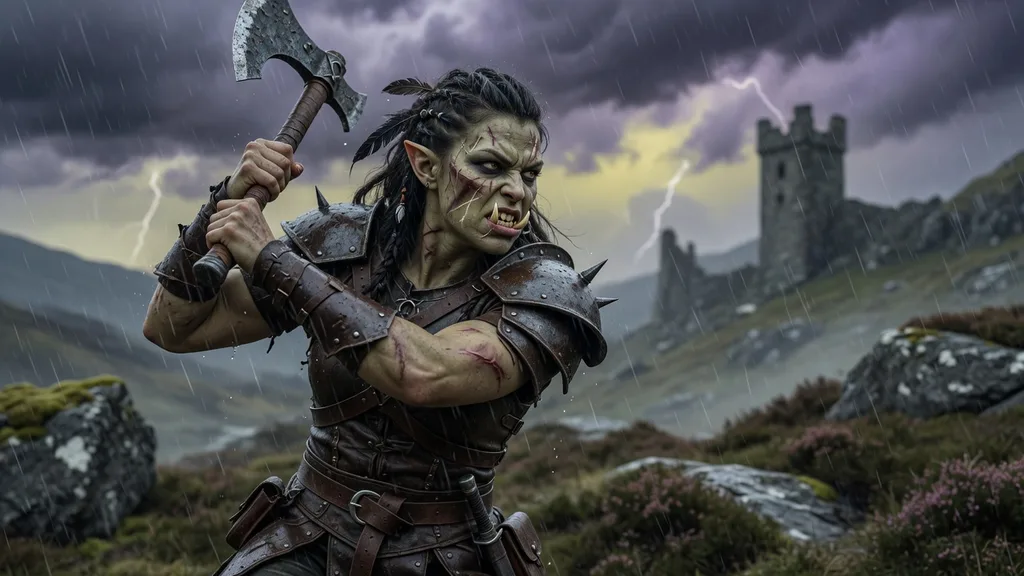
How Heritage Shapes a Half-Orc Name
The D&D Player's Handbook describes half-orcs as carrying names drawn from both orcish and human traditions, shaped entirely by upbringing. The difference between the two is phonetic and immediate. Orcish names are built from hard-stop consonants — K, G, R, Th, Gr — with blunt syllable endings that carry no softness. Human names, particularly the Norse and frontier-English variants that suit the genre, run longer and break more gently.
Blended names occupy a deliberate middle ground. They're not orcish names with a human ending tacked on, nor human names with a guttural opening forced in. The best blended names sound like they could belong to either tradition at a stretch — which is exactly the uncomfortable position most half-orcs occupy.
| Heritage | Feel | Example |
|---|---|---|
| Orc-leaning | Guttural, blunt, hard-stop consonants, short syllables | Urgash, Kragg, Thrakka |
| Human-raised | Grounded, Norse or frontier-English, familiar at a tavern | Sigurd, Hilde, Wulfric |
| Blended | Orcish attack, human cadence — belongs to both and neither | Gravan, Morthild, Rakeld |
Male and Female Half-Orc Name Patterns
Orcish naming conventions don't distinguish sharply by gender — both male and female names share the same hard phonetics. The difference is subtle: female orc-leaning names often carry a trailing vowel or softer ending (-a, -sha, -ka) where male names cut off hard (-kk, -rg, -ul). It's not a rule, but it's a pattern.
Human-raised names split more cleanly. The Norse-flavoured names used here have distinct male and female forms — Sigurd and Sigrid, Ragnar and Ragna — that immediately communicate gender to any player familiar with the genre. Blended names follow the same subtle logic: male blended names tend to close on a hard consonant or consonant cluster, female blended names on a softer syllable.
Half-Orc Names in D&D and Baldur's Gate 3
D&D 5e lists a handful of canonical half-orc names in the Player's Handbook: Dench, Feng, Gell, Shautha, Sutha, Vola, Krusk, and a few others. They're all orc-leaning — short, guttural, zero softness. The handbook acknowledges that human-raised half-orcs often take human names, but doesn't provide a list. That's the gap this generator fills.
Baldur's Gate 3 follows 5e lore closely. Half-orcs appear as both player characters and NPCs, and the game's tone rewards characters with names that sound like they belong in the Forgotten Realms — specific enough to feel lore-grounded, flexible enough that a DM won't challenge them at the table. All three heritage tracks in this generator sit comfortably in that space.
One practical BG3 note: the game's custom character system doesn't restrict name length, but names appear in dialogue, journal entries, and camp conversation. Short and pronounceable names hold up better across 60+ hours of play than ones that require repeated explanation.
Example Half-Orc Names
Male Half-Orc Names
- Grukk
- Thrak
- Urgash
- Korrak
- Drog
- Murgal
- Vorrak
- Zarag
- Ghorz
- Brukk
- Gareth
- Ragnar
- Halvard
- Wulfric
- Sigurd
- Gravan
- Thorgrim
- Rakeld
- Ulrick
- Morkeld
Female Half-Orc Names
- Grasha
- Urgra
- Morka
- Thrakka
- Zakka
- Drakka
- Bolga
- Vorga
- Korra
- Ragna
- Hilde
- Sigrid
- Astrid
- Thyra
- Valdis
- Gritta
- Morthild
- Gorsha
- Urghild
- Grendal
About Half-Orcs in D&D
Half-orcs carry the physical marks of orcish blood — greenish or grey-tinged skin, small tusks, a heavier build than most humans — in societies that notice those marks and draw conclusions from them. That tension is baked into the race's design. The Player's Handbook frames half-orcs as defined by their response to prejudice: some prove themselves through strength, others through relentless competence, others by walking away entirely.
Orcish Heritage. Orcs in D&D worship Gruumsh, god of slaughter, and organise around strength, dominance, and raiding. An orc-leaning half-orc raised inside that culture absorbs its values and its naming conventions — names that sound like commands, not introductions. Thrak. Urgash. Kragg. Names earned by surviving to the point where someone has to acknowledge you exist.
Human Upbringing. Half-orcs raised in human communities often receive human names as a deliberate act of integration — a parent's hope that a familiar name smooths a hard road. It sometimes works. It sometimes doesn't. Either way, the name stays.
The Blended Path. Some half-orcs grow up genuinely between worlds — in frontier settlements, border towns, or adventuring companies where neither tradition dominates. The names that come out of that context split the difference: recognisable enough to say without stopping, distinct enough to mark the character as something specific. That's the blended lane.
Relentless Endurance. The half-orc's signature racial trait in 5e is Relentless Endurance — once per long rest, dropping to 0 hit points instead drops you to 1. It's a mechanical expression of what the lore says: half-orcs don't go down easily. A name that carries that same stubbornness — hard, specific, not asking for approval — lands better at the table than one that softens the edges.
FAQ for Half-Orc Name Generator
How do half-orc names work in D&D?
Half-orcs usually take their name from whichever culture raised them. Those raised in an orcish clan carry guttural, blunt names forged in the orcish tongue — short, hard, built for a war camp. Those raised in human towns often bear simpler English or Norse-flavoured names that help them blend in. Half-orcs who grew up between both worlds sometimes end up with hybrid names that reflect the pull from each side.
Where do half-orc names come from?
The convention comes straight out of the Player's Handbook, which splits half-orc naming into orcish and human traditions depending on upbringing — a rule D&D borrowed from older fantasy tropes about mixed-heritage characters caught between two cultures. What keeps a half-orc name authentic is letting that split stay audible: hard orcish consonants or grounded human phonetics, not a blend that erases both. This generator keeps the two pools distinct for exactly that reason.
What makes a good half-orc name?
A name that fits how your character was raised. Orc-leaning names land hard — lots of K, G, R, and Th sounds, often a single or two-syllable punch. Human-raised names are more familiar and less jarring at a tavern table. Blended names split the difference: the orcish attack at the front, a human cadence at the close. Say it out loud; if it sounds like it belongs on a battlefield or in a frontier town, it's working.
What are some famous half-orc names in D&D lore?
The Player's Handbook names male half-orcs like Dench, Feng, Gell, and Obould, and females like Shautha, Vola, and Sutha. These follow the guttural orcish convention. Characters like Wulfgar (a human name for a human-raised backstory) show how upbringing shifts the naming pattern entirely. This generator covers all three lanes: orc-leaning, human-raised, and blended.
Where can I use the half-orc name generator?
It covers D&D 5e and Baldur's Gate 3 characters, but it works just as well for other tabletop systems, fantasy fiction, and any RPG that includes an orc-blooded race. Pick the heritage that matches the backstory, and the result reads right at the table or on the page.
Can half-orc names be used in Baldur's Gate 3?
Yes. BG3 follows D&D 5e lore closely, so any name from this generator fits the setting. Orc-leaning names suit a character with a brutal past or strong clan ties; human-raised names work for a character trying to pass in civilised society. Lae'zel and Karlach show how distinctive names can anchor a character's identity — your half-orc deserves the same.
Do half-orcs have last names?
Most do not in orcish tradition — a clan affiliation replaces a surname. Half-orcs raised among humans often adopt a human-style surname or family name from their human parent. Some earn an epithet through deeds, wearing it the way hobgoblins wear war-titles. The generator focuses on given names, which is where most players start.
What heritage filter should I pick for my D&D character?
Pick the heritage that matches your backstory, not your appearance. A half-orc who grew up in a human farming village and wants to be accepted carries a human-raised name. One raised by an orcish clan, proud of it, carries an orc-leaning name. A character torn between both worlds — maybe rejected by each — suits a blended name that belongs nowhere and everywhere at once.