How to Name a Ship
Royal Navy names come back every century, US carriers are presidents, and renaming a boat is meant to be bad luck. The real conventions, and how to use them in fiction.
A ship's name is doing a job before the vessel ever leaves harbour. It tells a crew what they're supposed to live up to, tells an enemy what to fear, and tells a reader or player what kind of story this is going to be. Real navies and merchant fleets have spent centuries refining how that job gets done, and fiction across every genre has borrowed, bent, and occasionally ignored those conventions for effect. Knowing which is which lets you pick a name on purpose instead of by accident.
This guide covers how real ships get named — naval, merchant, and otherwise — and how that practice translates, or deliberately doesn't, across fictional genres from the age of sail to space opera.
Royal Navy ship-name classes, and names reused for centuries
The Royal Navy names ships in "classes" — recurring names reused across generations of vessels, sometimes for well over four hundred years. HMS Victory, HMS Ark Royal, and HMS Warspite have each been carried by multiple different ships across history, each new vessel inheriting the name (and often something of the reputation) of its predecessor when the older ship was lost, scrapped, or retired. The current Royal Navy maintains a formal list of "Standing List" battle honours and name classes precisely so a name's history travels forward with each new hull that carries it.
HMS stands for His (or Her) Majesty's Ship, the prefix marking a vessel as a commissioned unit of the Royal Navy — it shifts between His and Her automatically with the reigning monarch. The convention of reusing proud names deliberately, rather than retiring them with the ship, is one of the most distinctive things about British naval naming, and it's worth copying in fiction precisely because it implies history: a ship named after one that fought (or was lost) generations earlier carries that weight into a new story without a line of exposition needed to explain it.
US Navy naming conventions: presidents, cities, and shifting rules for submarines
USS stands for United States Ship, and the US Navy assigns names by vessel class according to conventions set by the Secretary of the Navy, which have shifted over time and by ship type.
| Class | Typical naming source | Example |
|---|---|---|
| Aircraft carriers | Former US presidents (a convention formalized in the mid-20th century) | USS Gerald R. Ford, USS Abraham Lincoln |
| Attack submarines | Historically cities; more recently a mix including states and notable figures | USS Los Angeles (city-class era), USS Virginia (state-named class since the early 2000s) |
| Ballistic-missile submarines | US states | USS Ohio, USS Michigan |
| Destroyers | Notable US Navy and Marine Corps figures | USS Arleigh Burke |
| Cruisers | US cities | USS Ticonderoga |
Submarine naming is the clearest example of a convention that has actually changed within living memory: for decades attack submarines were named after cities, following the pattern set by the Los Angeles class, but the Virginia-class boats that followed switched to state names instead, blurring the older city/battleship-state distinction. It's a reminder that these conventions are administrative decisions, revised by naval leadership over time, not fixed laws of nature — useful to know if a story spans decades and a fleet's naming logic needs to shift plausibly along with it.
Merchant ships: people, places, and company series
Commercial and merchant vessels follow looser, more personal conventions than navies. A ship might be named after a person — a founder's spouse, a company patriarch, a saint invoked for safe passage — after a place the company serves or originates from, or as part of a deliberately branded series where every hull in a fleet shares a naming pattern (a shipping line whose vessels all end in "-ia," for instance, or all take mythological names). Unlike a naval name, a merchant ship's name usually carries hope rather than threat: safe return, good fortune, a loved one remembered. That emotional register is worth keeping in mind when writing a merchant captain — their ship's name is more likely to be a sentimental choice than a strategic one.
Ownership can also leave a mark on a merchant ship's name in ways that outlast the person it honours. A vessel bought secondhand and put into new service is sometimes renamed to fit its new owner's series, and older maritime records show the same hull carrying two or three different names across a working life under different flags. That's a useful detail for a writer building a merchant captain with a past — a ship that has changed hands, and names, more than once carries a quiet history a reader can sense before it's ever explained.
Keeping a name through refits, and the superstition about renaming
A ship traditionally keeps its name through refits, repairs, and even substantial rebuilds — a vessel that has been rebuilt from the keel up can still legitimately be "the same ship" as far as her name and service record are concerned, the way a long-serving warship might be rebuilt more than once across a career without ever losing her name. Sailors have long treated renaming a ship as bad luck, a superstition with roots that likely predate any single documented origin story, tied to the old belief that a vessel is registered by name with whatever powers govern the sea, and that changing the name without the proper ritual invites disaster.
Where a rename is unavoidable — a change of ownership, a change of flag, a marketing decision — maritime tradition holds that it should be done through a formal de-naming and renaming ceremony, which typically involves symbolically erasing the old name from every possible record aboard the ship (including, in some tellings, removing anything bearing it and even striking it from the ship's bell) before a new naming ceremony is performed. Sailors who take the superstition seriously treat skipping this step as asking for trouble. For fiction, a renaming scene played straight — the crew uneasy, the old name scraped off, a captain going through the ritual anyway — is a reliable way to signal that a vessel's history matters to the people who sail her.
How fiction names ships, genre by genre
Each genre has settled on its own naming logic, usually because it's solving a different storytelling problem.
Age of sail. Historical and nautical fiction set in the age of sail tends to mirror real naval and merchant convention closely — virtue names (Indomitable, Resolution), place names, and the HMS/period-appropriate prefix where the story sits inside a navy. Patrick O'Brian's Aubrey-Maturin novels and C. S. Forester's Hornblower books both lean on this kind of historically grounded naming, which is part of why they read as researched rather than invented.
Naval thriller. Contemporary naval fiction (Tom Clancy's submarine and carrier novels are the reference point) mostly uses real or realistic US Navy or NATO naming conventions directly — a fictional submarine gets a name that could plausibly appear on an actual commissioning list. The realism is the point; a name that broke real Navy convention would undercut the genre's core appeal.
Space opera. This is where fiction diverges furthest from real-world practice, and the most famous extreme is Iain M. Banks's Culture novels, whose ship names are full sentences or ironic phrases chosen by the ships' own AI minds — Just Read the Instructions, So Much for Subtlety, Of Course I Still Love You. The joke is structural: a Culture ship names itself, and the resulting names reveal a wry, self-aware machine intelligence in a way a conventional name never could. It's an extreme case precisely because it inverts the normal logic — instead of a name imposed by an institution, the vessel is the author of its own name. Most other space opera stays closer to naval convention (Star Trek's USS Enterprise borrows the American naval prefix outright), reserving Culture-style naming as a specific, recognizable homage when a writer wants that particular joke.
Military SF. Military science fiction generally imports real naval convention wholesale, sometimes with an invented prefix (ISV, UNS, CSV) standing in for a fictional navy's registry. The goal is the same as a naval thriller's: a name that reads as institutionally plausible, carrying rank and mission rather than personality.
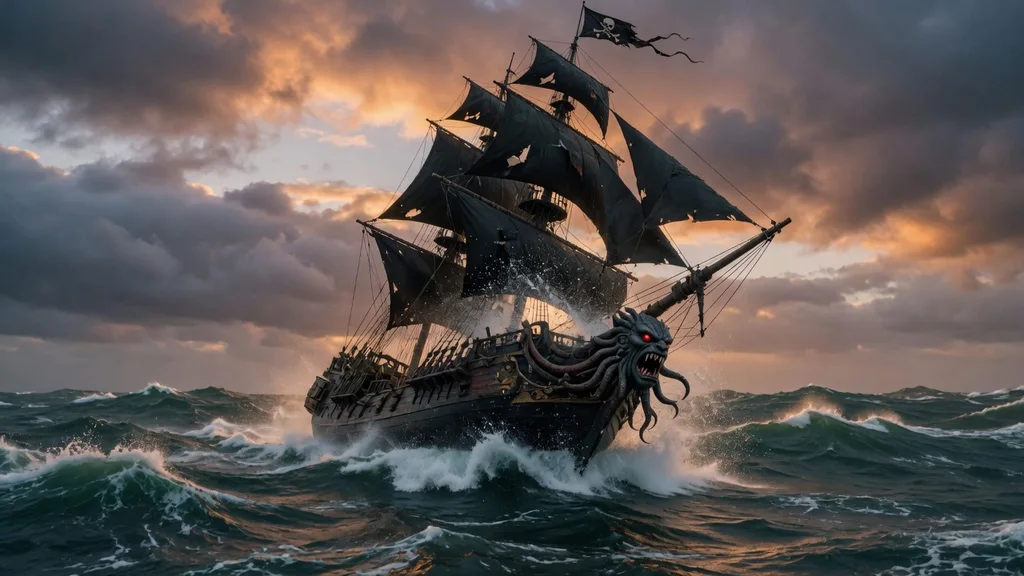
Pirate ships. Pirate naming runs on menace and reputation rather than institutional pride. A good pirate ship name promises violence before a shot is fired — Queen Anne's Revenge, the real flagship of Blackbeard, is the clearest historical example, a name that is simultaneously a boast and a threat. Fictional pirate ships tend to lean the same direction: short, hard-sounding names invoking blood, storms, or old sea superstitions, chosen to spread fear ahead of the ship itself.
The grammar of a good ship name
A few structural choices shape how a ship name reads, independent of genre.
Definite article or not. Sailors tend to speak of a ship as a place and almost a person — "the Endeavour," "the Black Gale" — even when the ship's own registry drops the article. Naval paperwork typically omits it (HMS Valiant, not "the HMS Valiant"), but the article creeps back into speech and narration almost immediately. Fiction can use this deliberately: dropping the article in formal or narrated contexts and letting characters use it in dialogue mirrors how real sailors actually talk about their ships.
One word versus a phrase. A single strong word (Victory, Endurance, Nautilus) reads as classic and carries weight through repetition. A phrase (Queen Anne's Revenge, Just Read the Instructions) reads as more personal or more pointed, and works especially well when the name itself is meant to say something about who chose it.
Abstract virtue versus animal versus place. Virtue names (Valiant, Resolute, Indomitable) suit institutional vessels — navies, formal fleets — because they describe an ideal the ship is meant to embody. Animal names (Albatross, Kestrel, Leviathan) suit vessels that need a personality or a totem, common for merchant ships and privateers alike. Place names (Ticonderoga, York) suit vessels meant to honor a location, common in both navies and merchant lines with regional ties. Picking the wrong category for the wrong kind of ship is a subtle but real tell — a warship named after a flower reads oddly unless that mismatch is the point.
What a ship's name tells the reader about who commissioned it
Before a character says a word, a ship's name has already told the reader who's in charge of it. A name like HMS Indomitable signals an institution with a battle record to defend and live up to. The Albatross signals a private owner hoping for a safe, uneventful voyage. The Bloody Maw signals someone who wants a reputation to arrive at port ahead of the ship itself. A Culture-style ship name signals an AI with a sense of humor and enough autonomy to name itself rather than accept a name handed down. Readers pick up on this instantly and mostly unconsciously, which is exactly why a mismatched name — a menacing pirate hull called The Gentle Breeze with no ironic intent — reads as a mistake rather than a choice.
Pitfalls: names that fight the tone, and names that try too hard
A few recurring problems undercut an otherwise good ship name.
- A name that fights the scene's tone. A grim naval battle loses weight if the flagship is called something whimsical with no irony intended. Tone mismatch reads as an oversight, not a choice, unless the mismatch is clearly deliberate.
- Unpronounceable names. A ship's name gets said aloud constantly in dialogue and narration. A name that trips the tongue on every mention becomes a small tax on the reader every single time it appears — worth testing by reading it out loud before committing.
- Over-clever names that undercut a serious scene. A pun or a too-knowing joke works fine for a comic vessel and badly for a ship meant to carry real dramatic weight. Culture-style humor works precisely because the entire series has established that register; dropped into an otherwise straight naval thriller, the same joke reads as a tonal accident.
- Generic virtue-name overload. Indomitable, Valiant, Resolute, and Indefatigable are all real, all historically attested, and all slightly interchangeable when stacked together in one fleet. A named ship that's meant to stand out benefits from a more specific choice than the next available virtue off the shelf.
Well-known ship names and what they signal
| Name | Type | What it signals |
|---|---|---|
| HMS Victory | Real, Royal Navy (Nelson's flagship at Trafalgar) | Institutional pride, a name deliberately reused across the fleet's history |
| Queen Anne's Revenge | Real, Blackbeard's flagship | Menace and personal history worn as a boast |
| USS Enterprise | Real (multiple US Navy vessels) and fictional (Star Trek) | Exploration and ambition; the fictional use borrows the real prefix's institutional weight directly |
| Nautilus | Fictional (Jules Verne's Twenty Thousand Leagues Under the Sea) | Scientific ambition and isolation, a single evocative word carrying the whole vessel's identity |
| Just Read the Instructions | Fictional (Iain M. Banks's Culture novels) | A self-naming AI mind with a dry, self-aware sense of humor |
| Black Pearl | Fictional (Pirates of the Caribbean) | Menace wrapped in mystique — dark, valuable, and slightly supernatural |
Try it
Our ship name generator covers all of this in one tool — naval, pirate, sailing, sci-fi, and fantasy types, each pulling from its own themed word pool, with an optional prefix like HMS or ISV. For a name built specifically for a pirate captain's ship, the pirate ship name generator goes deeper on class, tone, and origin story. For a starship inside a Star Wars-flavored setting, the Star Wars ship name generator builds original names in that specific register.
FAQ
What does HMS stand for?
His (or Her) Majesty's Ship — the prefix marks a vessel as a commissioned unit of the Royal Navy, and it switches between His and Her automatically depending on the reigning monarch.
Why do navies reuse the same ship name across centuries?
Reusing a name deliberately carries its history and reputation forward. The Royal Navy in particular maintains name classes reused across generations of ships — HMS Victory and HMS Ark Royal have both been carried by multiple vessels across history — so a new ship inherits something of the record built by every ship that carried the name before it.
Is it really bad luck to rename a ship?
It's a long-standing maritime superstition rather than a documented, provable danger, but it's taken seriously enough that sailors who do rename a vessel often insist on a formal de-naming and renaming ceremony to symbolically clear the old name first. Whether or not the superstition holds any real weight, the ritual itself is real and still practiced.
Should a ship name use "the" in front of it?
Naval registries usually drop it on paper (HMS Valiant, not "the HMS Valiant"), but spoken usage and narration commonly bring it back — sailors talk about a ship as a place, "the Endeavour." Either is defensible; consistency within one piece of writing matters more than which you pick.
Why are Culture ship names so different from other space opera?
In Iain M. Banks's Culture novels, ships are AI minds that name themselves, which is why the names read as jokes or philosophical statements (Just Read the Instructions, So Much for Subtlety) rather than institutional designations. Most other space opera keeps closer to real naval convention, so Culture-style naming reads as a specific, recognizable homage when other writers borrow it.
Sources and Further Reading
- Wikipedia — Royal Navy ship naming conventions
- Wikipedia — List of United States Navy ship class names
- Wikipedia — United States ship naming conventions
- Wikipedia — Queen Anne's Revenge
- Wikipedia — Ship naming and launching (renaming superstition and de-naming ceremony)
- Wikipedia — The Culture (Iain M. Banks) (Culture ship naming conventions)
Generators from this guide
Put any of this into practice — every tool below is free and needs no sign-up.